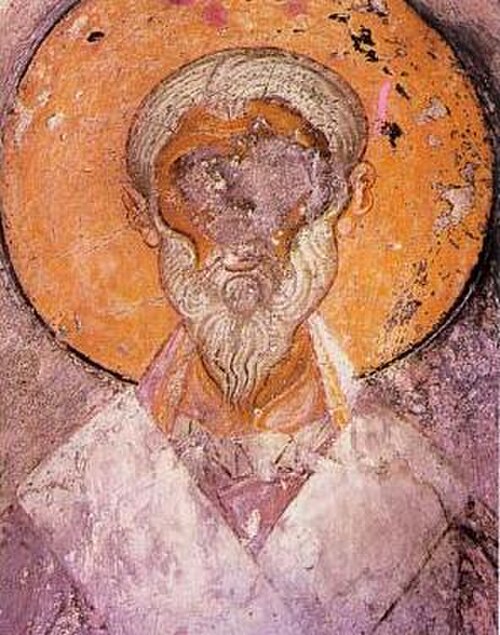
Saint
Alexander of Alexandria
Patriarch of Alexandria
Patriarch of Alexandria who opposed the teaching of Arius, in the time of the First Ecumenical Council.
Life
Saint Alexander, Bishop of Alexandria, led the Church of Alexandria from 313 until his repose in 326 (by some reckonings 328). He was the first to rise against the teaching of Arius, and one of the defenders of the faith at the First Ecumenical Council of Nicaea. He had Saint Athanasius the Great as his disciple and successor. The Orthodox Church commemorates him on 29 May.
Beginnings
Little is known of his youth. As a priest he lived through the persecutions under the emperors Galerius and Maximin Daia. When Bishop Achillas died, he was chosen bishop of Alexandria in his place, on the throne of the holy Apostle Mark. The see was troubled by three problems: the date of Pascha, the rivalry of Meletius, and the teaching of Arius.
Difficulties of his ministry
First, a group led by a certain Crescentius questioned the way of calculating Pascha. Alexander wrote a work using the words of Dionysius of Alexandria, and the dispute quieted, but full clarification came only at Nicaea. Then Meletius of Lycopolis, a bishop under Alexandria, stirred up trouble: he ordained bishops without Alexander's consent and made a schism. He also complained to the court of the emperor Constantine, but no notice was taken of it. Later Meletius drew close to the Arians.
The struggle with Arius
The gravest trial was Arianism. Arius was a priest in Alexandria. It is said that Bishop Peter of Alexandria had earlier commanded that he never be readmitted, but Achillas received him back and gave him the oldest church of the city, from which he had great influence. The dispute began when Alexander spoke in a sermon of the unity of the Trinity, and Arius accused him of Sabellianism. Arius taught that the Son is not co-eternal with the Father and is not like the Father in essence.
Alexander first gathered his priests and deacons, without reaching a conclusion. In 320 he held a synod of Alexandria and Mareotis, where thirty-six priests and forty-four deacons, among them Athanasius, signed the condemnation of Arianism. In 321 he called a council of the whole of Egypt, with at least a hundred bishops, who placed Arius under anathema until he should recant. Arius left for Palestine and found support with Eusebius of Nicomedia, who had close ties to the imperial court. Alexander wrote an encyclical to bishops throughout Christendom, telling of the troubles and showing the error of the Arians, and gathered about two hundred and fifty signatures under his confession of faith. The emperor Constantine sent a letter to Alexandria by Hosius of Cordoba, asking both men to end the dispute.
The Council of Nicaea
Constantine summoned the First Ecumenical Council to Nicaea in 325. Alexander came with a party that included Potamon of Heraclea, Paphnutius of Thebes and his deacon Athanasius, who spoke for him. Though he should have presided, Alexander judged that he could not be both president and chief accuser, and left the chair to Hosius of Cordoba. The Council confirmed the condemnation of Arius and confessed that the Son is of one essence with the Father. Meletius was allowed to keep the title of bishop, without the power to ordain. The Council gave Alexandria the right to decide the date of Pascha and announce it to Rome and the other Churches. On the advice of Paphnutius, Egypt also kept its custom of not forbidding married priests.
Repose
Five months after he returned from Nicaea, Alexander passed to the Lord. One source places his death on 17 April (22 Baramudah by the Coptic calendar). It is said that on his deathbed he named the deacon Athanasius as his successor. Two of his letters on the Arian controversy survive. He is honoured as a saint in the Orthodox, Coptic and Catholic Churches. The Orthodox Church commemorates him on 29 May.
Commemorated the same day May 29
 Senator of MilanSaint · Bishop of MilanMay 29
 Theodosia of ConstantinopleVenerable Martyr · Nun of ConstantinopleMay 29
 Euthymios of ZelaHieromartyr · Bishop of ZelaMay 29
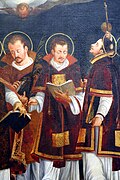 Sisinnius, Martyrius and AlexanderHoly MartyrsMay 29
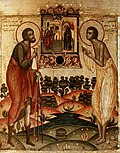 John of UstyugFool-for-Christ · Fool for ChristMay 29
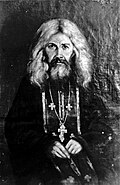 Matthew of YaranskVenerable · HieromonkMay 29
- Andrew of ChiosNew MartyrMay 29
- CuonoMartyrMay 29
- Jacob of Nova PrahaHieromartyrMay 29
- Andrew TrofimovMartyrMay 29
- Briuinseach Gael of Magh TreaVenerableMay 29
- Commain of Daire Inghen AillenVenerableMay 29