
Venerable Martyr
Theodosia of Constantinople
Nun of Constantinople
Nun and martyr of Constantinople who opposed Byzantine iconoclasm in the eighth century.
Life
Saint Theodosia of Constantinople, Venerable Martyr, was a nun who opposed Byzantine iconoclasm in the eighth century, regarded as the first martyr of the iconoclast time. She is remembered on 29 May (in the Roman Catholic Church, in earlier times, on 18 July).
She was born in Constantinople, according to the life published by the Orthodox Church in America, in answer to the fervent prayers of her parents. According to the Serbian tradition her mother asked for a child from Saint Anastasia, who appeared to her and promised that she would bear one. The parents dedicated her to God and had her baptized at forty days in the church of Saint Anastasia. When her parents died she was sent to be raised at the women's monastery of the Holy Martyr Anastasia in Constantinople. She distributed to the poor what remained of her parental inheritance, after commissioning from a goldsmith three icons (of the Saviour, of the Mother of God and of Saint Anastasia), and then became a nun.
On 19 January 729, at the beginning of the iconoclastic persecutions, the emperor Leo III the Isaurian demanded that an icon of Christ which stood over the great Chalke Gate of the imperial palace be removed. Patriarch Anastasius ordered the Church to comply. While an officer was carrying out the order, a group of women gathered to prevent the operation. Among them was Theodosia, who shook the ladder strongly until the officer fell. The man died of his injuries, and Theodosia was arrested and brought to the Forum Bovis. According to the Russian sources, the other nuns were killed by order of the emperor, while Theodosia was tortured for a week, and on the eighth day was led through the city, being cruelly beaten. When she reached the square called the Forum of the Ox, where horned cattle were sold, a soldier cut himself on a horn lying on the ground and, enraged, struck her on the head with it and then drove it into her throat. So she was executed.
Her body was buried with reverence in the church of Saint Euphemia in Petrion, in the quarter of Dexiokratianai, on the shore of the Golden Horn. After the triumph of Orthodoxy over iconoclasm, in 843, she was recognized as a martyr and saint. The church was later renamed for her, after the beginning of the fourteenth century. A gate in the sea walls of Constantinople, the Gate of Saint Theodosia (Ayakapı), was named after her church. She became one of the most venerated saints of Constantinople. She is invoked especially by the infirm, her fame growing through the cure of a deaf-mute blacksmith in 1306 by her relics, at about the time when Constantine Akropolites wrote a praise of her. It is held that her person, like that of other martyrs of the iconoclast era, is semi-legendary.
Commemorated the same day May 29
 Alexander of AlexandriaSaint · Patriarch of AlexandriaMay 29
 Senator of MilanSaint · Bishop of MilanMay 29
 Euthymios of ZelaHieromartyr · Bishop of ZelaMay 29
 Sisinnius, Martyrius and AlexanderHoly MartyrsMay 29
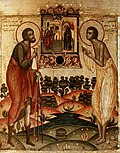 John of UstyugFool-for-Christ · Fool for ChristMay 29
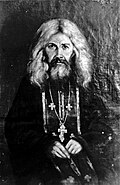 Matthew of YaranskVenerable · HieromonkMay 29
- Andrew of ChiosNew MartyrMay 29
- CuonoMartyrMay 29
- Jacob of Nova PrahaHieromartyrMay 29
- Andrew TrofimovMartyrMay 29
- Briuinseach Gael of Magh TreaVenerableMay 29
- Commain of Daire Inghen AillenVenerableMay 29