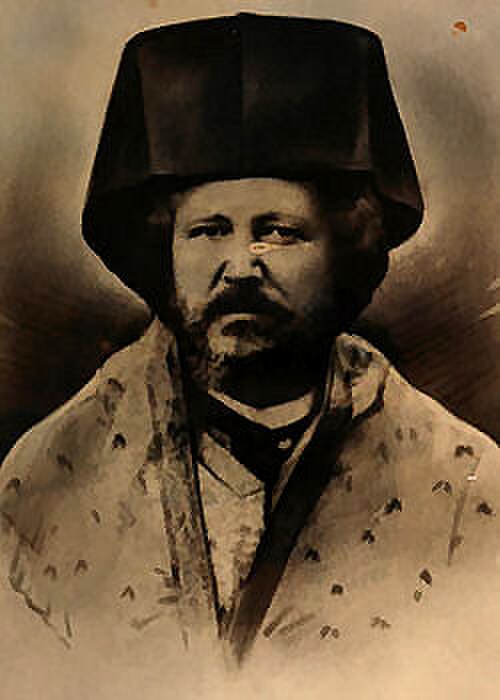
Hieromartyr
Euthymios of Zela
Bishop of Zela
Last resident bishop of Zela in Western Pontus, martyred at Amasya in 1921.
Life
Saint Euthymios of Zela was the last resident bishop of Zela in Western Pontus and auxiliary bishop of the Metropolis of Amasya. Born in 1876 on the island of Lesbos, he died in the prison at Amasya on 29 May 1921, during the great persecution of the Greeks of Pontus. The Church of Greece and the Ecumenical Patriarchate venerate him among the new martyrs of Asia Minor as a shepherd who laid down his life for his flock.
Childhood at Leimonos
His name in the world was Eustratios Agritellis. He was born on 6 July 1876 into a farming family in the village of Parakila in western Lesbos. At the age of nine, in 1885, his parents dedicated him to the then flourishing Leimonos Monastery near Kalloni.
In 1889 he enrolled in the monastery's Leimonias school, a renowned boys' school, and graduated with the highest marks in 1892. The abbot, Archimandrite Anthimos (Georgiellis), tonsured him a monk with the name Euthymios, and in the following years he lived the ascetic life in the monastery.
Studies at Halki
In 1900 the monastery sent him on a scholarship to the Theological School of Halki near Constantinople, where he studied until 1907. In 1906 he was ordained deacon at the Holy Trinity Monastery on Halki by Metropolitan Agathangelos of Grevena.
In 1907 he presented his thesis, The Purpose of Monastic Life in the East until the Ninth Century, and graduated with distinction. Fifty manuscripts in his hand, most of them notebooks from his years at Halki, are still kept at the Leimonos Monastery.
Preacher on Lesbos
Returning to Leimonos, he was appointed by Metropolitan Stephen (Soulidis) of Methymna head of the monastery school and preacher of the metropolis. He became known for his gift of eloquence and the rich content of his sermons as he travelled through the villages and towns of the diocese.
In the 1909-1910 school year he headed the school in the village of Skopelos in the Gera district of Lesbos. In 1910 Metropolitan Stephen ordained him a priest, and until 1912 he served as protosynkellos of the Metropolis of Methymna.
Bishop of Zela
In 1912 Metropolitan Germanos (Karavangelis) of Amasya, who resided at Samsun and was himself a native of Lesbos, took him on as his general commissioner and secretary. It is said that Ecumenical Patriarch Joachim III himself recommended him, knowing his gifts.
The Great Church chose him as auxiliary bishop of the Metropolis of Amasya with the ancient and honoured title of Bishop of Zela (modern Zile) in Western Pontus. His consecration took place in Constantinople on 12 June 1912 (other sources say 27 July).
He lived at Amisos (Samsun) and cared for a vast diocese, the largest in Asia Minor, with some 340 Orthodox communities and between 130,000 and 150,000 faithful, many of them Turkish-speaking but Greek in identity. Since Metropolitan Germanos often travelled to Constantinople and Athens, Bishop Euthymios largely governed the metropolis alone.
From 1913 he was based in the district of Pafra (Bafra). Over ten years he built churches and schools for boys and girls in the town and in many villages and saw to the placing of priests and teachers. The metropolis showed signs of unusual revival, with youth and community associations.
Years of persecution
Soon, however, the great persecution of the Greeks of Anatolia broke out, especially around Samsun and Pafra. From then on his work turned from building up to relief and rescue. He travelled tirelessly from place to place, often hunted and in danger of arrest, heedless of hunger, sickness and hardship, to help and encourage the despairing faithful and the deportees.
When the First World War began, Enver Pasha ordered the mobilization of all Ottoman subjects. Many Greeks of Pafra, urged on by Bishop Euthymios, refused to join the Turkish army and went up into the mountains, where they formed armed bands and were pursued as deserters. The authorities decided to deport the Christian populations, Armenian and Greek, from coastal Pontus to the interior of Anatolia.
The bishop urged the schools and people of Pontus to take part each year, on 25 March, in the commemoration of the thirty or more girls of the village of Asar near Pafra who in 1680 (another source says 1860) threw themselves from the walls of the fortress of Ali Bey rather than fall into the hands of their oppressors.
From 1917 he became the leader and soul of the partisan bands in the Nebian Dag mountains, which defended themselves against the Turkish army and irregular bands. In April 1917 a large Turkish force surrounded the monastery of the Theotokos at Maara near the village of Otkaya and the cave in which some 650 women and children and 60 armed men had taken refuge. After six days of resistance most were killed or took their own lives rather than be captured, and few of those taken survived.
In the spring of 1919, through the bishop's mediation, the British asked the partisans to lay down their arms, but they refused. On 15 August 1919, the feast of the Dormition, Bishop Euthymios gathered some 12,000 partisans outside the town of Cagsur south of Pafra under the command of Kyriakos Papadopoulos, who wiped out the Turkish armed forces in the town, and the town was largely destroyed. From that day the Kemalists sought him as the leader of the insurgents of Western Pontus.
Imprisonment and martyrdom
In 1921 the Kemalist government ordered all metropolitans, bishops and archimandrites of Pontus to abandon their sees and leave the region. The only ones who refused were Metropolitan Chrysanthos (Philippidis) of Trebizond, Bishop Euthymios and the protosynkellos of Amasya, Archimandrite Platon (Aivazidis).
On 21 January 1921 the Kemalists arrested Bishop Euthymios together with Archimandrite Platon and many leading members of the community. He was taken to Amasya, condemned to death and held in the Souyia prison, a place of terrible torments.
Seeing how those arrested with him were being tortured, he asked the government in Ankara to regard him as the only culprit and punish him alone, so that the others could go free, but he received no answer.
On Pascha, 18 April 1921, unseen by the guards, he entered the hall where many of his compatriots were held in isolation, to comfort and encourage them. From then on he was regarded with still greater suspicion and confined alone in the damp cellars of the prison. His sufferings became known later through the testimony of released prisoners. At times his voice could be heard chanting the funeral service, which he sang for himself.
On the forty-first day of his isolation, 29 May 1921, worn out by torture and privation, he gave up his soul in prison and received the crown of martyrdom. His death sentence from Ankara arrived only after he had died. His body was nevertheless hanged in the town square together with the others condemned, Greek politicians, merchants, journalists and clergy, and afterwards it was quietly buried in the courtyard of the nearby church.
Glorification and veneration
On 30 May 1936, the fifteenth anniversary of his martyrdom, the Leimonos Monastery on Lesbos unveiled a bust of him, which reminds pilgrims of the shepherd who laid down his life for his sheep.
On 4 November 1992 the Holy Synod of the Church of Greece numbered him among the hieromartyrs, together with Saint Chrysostomos of Smyrna and the hierarchs Gregory of Kydonies, Ambrose of Moschonisia and Prokopios of Iconium, commemorated with the clergy and laity who perished in the Asia Minor catastrophe. On 5 July 1993 the Holy Synod of the Ecumenical Patriarchate included him among the new martyrs of the Asia Minor catastrophe.
In 1998 a chapel was dedicated to him at the Leimonos Monastery in the Metropolis of Methymna. Saint Euthymios of Zela is commemorated on 29 May, especially in his birthplace, and on the Sunday before the Exaltation of the Holy Cross together with the new martyrs of Asia Minor.
Commemorated the same day May 29
 Alexander of AlexandriaSaint · Patriarch of AlexandriaMay 29
 Senator of MilanSaint · Bishop of MilanMay 29
 Theodosia of ConstantinopleVenerable Martyr · Nun of ConstantinopleMay 29
 Sisinnius, Martyrius and AlexanderHoly MartyrsMay 29
 John of UstyugFool-for-Christ · Fool for ChristMay 29
 Matthew of YaranskVenerable · HieromonkMay 29
- Andrew of ChiosNew MartyrMay 29
- CuonoMartyrMay 29
- Jacob of Nova PrahaHieromartyrMay 29
- Andrew TrofimovMartyrMay 29
- Briuinseach Gael of Magh TreaVenerableMay 29
- Commain of Daire Inghen AillenVenerableMay 29