
Venerable
Alexis Kabalyuk
Schema-archimandrite in Transcarpathia
Schema-archimandrite and Carpatho-Rusyn missionary, born in 1877, died at Iza in 1947; a local saint.
- Feast
- April 24old style May 7
- Reposed
- 194720th century
- Place
- Iza
- Order
- Venerables
Life
Saint Alexis Kabalyuk, also called Alexis the Carpatho-Russian, was a schema-archimandrite, missionary and confessor of Orthodoxy among the Rusyns of the Carpathians. He was born in 1877 in the village of Yasinia, in present-day Transcarpathia, then part of Austria-Hungary, and he reposed in 1947 at Iza, in the monastery he had founded. The Church remembers him because, in a time of persecution, he brought great numbers of villagers back to the Orthodox faith and suffered trial and imprisonment for it.
Childhood and search for the faith
His name in the world was Alexander Ivanovich Kabalyuk. He was born on 12 September 1877 at Yasinia near Rakhiv, into a family of woodcutters. His parents, Ivan Kabalyuk and Anna Kulchitskaya, were devout Greek Catholics with strong Russian sympathies, and they named their son after the holy Prince Alexander Nevsky.
He finished the parish school and entered the Greek Catholic monastery of Kis-Baranya as a novice. From childhood, however, his heart was drawn to Orthodoxy. He read widely and longed to understand the faith more deeply.
After his military service he resolved to bind his life to the Church. He went to a clairvoyant elder of the Beskid monastery, who told him to put aside thoughts of marriage and give himself to the service of God.
After his father's death he became a prosperous householder in his native village. There he met a man who spoke to him about the Orthodox faith and the holy places of Russia, and who gave him the book known as the Spiritual Alphabet, associated with Saint Demetrius of Rostov. In 1905 he travelled to Russia. His stay was short, but he came home on fire with love for Orthodoxy and began to preach among the Rusyns.
A year later he visited Russia again, going to Kiev, and then made pilgrimages to the Pochaev Lavra and to the Holy Land.
Reception into Orthodoxy and monastic life
In 1907 a secret meeting of the Orthodox movement in the village of Ilnytsia decided to send Alexander to Mount Athos to bring back holy objects. In 1908 he reached the Russian monastery of Saint Panteleimon. There, as it turned out, lived the monk Vyacheslav, a Rusyn from the village of Berezovo, who introduced him to the abbot, Archimandrite Misail (Sopegin).
The archimandrite listened to his account of the plight of the faithful in Carpathian Rus and called together the council of the monastery's elders. The council decided to receive Alexander into the Orthodox Church.
In 1909 the Orthodox Rusyns gathered secretly once more, at Khust. Tension in the region was growing. In several villages peasants had tried to return to Orthodoxy, and the people of Iza and Velyki Luchky had succeeded, though only through the heaviest trials. Despite pressure from the authorities, court cases (the most notorious until then being the first trial at Maramarossziget, or Sighet, in 1904) and outright terror, the number of Orthodox kept rising.
On the suggestion of Bachinsky, a Greek Catholic priest with Russian sympathies who served at Yasinia, it was decided to send Alexander to Russia to receive the priesthood. This became possible after Alexei Gerovsky, a grandson of Adolf Dobriansky and an active Carpatho-Russian leader, obtained permission from Bishop Eulogius of Kholm for young men from the Carpathians to study at the two-class theological school attached to the monastery of Saint Onuphrius at Yablochin. Alexander went there with several other young men, helped by A. S. Budilovich, Gerovsky's uncle.
At Yablochin he was tonsured a monk with the name Alexis, after Saint Alexis the Man of God, and was ordained to the priesthood. He then went back to Athos to obtain Athonite documents that would allow him to return to Austria-Hungary.
After some time on the Holy Mountain he travelled to Constantinople to the Ecumenical Patriarch. The Patriarch heard his account of the Church in Carpathian Rus, confirmed the certificate that Archimandrite Misail had given him, and issued him a charter in Greek with a blessing for his ministry.
Mission and persecution
He returned home for Great Lent of 1911 as an assistant to the archpriest of Miskolc. At Yasinia he set up a house church with a folding iconostasis and with vessels and vestments brought from Russia. Besides serving, he earned his bread as a simple knife-grinder so as not to burden his flock.
His arrival alarmed the Hungarian gendarmes. He showed them the Patriarch's charter, which they sent on to Budapest, and from there came permission for him to serve at Yasinia on condition that he did not leave the village.
Yet Father Alexis saw how many Orthodox Rusyns were without a priest, and he kept setting out for other villages of Transcarpathia. He was arrested by the gendarmes many times but did not abandon his labour. He visited village after village where people were seeing an Orthodox priest for the first time, performed the sacraments and services, and often celebrated daily for weeks on end.
According to a Hungarian newspaper, about 14,000 people in Maramures returned to Orthodoxy during these years. The fame of the Orthodox priest spread throughout Carpathian Rus, which greatly disturbed the authorities.
Surveillance grew so tight that he could hardly continue his work. He was forced to leave for Russia and then for America, where, together with the priest Alexander Hotovitzky, himself now venerated as a hieromartyr, he cared for the community of Carpatho-Russian emigrants.
In 1913 he learned of the trial brought against Orthodox Rusyn peasants accused of high treason, in which he himself was named as the principal defendant. He decided to go back to his people and gave himself up to the court.
The trial, staged for show and built on provocation and forged evidence, lasted two months. Father Alexis was sentenced to four years and six months in prison and a fine of 100 crowns. The case resounded throughout the Slavic world, especially in Russia, and after it ended Emperor Nicholas II presented him with a golden altar cross.
Building up the Church in Carpathian Rus
After his release he went on serving God and the people of Carpathian Rus. He founded the monastery of Saint Nicholas in the village of Iza and remained there to the end of his life.
In 1921 he opened the council of the Carpatho-Russian Orthodox Church, which then existed as an autonomous body within the Serbian Orthodox Church. About four hundred delegates attended. A statute was adopted, together with the official name of Carpatho-Russian Eastern Orthodox Church.
In the same year he was elected abbot of the men's monastery at Iza, and in 1923 he was raised to the rank of archimandrite. Bishop Dositheus then appointed him chairman of the spiritual consistory and rector of the parish of Khust.
During the so-called Savvaty schism, which aimed to detach the Carpatho-Russian Church from the Serbian Church and place it under the Czechoslovak Church, Father Alexis stayed loyal to the Serbian Church and to Bishop Dositheus.
In 1944 he initiated an Orthodox congress at Mukachevo, attended by many well-known Rusyn priests, scholars and public figures. They petitioned for Subcarpathian Rus to join the Soviet Union as a separate Carpatho-Russian republic, and 23 of the priests asked the Holy Synod of the Russian Church to receive the eparchy of Mukachevo and Presov into the Moscow Patriarchate.
A delegation led by the scholar Georgy Gerovsky was received in Moscow by Patriarch Alexis, and the Rusyns repeated that they did not wish their land to be joined to Soviet Ukraine. The decision had already been taken, however, and Subcarpathian Rus was annexed to the Ukrainian SSR.
Father Alexis took these events very hard. Once the Soviet state began to interfere in church life, Orthodoxy in the region was again under threat. Churches were closed and despoiled and believers were harassed.
Repose and glorification
Archimandrite Alexis received the great schema and reposed on 2 December (19 November, Old Style) 1947. He was buried in the brethren's cemetery of the monastery of Saint Nicholas at Iza.
In 1999 his relics were uncovered and found almost incorrupt. On 21 October 2001, at the monastery of Saint Nicholas at Iza, he was glorified among the locally venerated saints of the Ukrainian Orthodox Church.
The service of glorification was led by Metropolitan Vladimir (Sabodan) of Kiev, with several hierarchs concelebrating, among them Metropolitan Onuphrius of Chernivtsi and Bukovina, the bishops of Khust and Mukachevo, and clergy from the dioceses of Transcarpathia.
Today he is honoured as Saint Alexis, Confessor of Carpatho-Russia, above all in Transcarpathia and at the monastery of Iza, where the faithful come to venerate him.
Commemorated the same day April 24
 MellitusSaint · Archbishop of CanterburyApr 24
 Doda of ReimsVenerable · Abbess of Saint Peter's, ReimsApr 24
 Sabbas StratelatesMartyr · Roman generalApr 24
 Branko DobrosavljevićHieromartyr · Serbian Orthodox priestApr 24
- Sava II BrankovićSaint · Metropolitan of TransylvaniaApr 24
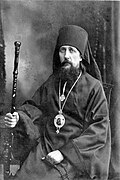 Ignatius SadkovskyHieromartyr · Bishop of SkopinApr 24
- Sava of the CavesVenerable · Monk of the Kyiv Caves LavraApr 24
- Simion ȘtefanSaint · Metropolitan of TransylvaniaApr 24
- Alexis the RecluseVenerable · Recluse of the Kiev CavesApr 24
- Joseph the ConfessorSaint · Bishop of MaramureșApr 24
 Alexander of LyonMartyr · Martyr of LyonApr 24
- PasicratesMartyr · Martyr of Lower MoesiaApr 24