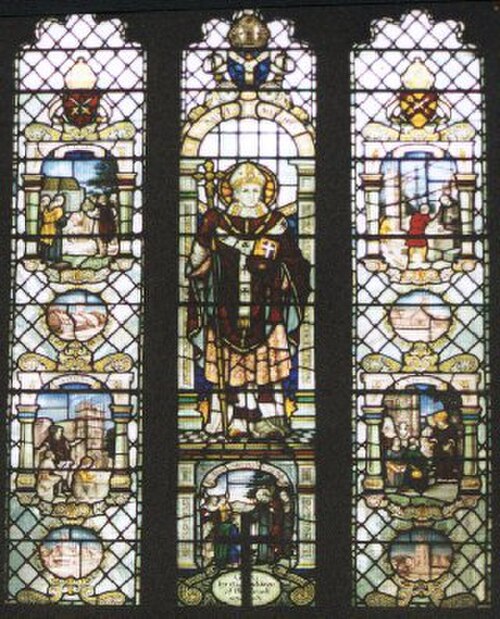
Saint
Mellitus
Archbishop of Canterbury
First bishop of Saxon London and third archbishop of Canterbury, who died in 624.
Life
Saint Mellitus of Canterbury, hierarch, was the first bishop of London in the Saxon period, the third archbishop of Canterbury and a member of the Gregorian mission sent to England to bring the Anglo-Saxons from their native paganism to Christianity. He fell asleep on 24 April 624. He is commemorated on 24 April.
Beginnings
Bede writes that Mellitus was of noble birth. Pope Gregory the Great calls him in his letters an abbot, but it is not known whether he had been abbot of a monastery at Rome or whether the rank was given to him to make him leader of those sent. He is first mentioned in the letters of Gregory, and nothing else is known of his earlier life. He seems to have been an Italian, like all the bishops consecrated by Augustine.
The journey to England
Pope Gregory sent him to England in June 601, at the request of Augustine, first archbishop of Canterbury, who needed more clergy for the mission in the kingdom of Kent, ruled by King Æthelberht. The new missionaries brought a gift of books and “all things needed for worship and the ministry of the Church”. A fifteenth-century chronicler says that in his day some of the books brought by Mellitus were still at Canterbury; an examination of the manuscripts shows that one of them may be the Gospels of Saint Augustine, now at Cambridge. With the letter to Augustine the missionaries brought one to Æthelberht, urging him to follow the emperor Constantine and bring his subjects to the faith and tear down the pagan temples. On the way Mellitus received from Gregory another letter, known as the Epistola ad Mellitum, by which Augustine was allowed to convert pagan temples into churches and animal sacrifices into Christian feasts, to ease the passage to the faith. The letter, preserved by Bede, shows a change in the manner of the mission, from compulsion towards persuasion, although some scholars hold that the two letters do not contradict each other, the first being a spiritual exhortation, the second practical counsel.
Bishop of London
Augustine consecrated him bishop of London in 604, when King Sæberht of Essex had received Christianity. In 610 Mellitus went to Italy to a council of bishops and returned with letters of the pope to some of the missionaries. When King Sæberht died, around 616, his pagan successors drove him from London; at the same time Æthelberht of Kent, his other supporter, died, and Mellitus had to flee to Gaul. He returned the next year, after Æthelberht’s successor accepted Christianity, but could no longer enter London, whose inhabitants remained pagan.
Archbishop
After Laurence, in 619 he was chosen archbishop of Canterbury. According to the account, in his time the cathedral and part of the town were saved by a miracle from a fire: ill with gout, he was carried before the flames and the wind is said to have turned. He fell asleep on 24 April 624 and was venerated as a saint.
Commemorated the same day April 24
 Doda of ReimsVenerable · Abbess of Saint Peter's, ReimsApr 24
 Sabbas StratelatesMartyr · Roman generalApr 24
 Branko DobrosavljevićHieromartyr · Serbian Orthodox priestApr 24
 Alexis KabalyukVenerable · Schema-archimandrite in TranscarpathiaApr 24
- Sava II BrankovićSaint · Metropolitan of TransylvaniaApr 24
 Ignatius SadkovskyHieromartyr · Bishop of SkopinApr 24
- Sava of the CavesVenerable · Monk of the Kyiv Caves LavraApr 24
- Simion ȘtefanSaint · Metropolitan of TransylvaniaApr 24
- Alexis the RecluseVenerable · Recluse of the Kiev CavesApr 24
- Joseph the ConfessorSaint · Bishop of MaramureșApr 24
 Alexander of LyonMartyr · Martyr of LyonApr 24
- PasicratesMartyr · Martyr of Lower MoesiaApr 24