Hieromartyr
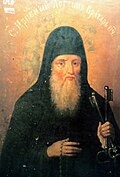
Alexis Nikonov
A Russian priest put to death for his faith in Christ in 1938, during the communist persecution.
- Feast
- October 16old style October 29
- Reposed
- 193820th century
- Order
- Martyrs
Life
Holy Hieromartyr Alexis Nikonov, a priest, was born on 15 October 1881 in Moscow, in the family of the land surveyor Mikhail Nikonov. He reposed in the Sevzheldorlag camp, in Komi, on 29 October 1938, after three arrests. The Russian Church honours him among the New Martyrs and Confessors.
In 1902 he finished the commercial school in Moscow, from 1903 he served in the army, and in 1905 he entered the Moscow Theological Academy, graduating in 1910. From 1911 to 1914 he was a teacher at Dankov, in the Ryazan province. In the First World War he was an officer in a Siberian rifle regiment, and in 1917 in the regiment in the Pinsk marshes; from December 1917 to July 1918 he commanded a platoon at Dankov. From 1918 he was a teacher again. In 1921 he became a psalm-reader, and at the end of August 1922 he was ordained priest and served at the church of the Dormition in the town of Klin, near Moscow.
In May 1922 the Renovationist schism had broken out. Bishop Innocent of Klin recognised the unlawful Renovationist leadership, and Patriarch Tikhon put Bishop Gabriel in his place, who rose against the schism and was helped by the dean of Klin, Priest Alexis Vorobyov. With him, Father Alexis Nikonov was arrested on 26 September 1924, accused of having gathered a meeting of the faithful in church without the authorities' permission and of giving speeches on the persecution of Orthodoxy. Since the guilt could not be proved, they sat several months at Butyrka without being questioned. On 27 February 1925 he was sentenced to two years of exile in the Narym region. After his exile he was forbidden for three years to live in six large regions and settled in the village of Spas-Doshchaty, in the Zaraysk district, where he served at the church of the Transfiguration, keeping the order of the services strictly and proving a faithful pastor of the Church of Christ. A communist wrote to the OGPU a complaint asking that he be expelled.
In February 1930 he was arrested for anti-Soviet activity. He said that he had not spoken against the authorities in his sermons, that if a man does not believe, life itself will bring him to faith, and that he was ill with pulmonary tuberculosis, with eighty per cent loss of capacity to work. The prosecutor held that there were not sufficient grounds, and on 30 April 1930 the OGPU troika counted the time spent in custody as punishment and released him. He went on serving at the church of the Transfiguration. On 25 September 1936 he was arrested for the last time, accused of counter-revolutionary propaganda. In prison he was asked about a manuscript he had written, "Addition to the Draft of the New Constitution", in which he asked that article 124 give the servants of religion full freedom of religious propaganda, in church and outside it, and protect church life from administrative interference. He said that he wrote it out of his own conviction and did not admit guilt. On 20 January 1937 the Special Council of the NKVD sentenced him to five years in a camp.
He was sent to Sevzheldorlag and reposed there on 29 October 1938. He was buried in the cemetery of the settlement of Kyltovo, in the Knyazhpogost district of Komi, two and a half kilometres south of the settlement. He is commemorated on 29 October, on 7 February, in the Synaxis of the Saints of Komi, on 11 February, and in the Synaxis of the Moscow Saints.
Commemorated the same day October 16
 Longinus the CenturionMartyr · Centurion at the CrucifixionOct 16
 GallVenerable · Missionary in SwitzerlandOct 16
 Eliphius of ToulMartyr · Missionary at ToulOct 16
 Euphraxia of PskovRight-BelievingOct 16
- Fortunatus of CaseiMartyrOct 16
- John of TourkolekasSaintOct 16
- Dulcidius of AgenSaint · Bishop of AgenOct 16
 Longinus of the CavesVenerable · Gatekeeper of the Kyiv Caves LavraOct 16
- Silvanus of AhunMartyr · DeaconOct 16
- 220 Martyrs of North AfricaHoly MartyrsOct 16
- Amandus of ComodoliacVenerableOct 16
- AmbroseSaintOct 16