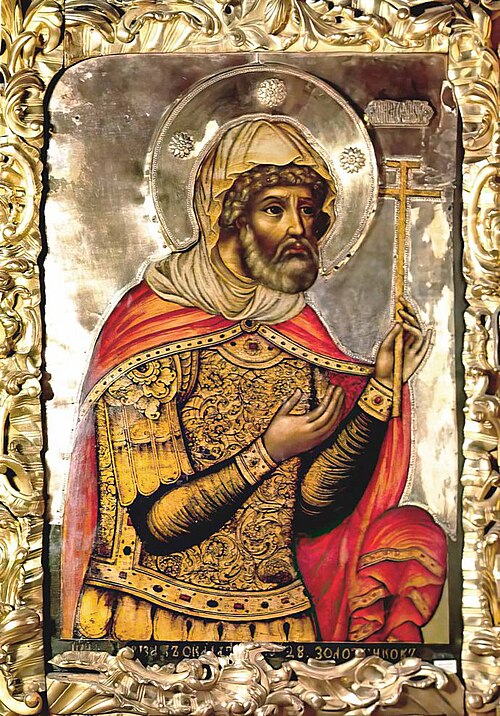
Martyr
Longinus the Centurion
Centurion at the Crucifixion
The Roman soldier at the cross of the Lord who, according to tradition, confessed Christ and died a martyr.
- Feast
- October 16old style October 29
- Born
- 1001st century
- Place
- Mantua
- Order
- Martyrs
Life
Saint Longinus the Centurion is, according to tradition, the Roman soldier who kept guard at the cross of the Lord and confessed that Christ is the Son of God. The Gospels do not give his name: the name Longinus appears in apocryphal writings and comes from the Greek lonche, "lance". The Orthodox Church commemorates him on 16 October.
In the Gospels
The Gospels of Matthew, Mark and Luke speak of a centurion who stood before the cross. Matthew writes that the centurion and those with him, seeing the earthquake and what took place, were filled with awe and said, "Truly this was the Son of God" (Matthew 27:54). Mark says that the centurion, seeing how He died, said, "Truly this man was the Son of God" (15:39). Luke writes that the centurion praised God and said, "Certainly this man was innocent" (23:47). The Gospel of John says that one of the soldiers pierced His side with a spear and blood and water came out (19:34), without naming him.
Tradition
The name Longinus first appears in the apocryphal Gospel of Nicodemus. Later tradition joined the centurion at the cross with the soldier who pierced the Lord's side. It is told that, touched by drops of the blood, Longinus was cured of diseased eyes, but the eye illness appears in the story only after the tenth century. The Orthodox service books keep another tradition. According to the synaxarion, Longinus came from the village of Ardales in Cappadocia and kept guard at the cross of the Lord and at the tomb. He saw the suffering, death and resurrection of the Lord and the wonders that accompanied them, and believed. Returning to his homeland, he preached the Gospel. At the instigation of the Jews, soldiers sent by Pilate beheaded him. They carried the head to Jerusalem and threw it without burial outside the city. Later a blind woman found the head of the saint, by a miracle, and received her sight. Two other soldiers who had believed in Christ suffered with him.
These stories cannot be proved. The name Longinus was not known to the Greeks before Patriarch Germanus in 715. As to his death, some Greek sources say he suffered in Cappadocia, while Western tradition holds that his body was found at Mantua, together with a sponge stained with the Lord's blood. Neither can be proved.
Veneration
In the Church of the Holy Sepulchre at Jerusalem a chapel is dedicated to Saint Longinus. In Saint Peter's Basilica in Rome there is a statue of him by Bernini, with the spear in his hand. In the West his spear was venerated under the name of the Holy Lance. The Orthodox Church commemorates him on 16 October. The Roman Catholic Church commemorated him on 15 March until 1969 and now on 16 October. In the preparation of the Holy Gifts, the cutting of the Lamb with the lance is done with the words of the Gospel about the deed at the Crucifixion.
Commemorated the same day October 16
 GallVenerable · Missionary in SwitzerlandOct 16
 Eliphius of ToulMartyr · Missionary at ToulOct 16
 Euphraxia of PskovRight-BelievingOct 16
- Fortunatus of CaseiMartyrOct 16
- John of TourkolekasSaintOct 16
- Dulcidius of AgenSaint · Bishop of AgenOct 16
 Longinus of the CavesVenerable · Gatekeeper of the Kyiv Caves LavraOct 16
- Silvanus of AhunMartyr · DeaconOct 16
- 220 Martyrs of North AfricaHoly MartyrsOct 16
- Alexis NikonovHieromartyrOct 16
- Amandus of ComodoliacVenerableOct 16
- AmbroseSaintOct 16