Venerable
Gall
Missionary in Switzerland
Irish monk, disciple of Columbanus, who preached on the continent and lived in the lands of Switzerland.
- Feast
- October 16old style October 29
- Reposed
- 6457th century
- Place
- Arbon
- Order
- Venerables
Life
Saint Gall (Gallus) was a monk of Irish origin, by tradition a disciple of Saint Columbanus and one of his twelve companions on his mission from Ireland to the continent. He is regarded as one of the apostles of Switzerland and founder of the hermitage from which the monastery and city of Sankt Gallen grew. He is commemorated on 16 October.
Life
The oldest Life, in fragments, was recast in the ninth century by two monks of Reichenau, enlarged by Wettinus between 816 and 824 and by Walafrid Strabo in 833-884. Gall’s place of birth is disputed: according to the hagiographers of Reichenau he was from Ireland, from Leinster, of a distinguished family; some modern scholars, however, think he was from the Vosges or Alsace, or perhaps of Irish stock but born and raised in Alsace. As a young man he studied at the monastery of Bangor, under Comgall, where Columbanus also was and where he was ordained priest. Around 589-590 Columbanus took him among the twelve companions with whom he set out to preach on the continent. They settled first at Luxeuil in Gaul. In 610 Columbanus was exiled by those opposed to Christianity and fled with Gall to Alemannia. They went up the Rhine as far as Bregenz, where Gall burned some pagan shrines on the lakes of Zürich and Constance, arousing the locals’ displeasure. In 612, when Columbanus went on to Italy, Gall, ill, stayed behind, nursed at Arbon. He remained in Alemannia, where, with a few companions, he lived as a hermit in the forests southwest of Lake Constance, near the source of the river Steinach. Cells were soon added for twelve monks, whom Gall carefully instructed. He was known in Switzerland as a powerful preacher.
When the see of Constance fell vacant, the clergy gathered to elect a bishop unanimously favoured Gall; he refused, saying that the election of a stranger would be against church law. Some time later, in 625, at the death of Eustasius, abbot of Luxeuil, the monks there came to ask him to take over the monastery; he would not leave his solitude, nor any office that would involve him in the cares of the world. He was then old. He died at ninety-five, around 645-650, at Arbon.
Stories and veneration
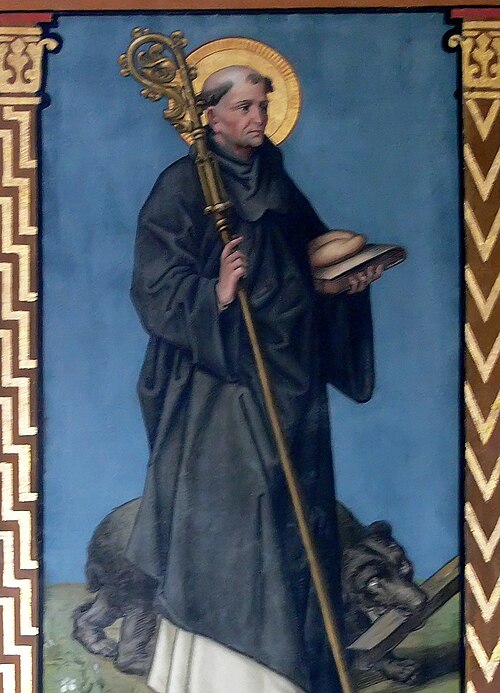
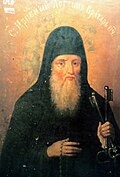
From the ninth century lives of him circulated. Among them is the story in which he delivered Fridiburga, the betrothed of King Sigebert II, from a demon; the king gave him, at Arbon, an estate of the treasury, to found a monastery. Another story says that one evening, as Gall was warming his hands at a fire in the woods, a bear came out; the saint rebuked it, and the bear, awed, went and brought firewood, then sat down to warm itself; from then on it followed him all his life. For this he is shown in icons with a bear.
After his death his cell remained, and his disciples lived by the rule of Saint Columbanus, joining prayer with work of the hands and reading with teaching. In 719 Saint Othmar, the first abbot, enlarged the cell into an abbey, which became the nucleus of the canton of Sankt Gallen in Switzerland; from 747 the abbey followed the rule of Saint Benedict. Columbanus, Gall and their companions brought with them from Ireland learning and the written word; monks copied books on vellum and kept in the abbeys of the continent many Irish texts that were lost in Ireland through the Viking raids.
Commemorated the same day October 16
 Longinus the CenturionMartyr · Centurion at the CrucifixionOct 16
 Eliphius of ToulMartyr · Missionary at ToulOct 16
 Euphraxia of PskovRight-BelievingOct 16
- Fortunatus of CaseiMartyrOct 16
- John of TourkolekasSaintOct 16
- Dulcidius of AgenSaint · Bishop of AgenOct 16
 Longinus of the CavesVenerable · Gatekeeper of the Kyiv Caves LavraOct 16
- Silvanus of AhunMartyr · DeaconOct 16
- 220 Martyrs of North AfricaHoly MartyrsOct 16
- Alexis NikonovHieromartyrOct 16
- Amandus of ComodoliacVenerableOct 16
- AmbroseSaintOct 16