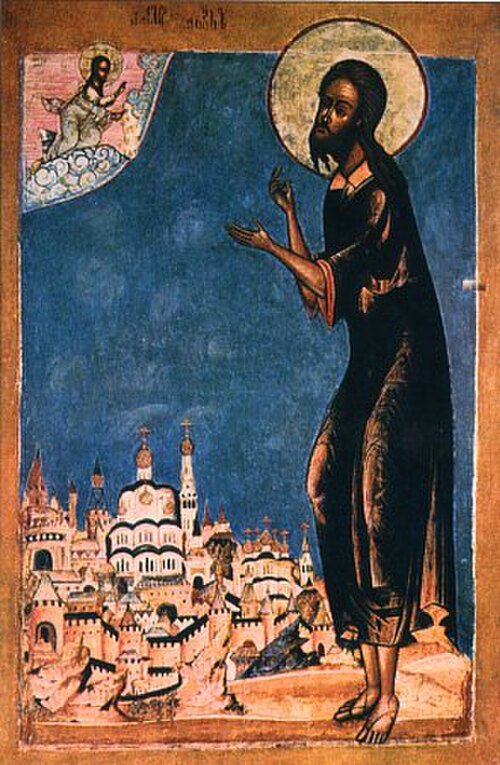
Venerable
Alexis the Man of God
Monk of the fourth century, known for a life lived in anonymity and devoted to Christ.
- Feast
- March 17old style March 30
- Reposed
- 4125th century
- Place
- Rome
- Order
- Venerables
Life
Saint Alexis, the man of God, venerable, was a monk of the fourth or fifth century, known for a life lived in anonymity and in devotion to Christ. He is commemorated on 17 March, and in the Latin calendar on 17 July.
His life
His life is known only from written sources, in two versions, one Syriac and one Greek. The oldest, from Syria, from the second half of the fifth century, makes him a saint of the East, who died at Edessa, a beggar who shared the alms he received with other poor and who after his death was found to be from Rome. The Greek version, from about the ninth century, makes him the only son of Euphemianus, a wealthy Christian senator of Rome, and of Aglaïs, people merciful to the needy. His parents chose a bride for him from a noble family. On the night of the wedding, left alone with the bride, Alexis gave her the buckle of his belt and his ring and said: “Keep these, and let the Lord be between me and you, until He renews us by His grace.” Then he left his parents’ house and set out by ship for the East.
At Edessa
Reaching Laodicea of Syria, he joined some muleteers and came with them to Edessa, where the image of the Lord not made by hand was kept. He shared out what he had left, dressed in rags and began to beg alms in the porch of the church of the Mother of God. For many years he lived on alms, eating only bread and water and spending the nights in vigil and prayer. In seventeen years he changed so much in face that the servants sent by his parents to seek him, who came also to Edessa, gave him alms without knowing him. After that, the news of his holiness spread through all Syria; moreover, the sexton of the church was informed by the Mother of God herself that Alexis was a saint, through a wonderworking icon of the Most Holy Virgin. To escape the glory of men, he fled.
Return to Rome
The ship on which he boarded for Laodicea was carried by the wind as far as Rome. Taking this as God’s work, he went to his father’s house and stayed there, unknown. His father did not recognize him, but out of pity let him live in a little room beneath the stairs, where Alexis spent another seventeen years, praying and teaching children the things of the faith, living on bread and water. After his death, his family found a paper on his body, telling who he was and how he had led a life of penance from the day of the wedding, for love of God. It is told that his relics worked healings and myrrh flowed from them. His body was placed in a marble coffin.
Veneration
His veneration came to Rome through the Greek metropolitan Sergius of Damascus, to whom Pope Benedict VII gave in 972 a church on the Aventine Hill, where a monastery was raised for Greek and Latin monks. Saint Alexis was added to the name of Saint Boniface as patron of the church. His relics are kept beneath the altar of the basilica of Saints Boniface and Alexis. His head is in the monastery of the Great Lavra in the Peloponnese. Five Byzantine emperors bore his name. His life is also told in a French poem of the eleventh century, among the oldest works of French literature. The Catholic Church counts him a saint, although since 1969 his day has been removed from the general calendar, because of the legendary character of the life.
Commemorated the same day March 17
 Patrick of IrelandSaint · Bishop and Enlightener of IrelandMar 17
- Ambrose of AlexandriaSaint · Friend of OrigenMar 17
 Makary of KalyazinVenerable · Founder of Kalyazin MonasteryMar 17
 Marinus of CaesareaMartyr · Roman soldierMar 17
 Paul KratirovSaint · Bishop of StarobelskMar 17
- Gabriel MtsireSaintMar 17
- Agricola of ChalonSaint · Bishop of Chalon-sur-SaôneMar 17
- Alexander and TheodoreHoly MartyrsMar 17
- Alexander PolivanovHieromartyrMar 17
- Beccan of RumVenerableMar 17
- Dativus of AquileiaSaintMar 17
- FaoiltigearnaVenerableMar 17