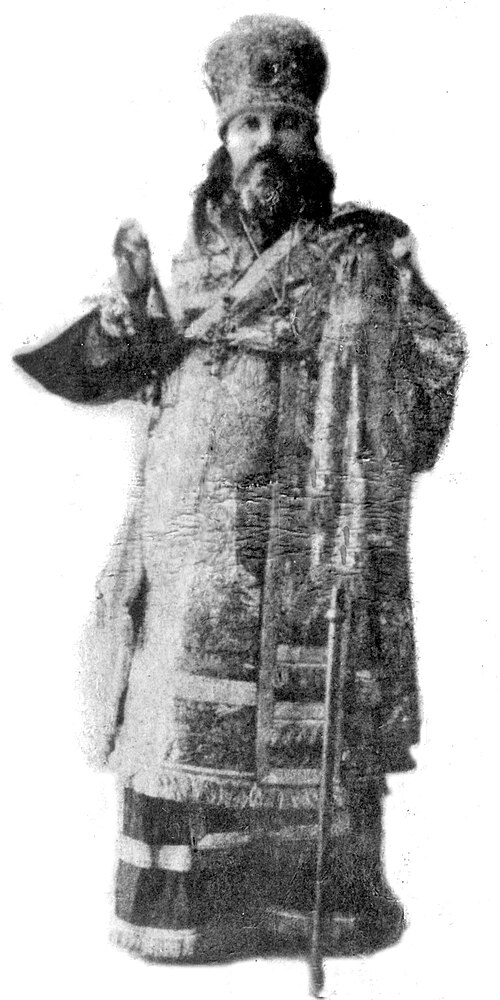
Saint
Paul Kratirov
Bishop of Starobelsk
Bishop of Starobelsk, vicar of the Kharkiv diocese and adherent of the Josephite movement, who died in 1932 in Kharkiv.
- Feast
- March 17old style March 30
- Reposed
- 193220th century
- Place
- Kharkiv
Life
Bishop Paul Kratirov was Bishop of Starobelsk and vicar of the diocese of Kharkov in the first years of the Soviet persecution. He was born in 1871 in the Vologda region and reposed on 5 January 1932 in Kharkov. He is remembered as a hierarch who suffered arrests, prisons, and exile for refusing to accept the Renovationist church, and as one of the first bishops to break with Metropolitan Sergius and join the Josephite movement.
Origins and studies
Paul Fyodorovich Kratirov was born on 6 May 1871, Old Style, in the village of Pokrovskoye in the Totma district of Vologda province, the son of the priest of the Holy Trinity church at Molochnoye. He studied at the Vologda theological school, and in 1891 he graduated from the Vologda seminary with the highest marks. In November 1891 he was appointed teacher at a model literacy school in Novocherkassk.
In 1896 he graduated from the Kazan Theological Academy as a candidate of theology, with the right to obtain a master's degree without a further oral examination. That same year he became teacher of religion at the school in his native village.
The teacher
On 10 July 1897 he was appointed teacher of Greek at the Tula Theological Seminary. In 1902 he was moved to the Kursk seminary to teach literature, and soon afterwards, by order of the Chief Procurator of the Holy Synod, to the Kharkov seminary, where he taught fundamental, dogmatic, and moral theology.
At the same time he taught religion at the boys' and girls' gymnasia and for a while Russian and history at the diocesan girls' school. He wrote often for the diocesan journals, held the rank of court councillor, and had been awarded the Order of Saint Stanislaus. He also spoke in favour of the death penalty for revolutionaries who committed political murders.
In June 1914 his wife died, leaving him with three daughters, Valentina, Inna, and Zoya. He taught at the Kharkov seminary until it was closed in 1918.
Priest and bishop
In 1920 the diocese of Kharkov was placed under Archbishop Nathanael (Troitsky), whose chief concern was the shortage of clergy. In September 1921 the widowed teacher was ordained deacon and then priest, and he served at the church of the Ozeryanskaya Icon of the Mother of God in Kharkov.
In January 1922, at Archbishop Nathanael's proposal, he was chosen Bishop of Starobelsk, vicar of Kharkov, with broad administrative rights and his residence at the Kharkov Protection Monastery. On 15/28 January 1922 he was tonsured a monk, keeping the name Paul, and in February he was raised to the rank of archimandrite.
On 6/19 February 1922 he was consecrated Bishop of Starobelsk, according to some sources in the monastery's church of the Joy of All Who Sorrow icon, according to others in Kharkov's cathedral. The consecrating bishops were Metropolitan Nazarius of Kursk, Archbishop Nathanael, Bishop Cornelius of Sumy, and Bishop Nikon of Belgorod. Besides his see as vicar he was given charge of the Transfiguration Monastery at Kuryazh.
Against the Renovationists
In May 1922, after the arrest of Saint Patriarch Tikhon, the Renovationist "Supreme Church Administration" was formed with the support of the authorities. Archbishop Nathanael and Bishop Paul refused to submit to it. In August 1922 that body retired them both and ordered them out of the diocese; the decision was read to them at the People's Commissariat of Justice, and the diocesan offices were sealed.
Archbishop Nathanael was tried and banished from Kharkov. In the autumn an assembly of clergy and faithful in the Old Trinity church resolved to call Bishop Paul to lead the diocese. He returned to the city, but was unable to serve anywhere.
On 17 March 1923 the secret police arrested him together with thirteen priests and two laymen. That day only the choir sang in the Annunciation Cathedral, since all its priests had been taken, and a few days later the cathedral was handed to the Renovationists. In May 1923 a special commission sentenced him to three years' exile from Ukraine for refusing to recognise the Renovationist authority. He was released on his signature and went to Crimea.
Years of wandering
In Crimea he briefly administered the vicariate of Yalta, and then lived in Abkhazia. In August 1923 he came to Vologda, where for a few weeks he was in charge of the diocese. In November 1923 Saint Patriarch Tikhon and the Synod appointed him Bishop of Alexandrov, vicar of Vladimir, and later he lived in Veliky Ustyug.
Abbess Juliania (Nevakhovich) left a memoir of him from this time. The nuns of the Cathedral of Christ the Saviour in Moscow heard of a sick bishop in shabby clothes who had just come out of Butyrka prison after about six months and was ill with tuberculosis. He told them that in every diocese to which he had been sent he had been arrested within a month at most. The nuns took him to a doctor, fed and clothed him, and in the spring he went to recover in Crimea.
In the autumn the Renovationists organised a public debate in Moscow, and beforehand all their serious opponents had been arrested. Bishop Paul arrived in the city just then, saw the posters, and went to the debate. Because he looked insignificant, he was given the floor without difficulty. According to the abbess, he overturned every argument of the Renovationists and spoke with such love for God that the whole hall was ready to follow him, and the debate was broken off at once. Her account implies that he was arrested again that same day.
In exile at Kharkov
In April 1925 he signed the act by which the bishops recognised Saint Metropolitan Peter (Polyansky) as Patriarchal Locum Tenens. From the spring of that year he lived in Kharkov as an exile, without a parish.
In 1926 he supported Metropolitan Agathangel of Yaroslavl in his claim to be Locum Tenens. He regarded Metropolitan Sergius as a usurper of church authority even before Sergius's well-known declaration of loyalty to the Soviet state in July 1927. Thus, through his letter "The Church in the Wilderness", he became the first bishop of the Patriarchal Church in the Soviet Union to break with Metropolitan Sergius, in September 1927, though the step attracted little notice at the time.
In opposition to Metropolitan Sergius
At the end of 1927 he wrote to Metropolitan Agathangel and received his support. In February 1928 he wrote a clandestine epistle criticising Metropolitan Sergius's second letter. In April 1928 he sent Metropolitan Sergius a formal declaration of separation, and Sergius and his synod suspended him from serving, a decision Bishop Paul did not recognise.
In May 1928 he wrote a second epistle, "On the Modernised Church, or Sergianist Orthodoxy". In it he went further than other critics, calling those who followed the new line not only schismatics but apostates, because they had bowed before the godless power in the name of the whole Church. Most of the bishops who separated based their action chiefly on Sergius's having exceeded his powers as deputy of the Locum Tenens.
When Metropolitan Agathangel was reconciled with Metropolitan Sergius, Bishop Paul separated from him as well. In the summer of 1928 he learned of Bishop Dimitry (Lyubimov), who was leading the Josephite movement in Leningrad in the absence of Metropolitan Joseph (Petrovykh). He wrote to him, explaining that he had left Metropolitan Sergius as early as 1926, and asked to be received into communion. After examining the documents, Bishop Dimitry received him and entrusted to him the care of the nearby communities.
Shepherd of the Josephite communities
From the summer of 1928 he acted as a ruling bishop. The secret police summoned him, asked his view of Sergius's declaration, and for a time allowed him to travel to serve in the churches that joined him. In that summer alone about twenty communities came under his care, and from each he required a lawful resolution of adherence.
He was soon told to stop commemorating Metropolitan Peter. He refused, and the authorities forbade him to travel far or to receive new parishes. In September 1928 travel was permitted again, each time with special approval, but in March 1929 it was banned for good. He no longer went to serve in other towns but continued to receive communities. In all he had charge of nearly forty Josephite parishes in the Kharkov, Sumy, and Dnepropetrovsk districts.
The end of his life
Bishop Paul reposed on 5 January 1932 in Kharkov. Little is recorded of his last years. He remains in the history of the Russian Church as a confessor who refused both Renovationism and compromise with the atheist state, and as one of the first hierarchs of the Josephite movement in Ukraine.
Commemorated the same day March 17
 Patrick of IrelandSaint · Bishop and Enlightener of IrelandMar 17
 Alexis the Man of GodVenerableMar 17
- Ambrose of AlexandriaSaint · Friend of OrigenMar 17
 Makary of KalyazinVenerable · Founder of Kalyazin MonasteryMar 17
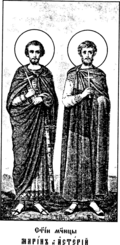 Marinus of CaesareaMartyr · Roman soldierMar 17
- Gabriel MtsireSaintMar 17
- Agricola of ChalonSaint · Bishop of Chalon-sur-SaôneMar 17
- Alexander and TheodoreHoly MartyrsMar 17
- Alexander PolivanovHieromartyrMar 17
- Beccan of RumVenerableMar 17
- Dativus of AquileiaSaintMar 17
- FaoiltigearnaVenerableMar 17