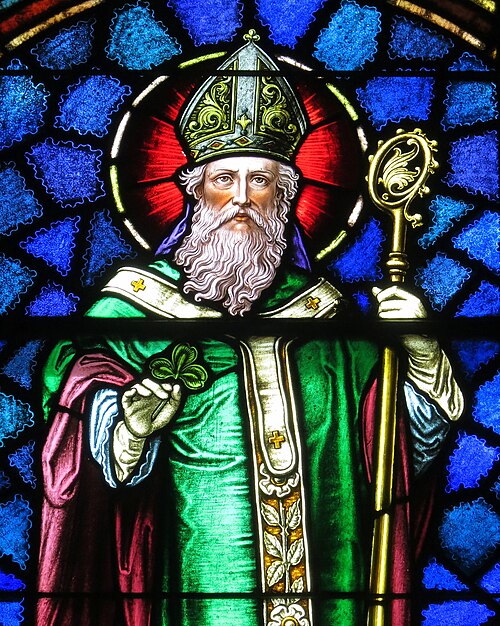
Saint
Patrick of Ireland
Bishop and Enlightener of Ireland
Romano-British missionary of the fifth century and bishop in Ireland, called the Apostle of Ireland.
Life
Saint Patrick of Ireland, bishop and enlightener of Ireland, was a missionary from Roman Britain who preached the Gospel in Ireland in the fifth century. The Church honours him as equal to the apostles, because through him a whole people came to Christ. He is one of the few saints of whom writings of his own survive.
Captivity and call
We know his life mainly from two writings: the Confession and the Letter to the Soldiers of Coroticus. He was the son of the deacon Calpurnius, a Roman official, and the grandson of the priest Potitus, from a family of Roman Britain. His birthplace is not known with certainty. He says he was not devout in his youth, but at sixteen he was seized by Irish raiders and taken as a slave to Ireland.
For six years he tended flocks, and in that solitude his faith was kindled. He prayed many times a day and at night. Hearing a voice in his sleep that he would soon go home and that his ship was ready, he fled and travelled about two hundred Roman miles, some three hundred kilometres, to a port, where he persuaded a captain to take him aboard. After some time he reached his own people in Britain.
A few years later he had a vision in which a man named Victoricus brought letters, one of them headed "The Voice of the Irish". In it he heard the voice of the people by the wood of Foclut, calling him to come and walk among them again. Saint Patrick then trained for the priesthood, according to tradition in Gaul, at Auxerre under Saint Germanus. He was consecrated bishop and sent to Ireland, after Saint Palladius, who had little success. Tradition gives the year 432, but the date is regarded as uncertain.
Mission
In the Confession he writes that he baptised thousands, ordained priests for the new communities, won wealthy women, some of whom became nuns despite the opposition of their families, and also taught the sons of kings. He refused gifts from kings, which set him outside the ties of kinship of the time. He was once beaten, robbed and put in chains, and at another time held captive for sixty days. The sons and daughters of chieftains took up the monastic life.
In the Letter to the Soldiers of Coroticus he excommunicated a British king and his men, who had killed and enslaved some of those he had baptised. Later he was summoned to Britain to answer accusations, among them that he had accepted gifts. He answered from Ireland with the Confession. Tradition places the centre of his work at Armagh, where his see is said to have been established in 444.
The hymn known as the Breastplate of Saint Patrick is also attributed to him. Later legends tell that he lit the paschal fire on the hill of Slane before the king of Tara, that he used the shamrock to explain the Holy Trinity, and that he drove out the snakes. The shamrock story is attested only from the seventeenth and eighteenth centuries, and the snakes have no historical basis.
Repose and veneration
The year of his death is uncertain: 461 by the usual tradition, 493 for some scholars. It is most often said that he died at Saul, with a traditional grave at Downpatrick, but this has never been proved. He was venerated as a saint long before the schism, and the Holy Synod of the Russian Orthodox Church added his name to its calendar on 9 March 2017. He is commemorated on 17 March, which falls on 30 March in the Churches that keep the Julian calendar. In Ireland 17 March is a national feast.
Commemorated the same day March 17
 Alexis the Man of GodVenerableMar 17
- Ambrose of AlexandriaSaint · Friend of OrigenMar 17
 Makary of KalyazinVenerable · Founder of Kalyazin MonasteryMar 17
 Marinus of CaesareaMartyr · Roman soldierMar 17
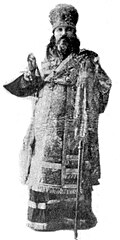 Paul KratirovSaint · Bishop of StarobelskMar 17
- Gabriel MtsireSaintMar 17
- Agricola of ChalonSaint · Bishop of Chalon-sur-SaôneMar 17
- Alexander and TheodoreHoly MartyrsMar 17
- Alexander PolivanovHieromartyrMar 17
- Beccan of RumVenerableMar 17
- Dativus of AquileiaSaintMar 17
- FaoiltigearnaVenerableMar 17