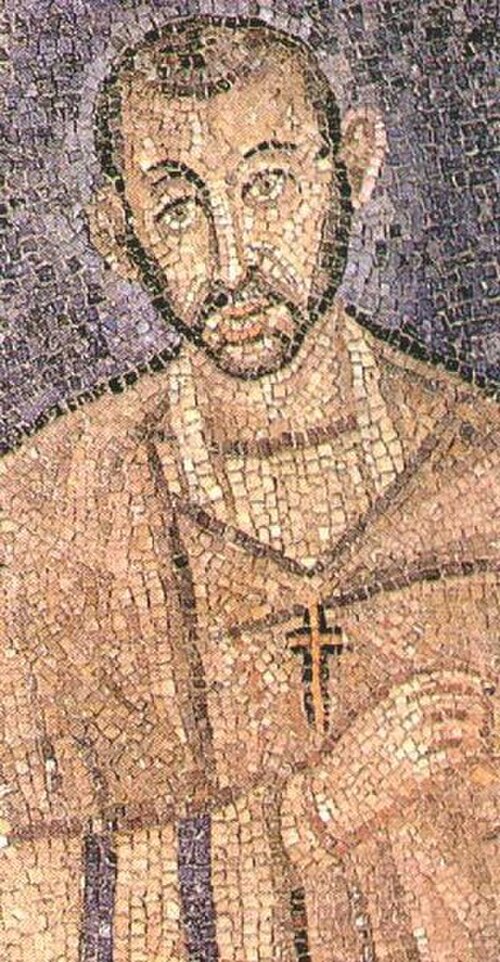
Saint
Ambrose of Milan
Bishop of Milan
Bishop of Milan from 374 to 397, great preacher who baptized Augustine of Hippo.
- Feast
- December 7old style December 20
- Reposed
- 3974th century
- Place
- Milan
- Order
- Hierarchs
Life
Saint Ambrose of Milan, bishop of that city (Mediolanum), was one of the greatest hierarchs of the West in the fourth century. The Church honours him as a fearless defender of the true faith against Arianism, as a pastor who was not afraid to rebuke emperors, and as the spiritual father of Blessed Augustine. He is commemorated on 7 December, the day of his consecration as bishop.
From official to bishop
He was born around 339 or 340 at Trier in Gaul, into the family of a Roman prefect. After his father's death he grew up in Rome with his brother Satyrus and his sister Marcellina, and studied law, rhetoric and philosophy. The synaxarion tells that in infancy a swarm of bees covered his face as he slept and left honey on his tongue, a sign to his father that the child would become great. Around 370 he was appointed governor of the provinces of Liguria and Aemilia, with his seat at Milan, where he was loved for his justice.
In 374, after the death of Auxentius, the Arian bishop of the city, Orthodox Christians and Arians quarrelled fiercely over his successor. Ambrose came to the church to calm the crowd, and a voice, which the synaxarion attributes to a child, cried "Ambrose for bishop", and all the people took up the cry. He was still a catechumen and resisted, even trying to flee, but the Emperor Valentinian ordered him to accept. He was baptized by an Orthodox priest and in seven days passed through all the ranks of the clergy, and was consecrated bishop on 7 December 374. He was the first man from the class of high officials in the West to take up the office of bishop.
Pastoral ministry
He gave his wealth to the churches, orphans and the poor, keeping only what his sister Marcellina needed, and led a strict ascetic life. He defended the unity of the Church: in 379 he went to appoint an Orthodox bishop at Sirmium, and in 385-386, when the Empress Justina, mother of Valentinian II, demanded a church in Milan for the Arians, Ambrose refused, barricaded himself in with the faithful, and the order was withdrawn.
He addressed his treatise on the faith, De Fide, to the Emperor Gratian, and at his insistence the altar of Victory was removed from the Senate house in Rome. His preaching was deeply influential. Blessed Augustine bears witness that he came to baptism in 387 through the preaching of the bishop of Milan, who baptized him in the night of Pascha. Learned men came to him from distant Persia, and Fritigil, queen of the Marcomanni, who often attacked Milan, asked him to instruct her in the faith. The synaxarion says that through his letter to her the queen accepted Christianity and persuaded her husband to make peace with the Empire.
Before emperors
After the massacre at Thessalonica in 390, Ambrose wrote to the Emperor Theodosius I and demanded public penance, saying that without it he would not give him communion. Theodosius complied: he came to church without his imperial robes and was admitted to communion only at Christmas. For Ambrose there was no difference between emperor and commoner.
Writings
Saint Ambrose left many writings. Among the dogmatic works are the Five Books on the Faith, On the Holy Spirit, On the Sacraments, On the Incarnation and On Repentance. On the Duties of the Clergy, written between 377 and 391, sets out the duties of the pastor. He also wrote the Hexameron, a commentary on the six days of creation, and a commentary on the Gospel of Luke. He brought antiphonal singing, after the Syrian model, into the West, known as Ambrosian chant, and composed hymns for the Church. The hymn Te Deum, attributed to him, entered the services of the Orthodox Church.
Repose and veneration
In old age Ambrose foresaw his departure and told his clergy, "Only until Pascha shall I be with you". He departed to the Lord on the night of Holy Pascha in 397, on 4 April, at about fifty-seven years of age; the synaxarion says that he appeared in a vision to the children being baptized that night. He was buried in the basilica of Milan, beneath the altar, between the Martyrs Protasius and Gervasius, and his body is still venerated in the church of Sant'Ambrogio in Milan.
Commemorated the same day December 7
 Sabinus of SpoletoHieromartyr · Bishop of SpoletoDec 7
 Anthony of SiyaVenerable · Founder of Antonievo-Siysky MonasteryDec 7
 Aemilianus the PhysicianMartyr · Physician and confessor of AfricaDec 7
 Nil of StolobnyVenerable · Founder of the Stolobny hermitageDec 7
 Philofteia of Curtea de ArgeșVenerable Martyr · Patron of Curtea de ArgeșDec 7
- Gregory of GornjakVenerableDec 7
 John the Faster of the Kiev CavesVenerable · Monk of the Kiev CavesDec 7
- Mastridia of AlexandriaVenerableDec 7
 Sergius GoloshchapovHieromartyr · ArchpriestDec 7
- Gregory the HesychastVenerable · Hesychast monk of AthosDec 7
- Romanus of SinaiSaint · Monk of SinaiDec 7
- Paul the ObedientVenerableDec 7