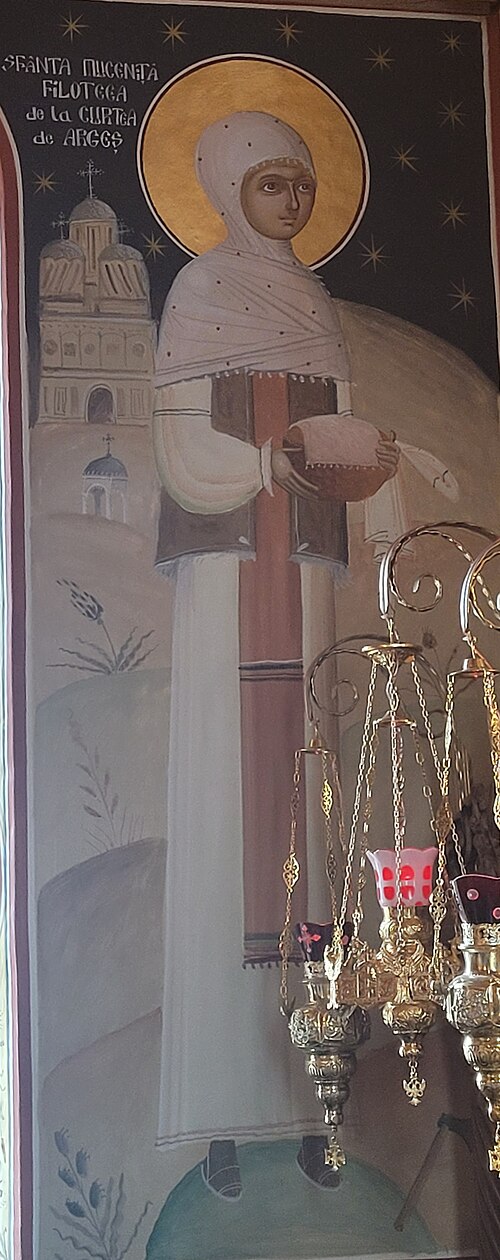
Venerable Martyr
Philofteia of Curtea de Argeș
Patron of Curtea de Argeș
Maiden born in Pamphylia in 1206 and killed in 1218 at Tarnovo, whose relics rest at Curtea de Argeș.
- Feast
- December 7old style December 20
- Reposed
- 121813th century
- Place
- Veliko Tarnovo
- Order
- Martyrs
Life
Saint Philofteia of Curtea de Argeș, also called Philotheia, is one of the saints whose relics are kept on Romanian soil and the patron of the town of Curtea de Argeș. The sources do not tell the same story of her. The Romanian tradition shows her as a girl of twelve, from near Tarnovo, killed by her father because she gave food to the poor. The Bulgarian sources, based on the Life written by Patriarch Euthymius of Tarnovo, speak of a widowed hermit from Pamphylia, brought with her relics to Tarnovo. Her feast is on 7 December.
Life according to the Romanian tradition
According to the tradition known in Romania, the Holy Martyr Philofteia (the name means "lover of God") was born in the early thirteenth century near Tarnovo, capital of the Bulgarian Tsardom, in a peasant family. Some sources give the years 1206 to 1218. She was raised in the true faith by her mother, who died while she was still small. The child fasted, listened to the Scriptures, learned to keep her virginity unstained and was above all merciful.
After her mother's death her father married a second time. The stepmother did not love her, beat and scolded her and denounced her to her father. Yet the young girl did not cease doing good and gave to the poor and hungry her own clothes and the food her stepmother gave her to carry to her father in the field. Learning of it, the father was seized by anger and, forgetting a father's love, grasped her by the braids as usual to beat her. Not in control of himself, he threw the axe he had at his belt at her and wounded her in the leg. From this wound the saint died on the spot. The whole place filled with light. She was twelve years old.
Coming to himself, the father was seized with fear. Wishing to lift the body, he could not even touch it. He ran to the town and told the archbishop and the leaders what had happened. The archbishop, with the chief men of the town and many people, came with torches, incense and prayers, saw the holy body shining with divine light and praised God. They tried to lift the body but could not move it, though they prayed earnestly. God, wishing to glorify His handmaid, had made the body heavy as a stone.
Then the father and those who helped him began to speak the names of lands, monasteries and churches beyond the Danube, to learn where the saint wished to rest. The body remained as heavy. But when the Princely Church of Târgul Argeșului was named, it became much lighter. They sent a letter to Voivode Radu Negru, who came with a procession, with torches and incense, to the Danube and brought the relics to Wallachia, placing them in the Princely Church at Argeș. There they stayed until the building of the monastery of Curtea de Argeș by Neagoe Basarab. They were moved here and now lie in the monastery's chapel. It is said that there they work many miracles and give healings to those who run to them with faith.
What the historical sources say
Historical documents show that the relics remained at Tarnovo and were brought to Wallachia only after 1393, when the Bulgarian tsardom was conquered by the Turks. It seems they were taken from there to Vidin, probably until 1396. So as not to be profaned, they were given to the prince Mircea the Elder (1386 to 1418), who placed them in the princely church of Saint Nicholas at Curtea de Argeș, then a metropolitan cathedral, the foundation of Basarab I and Nicholas Alexander. They stayed there until 1893, when, because of the church's state of decay, they were moved to the church of Saint George, then to the church of the Dormition-Olari. In the First World War they were taken to the chapel of the Antim monastery in Bucharest, then returned to Curtea de Argeș, to the great church founded by Neagoe Basarab.
The shrine was restored in 2004 at the State Mint, with cypress wood, red velvet and gilded silver pieces. The craftsmen found a curse written on the little bag in which the relics were wrapped. Metropolitan Cosma had commanded Abbot Parthenius to seal them in a new bag, leaving out only the right hand for the kissing of the faithful, and that all be careful not to nip off any of them, for he had laid a curse on whoever dared. Each year, on 7 December, the shrine is brought out of the chapel and placed in a pavilion before the monastery church, so that the faithful gathered may venerate it.
The Bulgarian and Serbian sources
The Bulgarian tradition says otherwise. According to the Long Life written by Patriarch Euthymius of Tarnovo, and the Eulogy by Joasaph of Bdin, Philotheia (in Bulgarian Filotea Tarnovska, the Venerable) was born at Molivot in Pamphylia, probably around Lake Beyşehir, where ruins of Byzantine monasteries are seen. Her parents were childless many years and obtained her by prayer. She received a good education for her time and, having come of age, was married against her will. She did not love her husband and persuaded him to live in chastity. After a time the husband died, and she, widowed, settled on an island in the nearby lake and made a hermit's cell. There she struggled alone with fasting, ceaseless prayer, vigils, tears and silence. God gave her the gift of miracle-working prayer and the wisdom to teach. Priests and many people came to her to hear her counsel, and some were healed. Weakened by abstinence, she foresaw her death and gave up her spirit to God on 7 December, in an unknown year. Her relics remained incorrupt and worked many miracles.
In the thirteenth century Tsar Kaloyan solemnly moved the relics from Molivot to Tarnovo. According to the Serbian source, he found them in Thrace, near Constantinople, in a local cult. They stayed in the old capital for nearly two hundred years, then, after the fall of Tarnovo in 1393, Metropolitan Joasaph of Bdin and Constantine II Asen took them to Vidin. After the Turks occupied Vidin, in 1396, they passed to Wallachia, to the old princely church at Curtea de Argeș. The Bulgarian sources count her the second saint of Bulgaria after Saint Paraskeva and also call her Philotheia of Temnitsa, after the Temnitsa monastery in Tarnovo, where the relics rested. No direct reports of her nationality have survived. In Romania she is also called Philofteia the Bulgarian. She is protector of Wallachia, with Saint Demetrius Basarabov, and, after the creation of the Romanian state, of that state. The Serbian source calls her venerable from the eighth century at the latest, which does not fit the other data.
Commemorated the same day December 7
 Ambrose of MilanSaint · Bishop of MilanDec 7
 Sabinus of SpoletoHieromartyr · Bishop of SpoletoDec 7
 Anthony of SiyaVenerable · Founder of Antonievo-Siysky MonasteryDec 7
 Aemilianus the PhysicianMartyr · Physician and confessor of AfricaDec 7
 Nil of StolobnyVenerable · Founder of the Stolobny hermitageDec 7
- Gregory of GornjakVenerableDec 7
 John the Faster of the Kiev CavesVenerable · Monk of the Kiev CavesDec 7
- Mastridia of AlexandriaVenerableDec 7
 Sergius GoloshchapovHieromartyr · ArchpriestDec 7
- Gregory the HesychastVenerable · Hesychast monk of AthosDec 7
- Romanus of SinaiSaint · Monk of SinaiDec 7
- Paul the ObedientVenerableDec 7