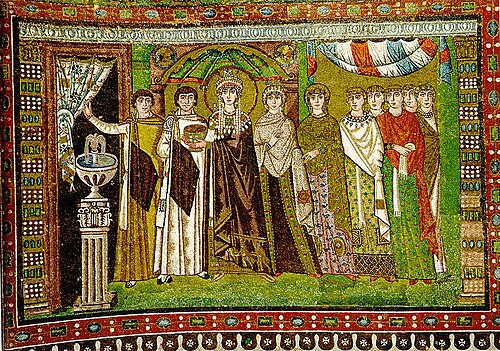
Venerable
Anastasia the Patrician
Byzantine court lady
Lady-in-waiting to Empress Theodora, who withdrew because of the empress's jealousy and lived as a nun in Egypt.
- Feast
- March 10old style March 23
- Reposed
- 5766th century
- Place
- Wadi El Natrun
- Order
- Venerables
Life
Saint Anastasia the Patrician (Anastasia Patricia, also called Anastasius the Eunuch), a venerable mother, was a Byzantine courtier, lady-in-waiting to the empress Theodora, who left Constantinople and lived as a nun in Egypt. She was born around 510 (in other sources, 501) and fell asleep in 576 (in other sources, 563). Her feast is on 10 March.
Life at court
She came from a noble Byzantine family. Beautiful and learned, she was the ornament of the imperial court. Widowed early, she kept her piety. Soon the empress Theodora began to be jealous of her, without cause, out of jealousy toward her husband; according to the account, Justinian I may have pursued her, and Anastasia, to avoid trouble, was forced to hide. Secretly hiring a ship and taking part of her gold, she left Constantinople and sailed for Alexandria, in Egypt. She arrived at a place called Pempton, near Alexandria, where she founded a monastery, which later took her name. She lived with monastic discipline, weaving cloth to support herself.
Exile in Scetis
After the death of the empress Theodora, in 548, the emperor Justinian sought the fugitive, trying to bring her back to Constantinople, without success; according to one account, he understood he would not find a better wife. To escape marriage and the return to the vanities of the world, Anastasia went to Scetis, to Abba Daniel, the hegumen of the monastery at that time. To safeguard her, he let her move into a laura or cell eighteen miles (about 29 km) from Scetis, in the desert, and dress as a (male) monk and take up the life of a hermit, which at that time was permitted only to men. She was called Anastasius the Eunuch, and her true name and social rank were hidden from all. Abba Daniel visited her every week and ensured that one of his disciples supplied her with jugs of water. Anastasia dwelt in seclusion for twenty-eight years, in prayer and self-denial.
Her repose
In 576, aware of her approaching death, she wrote several words for Abba Daniel on a piece of broken pottery and placed it at the entrance to the cave. The disciple found an ostracon with the words: "Bring the spades and come here." When Daniel heard this, he understood that Anastasia was near death. He went to her with his disciple, to give her communion and hear her last words; according to one source, he spent with her the last hours of her life and buried her at the entrance of the cave in which she had struggled. Only then did he reveal Anastasia's name and tell his disciple her whole story. He is said to have seen her face shining like the sun. Her story survives in one recension of the Copto-Arabic Synaxarion and in the tale of Daniel of Scetis, among the texts gathered in the Life of Abba Daniel, held by some to be of the seventh century. She is also commemorated on 26 Tobi in the calendar of the Coptic Church, the date of her death given in the Ethiopic Life of Daniel of Scetis.
Commemorated the same day March 10
 Simplicius of RomeSaint · Bishop of RomeMar 10
 Macarius of JerusalemSaint · Bishop of JerusalemMar 10
 Attala of BobbioVenerable · Abbot of BobbioMar 10
 Paul of TaganrogRighteous · Righteous man of TaganrogMar 10
 Codratus of CorinthMartyrMar 10
- Demetrius LegeydoMartyrMar 10
- Ioane of KhakhuliSaintMar 10
 Quadratus of NicomediaMartyrMar 10
- Agathon of AleppoVenerableMar 10
- Alexander of ApameaMartyrMar 10
- Anectus of CorinthMartyrMar 10
- Basilissa of CorinthMartyrMar 10