Saint
Macarius of Jerusalem
Bishop of Jerusalem
Bishop of Jerusalem from 312 until shortly before 335, in the age of Constantine the Great.
Life
Saint Macarius of Jerusalem was bishop of Jerusalem from the year 312 (between 311 and 314, according to some scholars) until shortly before 335, in the days of Saint Constantine the Great. The Church remembers him for his labour in the finding of the Precious Cross and in the building of the church of the Holy Sepulchre, and for his fidelity to the Council of Nicaea. He is commemorated on 10 March. He is venerated by both the Orthodox and the Catholic Church.
Bishop of Jerusalem
In Jerusalem, the city then called Aelia Capitolina, Macarius became bishop after Hermon. Saint Athanasius the Great cites him in one of his orations against the Arians as an example of the honest and simple style of apostolic men. Arius, in his letter to Eusebius of Nicomedia, writes of him with abuse, which shows how firmly he opposed Arius. Macarius is among the bishops to whom Saint Alexander of Alexandria wrote warning them against Arius.
At the Council of Nicaea
In 325 he took part in the First Ecumenical Council at Nicaea, where his name stands first among the bishops of Palestine who signed its decisions. According to some historians a dispute took place there between him and his metropolitan, Eusebius of Caesarea, over the rights of their two sees, and the seventh canon of the Council, which gives the bishop of Aelia precedence of honour while keeping the dignity of the metropolis, seems the fruit of a compromise. Other conjectures say that Macarius, together with Eustathius of Antioch, had a large share in drafting the Creed. A later work attributed to Gelasius of Cyzicus shows him defending the Descent into Hades in an imagined debate with the philosophers of Arius.
The finding of the Holy Cross
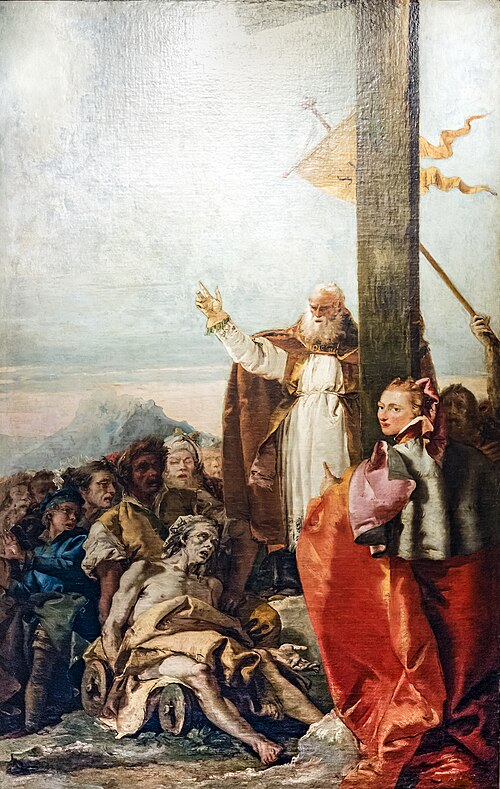
Around 325 he accompanied the holy Empress Helena, mother of Constantine, to Jerusalem in her search for the Precious Cross and the sites of the Passion. According to tradition, three crosses were found at Golgotha, and Patriarch Macarius had them laid one after another on a dead man. When the third cross touched him, the dead man rose, and the same cross also healed a sick woman. Macarius then lifted the Cross so that all the people might see it, and the crowd sang with tears, Lord, have mercy. The empress placed the Cross in a silver casket.
The emperor Constantine wrote Macarius a long letter about the building of the church of the Holy Sepulchre, speaking with wonder of the finding of the place hidden for so long, and bidding him send word if he needed columns and marble, since the most marvellous place in the world deserved to be adorned worthily. So the church of the Resurrection was raised. According to some sources Macarius decided to appoint Maximus, his later successor, as bishop of Lydda, but the people would not part with him, so the decision was not carried out.
Death and veneration
Macarius departed to the Lord, probably before the Council of Tyre in 335, at which his successor Maximus was present. His relics, including his head, are kept in a chapel of Saint Anthony in Pittsburgh. He is commemorated on 10 March.
Commemorated the same day March 10
 Simplicius of RomeSaint · Bishop of RomeMar 10
 Anastasia the PatricianVenerable · Byzantine court ladyMar 10
 Attala of BobbioVenerable · Abbot of BobbioMar 10
 Paul of TaganrogRighteous · Righteous man of TaganrogMar 10
 Codratus of CorinthMartyrMar 10
- Demetrius LegeydoMartyrMar 10
- Ioane of KhakhuliSaintMar 10
 Quadratus of NicomediaMartyrMar 10
- Agathon of AleppoVenerableMar 10
- Alexander of ApameaMartyrMar 10
- Anectus of CorinthMartyrMar 10
- Basilissa of CorinthMartyrMar 10