Saint
Anthony of Novgorod
Archbishop of Novgorod
Archbishop of Novgorod from 1210 to 1218 and from 1226 to 1228, born Dobrynya Yadreykovich; died in 1232.
Life
Saint Anthony of Novgorod (in the world Dobrynya Yadreykovich) was archbishop of Novgorod several times between 1210 and 1229 and fell asleep in the Lord on 8 October 1232. He is also known as the author of the Pilgrim's Book, an account of his journey to Constantinople. The Russian Church honours him as a hierarch.
Beginnings
He was born into a wealthy family in Novgorod. Some sources say he was the son of the voivode Yadrey, who died in 1194 on a campaign against the land of Yugra. Around 1190 he became a monk at the Khutyn Monastery near Novgorod. A short life of the saint says that Saint Varlaam of Khutyn, the monastery's founder, himself handed him the abbacy, but the report is not considered reliable.
In 1200 he went on pilgrimage to Constantinople and described it in the Pilgrim's Book. The book is precious to historians because it depicts the city and its holy places before the capture by the Crusaders in 1204. Anthony describes churches, icons, relics and many Byzantine legends, among them the keeping of the staff of Moses and the trumpets of Jericho. According to tradition, he also brought from Jerusalem a wooden cross made from the Holy Wood, later kept in the Cathedral of Saint Sophia in Novgorod.
The archbishop
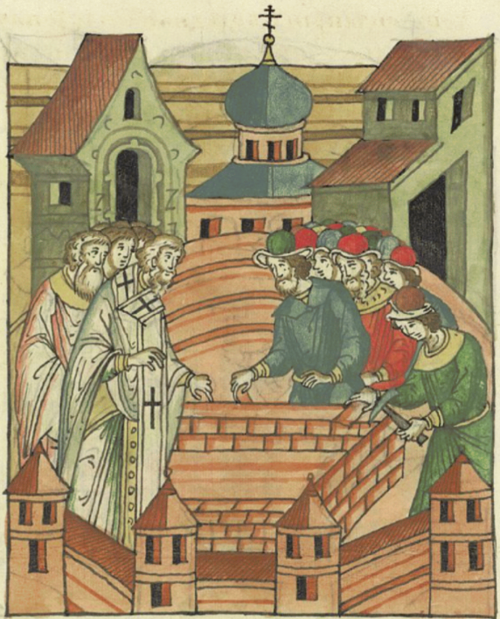
In 1210, after Archbishop Mitrofan was driven from the see, Anthony was set in his place, having been sent to Kiev to Metropolitan Matthew. In 1218, when the citizens called Mitrofan back, he was removed from the see. In 1218 he supported the building of the stone church of Saint Barbara at Khutyn. Later, around 1220, the metropolitan appointed him bishop of Przemyśl in Galicia, in the time of Prince Mstislav Mstislavich, according to some Russian sources.
After Mitrofan's death in 1223, and after Przemyśl was taken by the Hungarians, Anthony returned to Novgorod around 1225 or 1226. In 1228, ill and deprived of speech, he withdrew to Khutyn. His successor Arsenius was driven out by the people, who had been struck by rains and famine, and Anthony was called back, until 1229. He died in 1232, after an illness that had made him mute.
Veneration
He was canonized locally in 1439. Archbishop Euthymius II of Novgorod established on 10 February the commemoration of the princes and saints of Novgorod, and his name entered the Synaxis of the Saints of Novgorod of the seventeenth and eighteenth centuries.
The saint is commemorated on 8 October, the day of his repose, on 10 February, in the Synaxis of the Hierarchs of Novgorod, and on the second Sunday after Pentecost, in the Synaxis of the Saints of Novgorod.
Commemorated the same day October 8
 Pelagia the PenitentVenerable · The penitent of AntiochOct 8
 Thaïs of EgyptVenerableOct 8
 Reparata of CaesareaMartyrOct 8
 Pelagia of AntiochMartyr · Virgin of AntiochOct 8
 Tryphon of VyatkaVenerable · Abbot and missionary at VyatkaOct 8
 Libaria of GrandMartyrOct 8
 Luke of RostovSaint · Bishop of RostovOct 8
 Chariton of SyanzhemaVenerable · Abbot of Syanzhema MonasteryOct 8
 Dositheus of PskovVenerableOct 8
 Ambrose AstakhovVenerable Martyr · ArchimandriteOct 8
 Elizabeth KuranovaMartyrOct 8
 PalaziaMartyrOct 8