
Martyr
Pelagia of Antioch
Virgin of Antioch
Virgin of Antioch who leapt to her death rather than sacrifice to the pagan gods in the Diocletian persecution.
Life
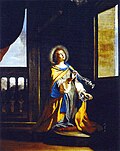
The holy martyr Pelagia of Antioch was a fifteen-year-old Christian maiden who, in the time of Diocletian's persecution, chose to throw herself from the roof of her house into the sea rather than be forced by Roman soldiers to offer sacrifice to pagan gods or to suffer dishonour. She is commemorated on 8 October, the day on which, in ancient times, Saint Pelagia the Harlot and Saint Pelagia of Tarsus were also kept together with her.
She was from Antioch in Syria, of a noble family, and had as her teacher Saint Lucian of Antioch. According to tradition, while she was alone at home during the persecution, Roman soldiers came. She went out to meet them and, learning that they meant to take her to a pagan sacrifice, asked leave to change her clothes. She prayed, dressed in her best garments, went up to the roof and threw herself into the sea. She was fifteen. Her death is reckoned to have been in 303.
Her death is mentioned by Saint Ambrose of Milan, and Saint John Chrysostom devoted two homilies to her. In them he says that Christ caught death, which had terrified human nature, and made it a plaything even for maidens, so that Pelagia rushed on it with such joy that she did not wait for the torturers' hands, nor enter the court, but out of the abundance of her zeal outran their cruelty. She was ready for torments and every punishment, but feared to lose the crown of virginity. The same Father writes that her virgin body, purer than gold, lay on the ground with angels around it, archangels honouring it and Christ himself near. The Fathers of the Church thus regarded the event as a holy martyrdom, not a shameful suicide.
Her story was probably the basis of the later, uncertain accounts of Pelagia of Tarsus. After the Great Schism the Roman Catholic Church moved her commemoration to 9 June, and in Naples she is celebrated on 5 October.
Commemorated the same day October 8
 Pelagia the PenitentVenerable · The penitent of AntiochOct 8
 Thaïs of EgyptVenerableOct 8
 Reparata of CaesareaMartyrOct 8
 Anthony of NovgorodSaint · Archbishop of NovgorodOct 8
 Tryphon of VyatkaVenerable · Abbot and missionary at VyatkaOct 8
 Libaria of GrandMartyrOct 8
 Luke of RostovSaint · Bishop of RostovOct 8
 Chariton of SyanzhemaVenerable · Abbot of Syanzhema MonasteryOct 8
 Dositheus of PskovVenerableOct 8
 Ambrose AstakhovVenerable Martyr · ArchimandriteOct 8
 Elizabeth KuranovaMartyrOct 8
 PalaziaMartyrOct 8