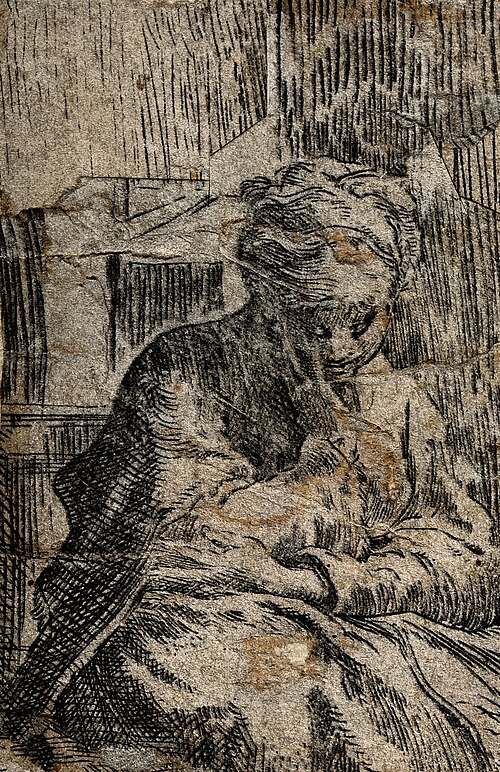
Venerable
Thaïs of Egypt
Courtesan of Alexandria who repented and lived in the Egyptian desert in the fourth century.
- Feast
- October 8old style October 21
- Reposed
- 4004th century
- Place
- Ancient Egypt
- Order
- Venerables
Life
Saint Thaïs of Egypt was a woman of Alexandria in the fourth century who lived first as a courtesan, and then repented and spent years in solitude and prayer. The Church remembers her as an example of saving repentance, on 8 October.
Her life
According to her Life, Thaïs was beautiful and wealthy, living in the great city of Alexandria, and was known to all as a sinner. According to some sources her mother had taught her that way of life. A monk heard of her, and the sources name him differently: Paphnutius, Bessarion or the bishop Serapion. Dressed in worldly clothes, he came to her with a gold coin to bring her to repentance. Thaïs, who had thought he came like any other, learned from him that God sees everything and that nothing is hidden from Him. Her conscience awoke and she began to weep.
She burned in the city square all the riches she had gathered and, according to some sources, gave her property to the poor and followed him to a convent of virgins. There she was shut in a cell, where she stayed three years, eating once a day and, in some versions, only bread and water.
Forgiveness
After three years Paphnutius went to Saint Anthony the Great to learn whether God had forgiven her. Anthony told his disciples to pray for an answer, and the disciple Paul the Simple saw in a vision a bed with coverings of unspeakable beauty, guarded by three maidens with shining faces. Paul said it was ready for father Anthony, but a voice told him it was for Thaïs the sinner. So Paphnutius learned God's will about her.
He returned to the convent and brought her out of the cell, though she resisted. After fifteen days she fell ill, and three days later she died. According to the Serbian Prologue, she fell asleep around 340.
About the sources
Her Life has come down in two writings. The first, in Greek, perhaps of the fifth century, was translated into Latin by Dionysius Exiguus. The second is in the medieval Latin of Marbod of Rennes. She does not appear in the early Latin martyrologies, and some modern scholars think hers is mainly a moral tale composed for edification. In 1901 the Egyptologist Albert Gayet announced that he had found at Antinoë the mummies of Thaïs and the bishop Serapion, but shortly afterward he considered the identification uncertain.
Her story was much loved in the West and inspired a play by Hrotsvitha of Gandersheim, a painting by Ribera and Anatole France's novel Thaïs, and then Massenet's opera. The Orthodox Church commemorates her on 8 October, and the Catholic Church, which has her in its calendar, on the same date.
Commemorated the same day October 8
 Pelagia the PenitentVenerable · The penitent of AntiochOct 8
 Reparata of CaesareaMartyrOct 8
 Pelagia of AntiochMartyr · Virgin of AntiochOct 8
 Anthony of NovgorodSaint · Archbishop of NovgorodOct 8
 Tryphon of VyatkaVenerable · Abbot and missionary at VyatkaOct 8
 Libaria of GrandMartyrOct 8
 Luke of RostovSaint · Bishop of RostovOct 8
 Chariton of SyanzhemaVenerable · Abbot of Syanzhema MonasteryOct 8
 Dositheus of PskovVenerableOct 8
 Ambrose AstakhovVenerable Martyr · ArchimandriteOct 8
 Elizabeth KuranovaMartyrOct 8
 PalaziaMartyrOct 8