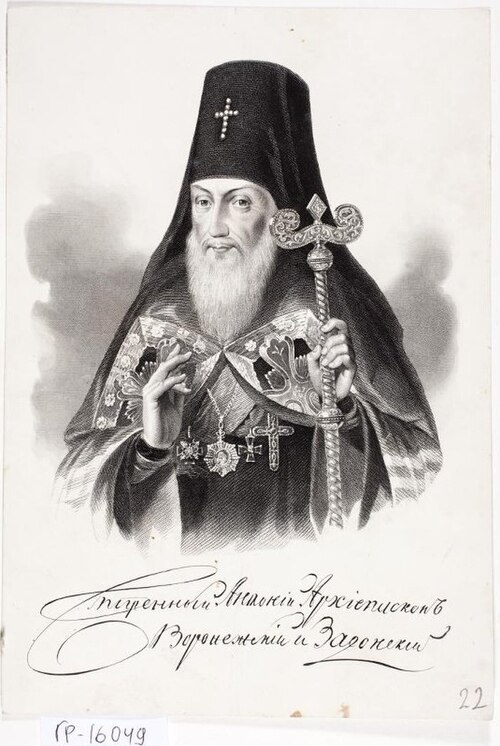
Saint
Anthony Smirnitsky
Archbishop of Voronezh
Archbishop of Voronezh and Zadonsk, 1773 to 1846, venerated locally in the Voronezh and Lipetsk dioceses.
- Feast
- December 20old style January 2
- Reposed
- 184619th century
- Place
- Voronezh
- Order
- Hierarchs
Life
Saint Anthony (in the world Abraham Gavrilovich Smirnitsky, 1773-1846) the hierarch was bishop, then archbishop of Voronezh and Zadonsk in the Russian Orthodox Church, an ascetic hierarch known for his humility, who prepared the glorification of Saint Mitrofan of Voronezh and of Saint Tikhon of Zadonsk. He died at Voronezh on 20 December 1846 (2 January in the new style). He was canonized as a locally venerated saint of the dioceses of Voronezh and Lipetsk on 26 May 2003, and in 2008 the Council of Bishops of the Russian Church decided on his veneration in the whole Church. He is commemorated on 20 December.
Youth and monasticism
He was born on 29 October 1773 in the village of Povstin, Piryatin district, Poltava governorate (now in Ukraine), in the large family of an archpriest. He learned reading from the Horologion and the Psalter and helped his father as psalm-reader. The surname Smirnitsky (from "humble") he received at school, for the humility that marked him from childhood and which he did not lose all his life. He did his theological studies at the Kyiv Academy. On graduating, in 1796, he wished to be a regimental priest, but did not receive the blessing of Metropolitan Samuel of Kyiv, who said on his deathbed that "other paths are appointed for Smirnitsky". In August 1796 he entered the Kiev Caves Lavra, where on 21 February 1797 he was tonsured a monk by Metropolitan Hierotheus (Malitsky) and given the name in honour of Saint Anthony of the Caves; on 21 April 1797 he was ordained hierodeacon. First he had charge of the Lavra's library; on 20 November 1799 he was ordained hieromonk by Metropolitan Gabriel (Banulescu-Bodoni), and on 25 January 1808 appointed by Metropolitan Serapion head of the Lavra's printing house.
From the first days of monasticism he gave himself to labours of abstinence, prayer and humility; he had no possessions, wore a rough hair shirt and gave to the poor all he received. This won him deep respect. From 20 September 1814 he was appointed head of the Near Caves and then asked to be tonsured into the schema, but did not receive the metropolitan's permission. From 2 January 1815 he was vicar (namestnik) of the Lavra, and in 1817 Metropolitan Serapion raised him to archimandrite. In the Lavra he established the weekly reading by the brethren of the akathist of the Dormition of the Mother of God, in thanksgiving for the saving of Kyiv from the French invasion in 1812. In 1816 Emperor Alexander I, who visited in the Lavra the ascetic schemamonk Vassian, showed deep respect to the vicar Anthony too and on leaving gave him a pectoral cross adorned with diamonds.
Bishop of Voronezh
On 31 January 1826 he was consecrated bishop of Voronezh. The flock of Voronezh revered its bishop for his ascetic life. People came from afar to Voronezh to receive Anthony's blessing and hear his counsel. Whoever could not come in person wrote, and no one was left without an answer and instruction. "I have lived many years," he used to say humbly, "and have no good deeds." To the praises addressed to him he only remarked: "He does not yet know all my weaknesses and failings." Bishop Anthony was one of the initiators of the translation into Russian of the works of the Holy Fathers, especially of the venerable Ephrem the Syrian, which was done in 1829. He also helped develop church publishing: icons, akathists and soul-profiting instructions were printed in large editions. He blessed N. A. Motovilov to go to Kursk and gather information about the parents of the venerable Seraphim of Sarov.
He carried out the glorification of Saint Mitrofan of Voronezh. From 1830 he began to prepare materials for the glorification and appealed for the first time to the Holy Synod; after the second report, on 25 June 1831, the saint's relics were recognized by the Synod as incorrupt, and on 6 August 1832, in concelebration with the Synod member Archbishop Gregory (Postnikov) of Tver and twelve priests, Bishop Anthony led the celebrations of the opening and finding of the relics; on 6 December 1832 he was raised to archbishop. Twice, at the end of the 1830s and the beginning of the 1840s, he petitioned the emperor and the chief procurator to be allowed to retire to the Caves Lavra, but was refused; on 28 October 1841, to help him, the vicariate of Ostrogozhsk was established. On 20 May 1846 he reported to the Holy Synod the finding of the incorrupt relics of Saint Tikhon, and in October 1846, after a new examination of the relics, he petitioned for his glorification. He received the Order of Saint Vladimir and the Order of Saint Alexander Nevsky (13 April 1840).
His end and veneration
He died at Voronezh on 20 December 1846. On the day of his death he dictated a remarkable "Spiritual Testament to His Flock", which, left without his signature, had no official status. He was buried on 27 December in the Annunciation cathedral of the Mitrofan monastery, in the crypt beside the shrine of Saint Mitrofan, with a cast-iron slab above. Archbishop Anthony had left word to be buried in schema vestments right at the entrance to the church, with no monument, "that all who come in may trample me underfoot". In 1914 a commission was created at Voronezh that examined the remains; on opening the crypt it was seen that the coffin in which lay the incorrupt body and preserved vestments had rotted and crumbled at a touch; the body was moved to a new coffin, and the entrance to the tomb was walled up. Through the labours of Archimandrite Alexander (Kremenetsky) and A. A. Polyansky, with the gifts of venerators, a chapel-crypt and a marble gravestone were made over the grave. Materials for canonization were prepared for the Local Council of 1917-1918. With the blessing of Patriarch Alexy II, on 26 May 2003 Metropolitan Methodius of Astana performed the numbering of Archbishop Anthony among the saints of the dioceses of Voronezh and Borisoglebsk. In 2008 the Council of Bishops glorified him for veneration in the whole Church.
Commemorated the same day December 20
 Ignatius of AntiochHieromartyr · Bishop of AntiochDec 20
 Rabbula of EdessaVenerable · Bishop of EdessaDec 20
 Philogonius of AntiochSaint · Bishop of AntiochDec 20
 Danilo II of SerbiaSaint · Archbishop of SerbiaDec 20
- Liberatus of RomeMartyrDec 20
- Ignatius MarkovMartyrDec 20
- Adventor of TurinMartyrDec 20
- Barbara ChernyshevaMartyrDec 20
- DiarmaitSaintDec 20
- Dominic of BresciaSaint · Bishop of BresciaDec 20
- FaoithleglanSaintDec 20
- FeidlimidhSaintDec 20