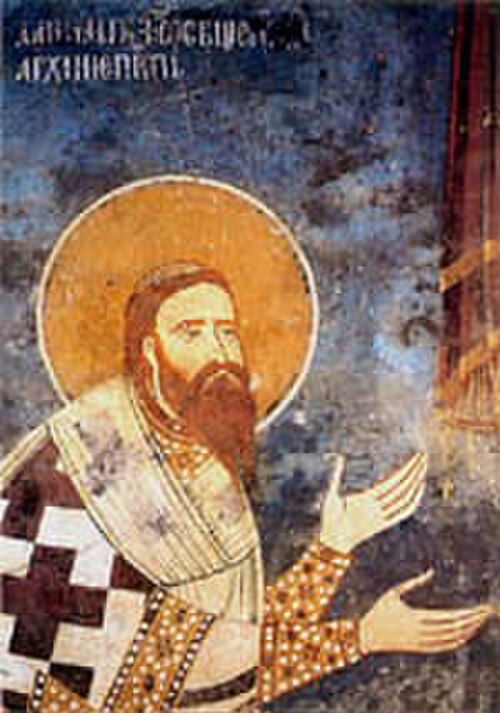
Saint
Danilo II of Serbia
Archbishop of Serbia
Archbishop of the Serbs from 1324 to 1337, a monk and chronicler active in court and Church affairs.
- Feast
- December 20old style January 2
- Reposed
- 133714th century
- Place
- Peja
- Order
- Hierarchs
Life
Saint Danilo II was archbishop of Serbia from 1324 to 1337, a monk of Mount Athos, a court counsellor, a builder of churches and the author of the oldest part of the Lives of the Serbian Kings and Archbishops. He is one of the most honoured saints of the Serbian Orthodox Church, and at the end of the twentieth century the Serbian Academy of Sciences and Arts placed him among the hundred most prominent Serbs. His memory is kept on 20 December.
Youth and tonsure
He was born around 1270, according to some sources in the district of Pilot, in what is now northern Albania, into a noble Serbian family. The name he bore before becoming a monk was not recorded. He received a fine education from the most learned men of Serbia and Byzantium and became one of the most trusted courtiers of King Stefan Uroš II Milutin.
After a conversation with an elder at a monastery of Sopoćani, where he had accompanied the king, he resolved to become a monk. Around 1300 he left his court career and entered the monastery of Saint Nicholas at Končul on the Ibar, where the abbot Nicholas tonsured him with the name Danilo. At the request of Archbishop Eustathius II he came to Peć and was ordained priest, and in 1305 he was chosen abbot of Hilandar on the Holy Mountain.
Hilandar and the bishopric
From 1307 to 1310, when Catalan bands plundered Athos, Danilo led the defence of Hilandar, acting more as soldier, diplomat and steward than as monk. He gathered the monastery's most precious treasures and travelled with an armed escort to Serbia, where he entrusted them to Milutin. When peace returned to Athos he laid down the abbacy and withdrew into complete silence. In those years he was close to the monastery of Saint Panteleimon, where many of the monks were Serbs, and had a spiritual father there.
In 1311 he was elected bishop of Banjska and came to Serbia, on the condition that he could live on Athos when not needed, and he oversaw the completion of the monastery of Banjska, King Milutin's foundation, and looked after the royal treasury. In 1315 he withdrew to Hilandar again. In 1316, after the death of Archbishop Sava III, Milutin wished to make him archbishop. The electoral council met three times, and in 1317 his disciple Nikodim, abbot of Hilandar, was chosen instead. In the same year Danilo was named bishop of Hum and stayed there until 1324, when he was made archbishop of Serbia, with his seat at Peć.
The archbishopric
His archiepiscopate fell in the reigns of King Milutin, Stefan Dečanski and the first years of Stefan Dušan. He was counsellor to the rulers and a skilled diplomat, and helped reconcile Milutin with his brother Dragutin, and then Milutin with Stefan Dečanski. Even in his lifetime he is said to have received the gift of working wonders and healing.
In 1328 he built the church of the Mother of God at Peć, which he joined by an exonarthex of his own design to the churches of the Holy Apostles and of Saint Demetrius. He also raised the church of Saint Nicholas at Peć and that of Saint George at Maglič.
Writings
Danilo wrote the oldest part of the collection Lives of the Serbian Kings and Archbishops, with the lives of Kings Stefan Uroš I, Stefan Dragutin and Milutin, Queen Helen, and Archbishops Arsenius I, Joanikije I and Eustathius I. This work, composed between 1317 (the Life of Queen Helen) and 1324 (the Life of King Milutin), is the most important source for the history of the Nemanjić dynasty and the Serbian Church from the mid-thirteenth to the first quarter of the fourteenth century, and continues the tradition of Saint Stefan the First-Crowned. He also composed services for Archbishops Arsenius and Eustathius. In Serbian folk poetry his work is called "the ancient books" and "the royal books". Danilo also played a prominent part at the Nemanjić court, where he helped shape the idea of a holy dynasty.
Repose and veneration
He departed to the Lord on 19 December 1337 and was buried at Peć, in one of the churches he had built, that of Our Lady Hodegetria. He is commemorated on 20 December, in the Synaxis of the Serbian Hierarchs and of the Athonite Venerable Fathers.
Commemorated the same day December 20
 Ignatius of AntiochHieromartyr · Bishop of AntiochDec 20
 Rabbula of EdessaVenerable · Bishop of EdessaDec 20
 Philogonius of AntiochSaint · Bishop of AntiochDec 20
 Anthony SmirnitskySaint · Archbishop of VoronezhDec 20
- Liberatus of RomeMartyrDec 20
- Ignatius MarkovMartyrDec 20
- Adventor of TurinMartyrDec 20
- Barbara ChernyshevaMartyrDec 20
- DiarmaitSaintDec 20
- Dominic of BresciaSaint · Bishop of BresciaDec 20
- FaoithleglanSaintDec 20
- FeidlimidhSaintDec 20