Hieromartyr
Ignatius of Antioch
Bishop of Antioch
Bishop of Antioch and disciple of the apostles, taken to Rome and thrown to wild beasts around 108.
- Feast
- December 20old style January 2
- Reposed
- 1082nd century
- Place
- Rome
- Order
- Martyrs
Life
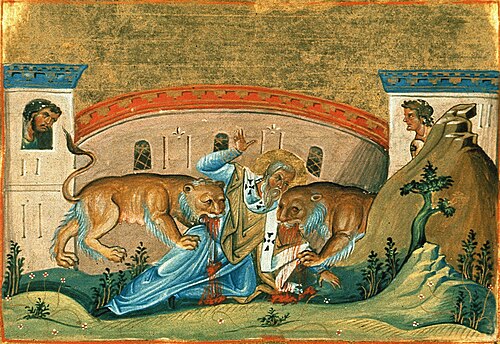
The holy Hieromartyr Ignatius the God-bearer, Ignatius of Antioch, was bishop of Antioch in Syria, a disciple of the holy Apostles and one of the Apostolic Fathers. Condemned in the time of Emperor Trajan, he was taken to Rome and given to the wild beasts around 107. On the way he wrote seven epistles that are among the most precious witnesses of the Church after the apostles.
Disciple of the apostles
Little is known of his life before he became bishop; nearly everything comes from his letters and later traditions. Tradition names him, together with Saint Polycarp of Smyrna, a disciple of the holy Apostle and Evangelist John the Theologian. The synaxarion says he was the second bishop of Antioch, succeeding Saint Evodius, one of the Seventy; the historian Eusebius likewise says that he followed Evodius. Theodoret of Cyrrhus adds that Peter himself left directions that Ignatius be appointed to the see.
He is called Theophorus, the God-bearer, either because he bore God in his heart and prayed unceasingly, or, according to tradition, because he was the child whom the Saviour took in His arms and placed before the disciples, saying that unless you turn and become like children you will not enter the Kingdom of Heaven. Orthodox tradition also credits him with introducing the antiphonal singing of two choirs in the services, after a vision of angels praising God in turn.
Confession and the road to Rome
In the time of Trajan a persecution began, and in 107 the emperor passed through Antioch. He was told that Bishop Ignatius openly confessed Christ and taught people to despise riches and to live in virtue and chastity. The saint came before the emperor of his own will, so as to turn the persecution away from the Christians of Antioch. He refused to sacrifice to the idols, and was condemned to be thrown to the beasts at Rome.
He was taken under guard of ten soldiers, whom he himself called leopards, across Asia Minor. From Seleucia the ship put in at Smyrna, where he met Saint Polycarp. Believers from other cities came to ask his blessing, and he urged them not to fear death. At Troas he heard that the persecution at Antioch had ended; then he passed through Neapolis and Philippi.
On the way he wrote seven epistles: to the Ephesians, Magnesians, Trallians, Romans, Philadelphians, Smyrnaeans and to Polycarp. Saint Polycarp mentions a collection of them in his own letter to the Philippians, and Saint Irenaeus of Lyons quotes from the letter to the Romans. In them he calls for unity around the bishop, with the presbyters and deacons, and confesses the true Incarnation of Christ. He calls the Holy Eucharist the medicine of immortality. In the epistle to the Smyrnaeans stands one of the earliest uses of the words catholic Church: where the bishop appears, there let the people be, as where Jesus Christ is, there is the catholic Church. In the epistle to the Romans he begs them not to try to save him from death, for he wished to be God's wheat, ground by the teeth of beasts.
Martyrdom
On 20 December, the day of a pagan festival, he was led into the arena. The synaxarion says he turned to the crowd: Men of Rome, you know that I am sentenced to death not because of any crime but because of my love for God, by Whose love I am embraced. The lions tore him apart, leaving only his heart and a few bones. According to tradition, on the way to the arena he kept repeating the name of Jesus Christ, and when asked why, said that this name was written in his heart. After his death, the pagans cut open the unharmed heart and found on it, in letters of gold, the name Jesus Christ. It is said he appeared to many of the faithful in sleep to comfort them, and that Trajan, hearing of his courage, ended the persecution.
Modern scholars do not agree on the date of the martyrdom; tradition places it under Trajan, and some researchers set it later, in the second century.
Relics and veneration
The Christians gathered the remaining bones and carried them to Antioch, where they were laid outside the gate of Daphne. According to tradition, the relics were moved into the city in 438. After the capture of Antioch by the Persians or the Arabs they were returned to Rome, to the church of Saint Clement, in 540 or in 637 according to other sources. The translation of the relics is kept on 29 January.
The Orthodox Church commemorates him on 20 December, Western churches on 17 October. In Romania, 20 December is also known as Ignat, when the slaughter of the pig is customary, a folk custom tied to this day.
Commemorated the same day December 20
 Rabbula of EdessaVenerable · Bishop of EdessaDec 20
 Philogonius of AntiochSaint · Bishop of AntiochDec 20
 Danilo II of SerbiaSaint · Archbishop of SerbiaDec 20
 Anthony SmirnitskySaint · Archbishop of VoronezhDec 20
- Liberatus of RomeMartyrDec 20
- Ignatius MarkovMartyrDec 20
- Adventor of TurinMartyrDec 20
- Barbara ChernyshevaMartyrDec 20
- DiarmaitSaintDec 20
- Dominic of BresciaSaint · Bishop of BresciaDec 20
- FaoithleglanSaintDec 20
- FeidlimidhSaintDec 20