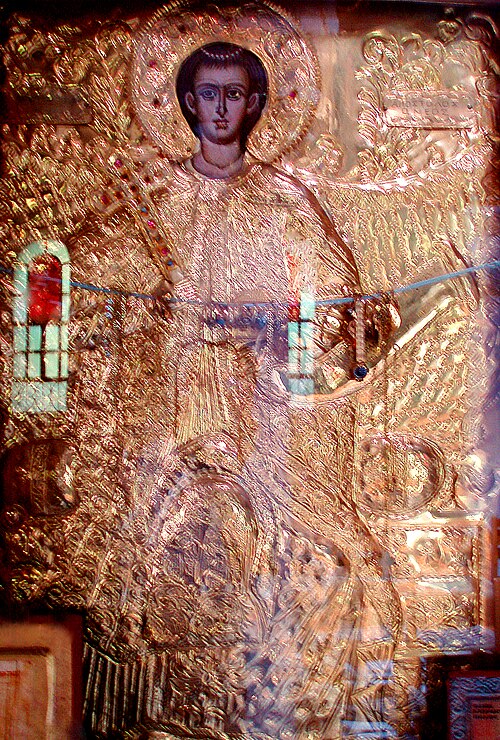
New Martyr
Apostolos the New
Young man from Pelion, orphaned at fifteen, who confessed Christ and was martyred at Constantinople in 1686.
Life
Saint Apostolos the New, New Martyr, was a young Greek from Pelion, put to death for his faith in Christ at Constantinople in 1686, at nineteen. He was born in 1667 at Agios Lavrentios in Magnesia, was orphaned at fifteen and worked as a helper in a tavern in Constantinople. He was beheaded near the Golden Horn, and the Church commemorates him on 16 August. His head is kept today in the Metropolis of Demetrias, in the region where he was born.
Childhood and the move to Constantinople
His name was Apostolos Stamatiou. His father was Kostas Stamatiou and his mother Melo. The Greek and Serbian sources say he was born at Agios Lavrentios on Pelion, in Magnesia (the Serbian one puts it in Thessaly). At fifteen he was left an orphan, and in 1682 he went to Constantinople, where he worked in a tavern. He knew Turkish well.
The affairs of his village
After about four years in the city, the people of his home village, weighed down by unjust taxes, decided to go to the sultan's commissioners and ask for a reduction. They chose a delegation of villagers to represent them and did obtain some relief, after which they returned. The voivode, however, did not accept the commissioners' documents, judged them forgeries, arrested three members of the delegation, took them himself to Constantinople and demanded that they be imprisoned for high treason.
Learning this, their fellow villagers sent another delegation to Constantinople to appeal to the sultan's mother (Valide Hanım Kösem) for their release. They did not know how or where to go, so Apostolos offered to help them, since he also knew Turkish. He took the petition the villagers had written and gave it to a high official of the sultan. That official, however, had already received orders from the voivode of Pelion. Apostolos was arrested and handed to the voivode, to be punished for his boldness. The voivode ordered him chained and demanded from him the tax of four years, for the time he had been away from the village. But he feared that the rest of the delegation might appeal to the sultan's mother herself, and he thought in the end of letting the three prisoners go, and Apostolos too. A fellow villager of Apostolos, out of envy that a poor and insignificant boy might be regarded as the benefactor of his place, slandered him, saying that he had stirred up the whole affair and that, if freed, he would surely speak ill of the voivode at the palace. Then the voivode ordered that he be tortured without mercy until death.
The attempt to make him renounce
After an unsuccessful attempt to escape, the voivode tried to force him to become a Muslim, beginning with circumcision, but did not succeed. Apostolos said he was a Christian and would not change his faith. He was then taken to high religious officials, who also tried to persuade him, promising wealth and glory, but Apostolos did not yield. He only said to them: "Do not delay and waste your time, what you have to do, do quickly. Whatever death you give me, I will accept most willingly for my Christ. So do not delay. Do you want to burn me? Let me gather the wood and prepare the fire. Do you want to hang me? Let me make the noose with my own hands. Do you want to behead me? Give me the sword and I will sharpen it as much as needed." Having achieved nothing, the vizier finally ordered him beheaded.
The witness
After a night of torment he was led, before dawn, to a place near the Golden Horn and waited there for the executioner. The executioner struck him first three times on the neck with his weapon, then seized him by the hair and cut off his head. Apostolos bore witness at nineteen, on 16 August. The Serbian source gives the year 1684, but if he was born in 1667 and was nineteen, the fitting year is 1686. Books on his life say that after the execution the men who had carried out the sentence saw from afar a great crowd going toward his body, and, thinking they were Christians, ran there, but saw no one, only the dead body. They threw the body into the sea and brought the head to the vizier as proof of the execution.
Veneration
The Christians who had seen the martyrdom asked, through the Patriarchate, for the head, so that they might bury it. When it was given to them, they put it in a silver case and gave it to the church of Saint Demetrius at Tatavla (now Kurtulus). Later, a fellow villager of Apostolos took the head and carried it to his homeland, to the saint's house, which by then had become a church in his honour. Today the head is in the Holy Metropolis of Demetrias and Almyros, in Magnesia. The Orthodox Church counts him a saint, and he is commemorated on 16 August.
Commemorated the same day August 16
 Constantine BrancoveanuMartyr · Prince of WallachiaAug 16
 Diomedes of TarsusMartyr · Unmercenary physician, martyr of TarsusAug 16
 Joseph the HesychastVenerable · Athonite elderAug 16
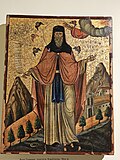 Gerasimos of KefaloniaVenerable · Patron of KefaloniaAug 16
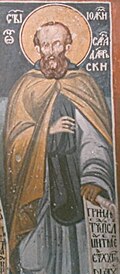 Joachim of OsogovoVenerable · Hermit of Mount OsogovoAug 16
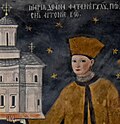 Maria BrâncoveanuRight-Believing · Princess of WallachiaAug 16
- Chaeremon of NitriaVenerableAug 16
- Cosmas II of NaplesSaint · Bishop of NaplesAug 16
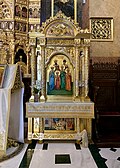 Ianache VăcărescuMartyr · Grand Treasurer of WallachiaAug 16
 Matthew BrâncoveanuMartyr · Son of Constantin BrâncoveanuAug 16
 Radu BrâncoveanuMartyr · Son of Constantin BrâncoveanuAug 16
- Raphael of BanatVenerableAug 16