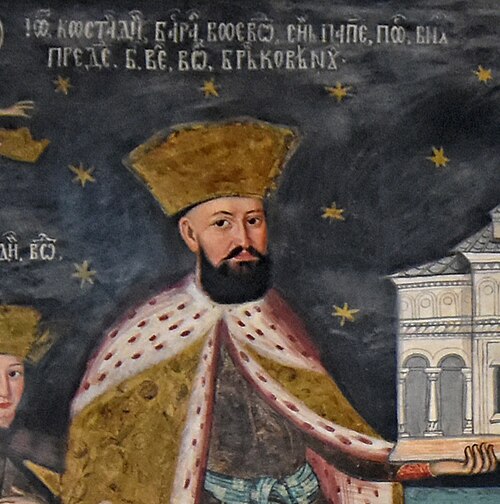
Martyr
Constantine Brancoveanu
Prince of Wallachia
Prince of Wallachia from 1688 to 1714, builder of churches, martyred by the Ottomans in Constantinople.
Life
Saint Constantine Brâncoveanu, martyr, was prince of Wallachia between 1688 and 1714, a builder of churches, put to death by the Turks at Constantinople because he would not renounce the Orthodox faith. He is commemorated on 16 August, together with his sons, as the Holy Martyrs Brâncoveanu.
His reign
He was born in 1654, at Brâncoveni, in Oltenia, in a family of Craiovești boyars, related on his mother’s side to the Cantacuzinos. He grew up in the house of his uncle, the stolnic Constantin Cantacuzino, and became prince in 1688, after the death of his uncle, Prince Șerban Cantacuzino. In his reign Wallachia knew a long time of peace and a flowering of culture, spiritual life and art: he moved the seat to Bucharest, built Mogoșoaia and many monasteries, among them Hurezi, in a style that bears his name, and opened printing houses and schools. He paid the tribute to the Turks patiently and kept a measured course among the powers of the time, the Porte, the Habsburgs and Russia. He sought, without committing himself, alliances against the Turks, but had to return the gifts he had received from Tsar Peter.
The arrest
His policies were denounced to the Porte. Sultan Ahmed III deposed him in April 1714 and brought him with his whole family to Constantinople, where he was imprisoned at Yedikule, the Seven Towers, and tortured to make him tell where his fortune was. It is said that the intrigues of the Cantacuzinos contributed to his fall.
Martyrdom
On 15 August 1714, the feast of the Dormition of the Mother of God, when Brâncoveanu was also turning sixty, he, his four sons, Constantine, Stephen, Radu and Matthew, and the counsellor Ianache Văcărescu were brought before the sultan, in the presence of the envoys of Austria, Russia, France and England. After his fortune was taken, he was asked, in exchange for his life and his family’s, to renounce the Orthodox faith. It is said he told his sons: “Behold, all my riches and all I had I have lost. Let us not lose our souls too. Be strong and manly, my beloved. Do not fear death. Look how much Christ, our Savior, endured for us and with what shameful death he died. Believe firmly and do not waver and do not leave your faith for this life.” The four sons and Ianache were cut down before their father. It is told that little Matthew, twelve years old, wept in fear and asked to renounce the faith, but his father said that none of their kin had lost their faith and that it was better to die a thousand times than to leave the ancestral faith. Matthew listened and gave his head. Last of all Brâncoveanu was beheaded. The heads were carried on the points of spears, and the bodies were thrown into the Bosporus. According to tradition, Christian fishermen took them from the water and buried them at the Halki monastery, near the city.
Veneration
The Romanian Orthodox Church numbered him among the saints in 1992, with the name Holy Martyrs Brâncoveanu, and the Russian Church received him into its calendar in 2018. His remains were placed in 2014 in a reliquary, three hundred years after his death.
Commemorated the same day August 16
 Diomedes of TarsusMartyr · Unmercenary physician, martyr of TarsusAug 16
 Joseph the HesychastVenerable · Athonite elderAug 16
 Gerasimos of KefaloniaVenerable · Patron of KefaloniaAug 16
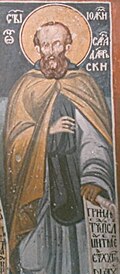 Joachim of OsogovoVenerable · Hermit of Mount OsogovoAug 16
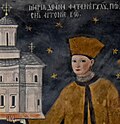 Maria BrâncoveanuRight-Believing · Princess of WallachiaAug 16
 Apostolos the NewNew MartyrAug 16
- Chaeremon of NitriaVenerableAug 16
- Cosmas II of NaplesSaint · Bishop of NaplesAug 16
 Ianache VăcărescuMartyr · Grand Treasurer of WallachiaAug 16
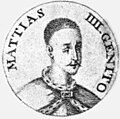 Matthew BrâncoveanuMartyr · Son of Constantin BrâncoveanuAug 16
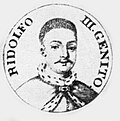 Radu BrâncoveanuMartyr · Son of Constantin BrâncoveanuAug 16
- Raphael of BanatVenerableAug 16