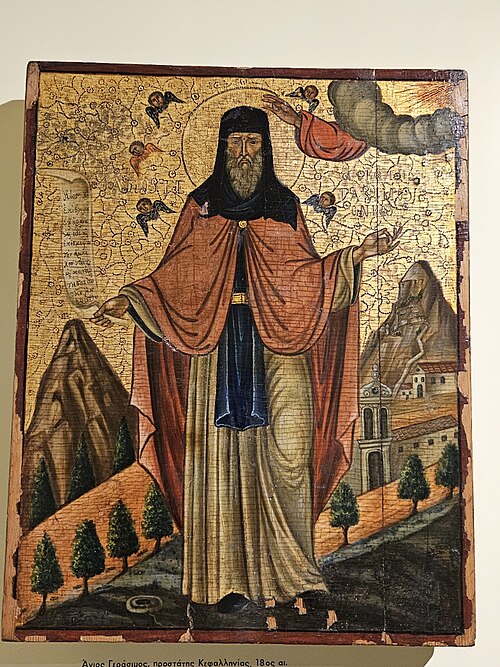
Venerable
Gerasimos of Kefalonia
Patron of Kefalonia
Patron saint of the island of Kefalonia in Greece, a monk who lived from 1506 to 1579.
- Feast
- August 16old style August 29
- Reposed
- 157916th century
- Place
- Omala municipal unit
- Order
- Venerables
Life
Saint Gerasimos of Kefalonia (1506-1579) is the patron of the Greek island of Kefalonia. A monk and priest who struggled on Mount Athos, in Jerusalem and on several islands, he founded a convent in the mountains of Kefalonia and became, for the islanders to this day, a living helper of the sick and afflicted.
Origins and monastic life
He was born in 1506 at Trikala in Corinthia, in the Peloponnese, to Demetrios and Kali, in a family of Byzantine descent, the Notaras. According to some sources his grandfather, Luke Notaras, had been grand duke of the Byzantine Empire. In the Greek sources his name in the world was George. As a youth he left home, came in 1527 to Zakynthos to study, then travelled through many holy places and reached Constantinople. On Mount Athos he was tonsured a monk with the name Gerasimos, after Saint Gerasimos of the Jordan. Some sources say he was tonsured on Zakynthos and then lived as a hermit in a cave in the Kapsala desert on Athos.
Jerusalem and the islands
With his elder's blessing he set out on pilgrimage to Jerusalem, then visited holy places in Egypt, including Mount Sinai and Alexandria, and in Syria, including Antioch and Damascus. He returned to Jerusalem and for twelve years served at the Church of the Holy Sepulchre as keeper of the lamps. Patriarch Germanos of Jerusalem, a relative of his, ordained him deacon and priest. During these years he would withdraw from time to time to the Jordan desert, where he fasted for days on end.
Longing for solitude, he left Jerusalem around 1548 and spent two years on Crete. He then returned to Zakynthos, where for five years he lived in a cave in fasting, nourished, says his life, only by herbs.
On Kefalonia
Around 1555 he came to Kefalonia and lived more than five years in a cave at Lassi, near Argostoli today. He then went to the mountainous country near Valsamata, on the Omala plateau at the foot of Mount Ainos. There, at a ruined chapel of the Dormition of the Mother of God, he founded in 1559 or 1560 a convent called New Jerusalem, which cared for the poor and became a centre of charity. The faithful came to hear his word, and his fame as a healer of the sick and a driver out of unclean spirits spread far.
Tradition says he knew his end beforehand. After blessing the nuns he fell asleep in the Lord on 15 August 1579, watched over by Fathers Ioanikios and Germanos and by the abbess Laurentia. His last words, according to tradition, were an exhortation to peace among the faithful and to humility. He was buried beside the south wall of the church.
Relics and veneration
The saint's body was exhumed in 1581 and again in 1582, at the request of Venetian authorities who doubted its incorruption. Both times it was found whole, and since then his holy relics have been kept in a silver shrine in the monastery. He was glorified in 1622.
On Kefalonia many boys bear his name, and many women are called Gerasimoula. The faithful believe he protects and heals them, and after the powerful earthquake of 1953, which destroyed most of the island, many said they had seen him comforting and tending the injured in their houses. The convent, the largest on the island, bears his name, and beside the church of the relics stands a huge plane tree which the saint is said to have planted. With many Kefalonians living abroad, a church bearing his name was built in New York in the early twentieth century.
The saint is commemorated on 16 August, the day after the Dormition of the Mother of God, when his relics are carried over the sick, and on 20 October, an official holiday on the island.
Commemorated the same day August 16
 Constantine BrancoveanuMartyr · Prince of WallachiaAug 16
 Diomedes of TarsusMartyr · Unmercenary physician, martyr of TarsusAug 16
 Joseph the HesychastVenerable · Athonite elderAug 16
 Joachim of OsogovoVenerable · Hermit of Mount OsogovoAug 16
 Maria BrâncoveanuRight-Believing · Princess of WallachiaAug 16
 Apostolos the NewNew MartyrAug 16
- Chaeremon of NitriaVenerableAug 16
- Cosmas II of NaplesSaint · Bishop of NaplesAug 16
 Ianache VăcărescuMartyr · Grand Treasurer of WallachiaAug 16
 Matthew BrâncoveanuMartyr · Son of Constantin BrâncoveanuAug 16
 Radu BrâncoveanuMartyr · Son of Constantin BrâncoveanuAug 16
- Raphael of BanatVenerableAug 16