Saint
Arbogast of Strasbourg
Bishop of Strasbourg
Missionary in the Frankish realm and bishop of Strasbourg in the seventh century.
Life
The Holy Hierarch Arbogast of Strasbourg was a missionary in the Frankish realm and bishop of Strasbourg in the seventh century, venerated from early times as the one who brought Christianity to Alsace. His feast is on 21 July; Orthodox faithful of the Diocese of Berlin and Germany honour him on 3 August.
What is known
Only a little of his life can be said with certainty: that he came to Francia, was made bishop of Strasbourg, and from the early Middle Ages was venerated as the saint who brought Christianity to Alsace; for this reason the name Arbogast became very popular in the region. The sources are mostly legends and traditions, with accounts that contradict each other. His origin is given in various ways: Scotland or Ireland (where he would have borne the name Arascach), Aquitaine or Francia, or southern France. It is said that around 550 he arrived in Alsace as a missionary and settled in a wooded place near Hagenau. His Life, written in the tenth century by Bishop Udo IV of Strasbourg, says he found a warm friend in the Merovingian king Dagobert; on Dagobert's accession, Arbogast was made bishop of Strasbourg and was famed for holiness and miracles. Other sources (in which the king is called Dagobert II, 676-679) say he was appointed bishop after the miracle below, in place of Bishop Solarius, who had fallen asleep.
The raising of the king's son
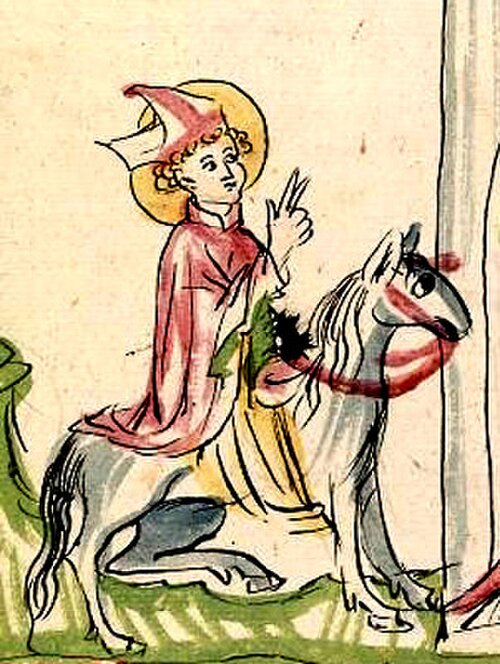
According to the Life, Siegebert, the king's son, was killed on a boar hunt in the forests along the river Ill, near Ebersheim. Separated from the others, he met a boar; his horse took fright, reared, threw him and trampled him, his foot caught in the stirrup. His companions found him and took him home, where he died the next day. The king summoned Arbogast, and the saint prayed to the Mother of God: if she had carried the life of the whole world, would she not intercede for the life of this one child? Siegebert stood up in his burial shroud. When the king offered him money as a reward, Arbogast declined, asking instead that land be given to build a cathedral at Strasbourg.
Bishop at Strasbourg
As bishop he built churches and monasteries and laboured for the flourishing and widening of the city. The Church regards him as the foremost spreader of Christianity in Alsace. He also founded the monastery at Surbourg, in Alsace. Many miracles are told: it is said he crossed a river walking dry-shod on the water, healed the sick, drove out demons and reconciled enemies. He made himself a small hermitage outside the city, on the bank of the river Ill, to which he often resorted. He fell asleep at Strasbourg, in 678 (in other sources around 618 or 658). Saint Florentius succeeded him in the see. According to the Life he was buried outside the city, either in the old Roman necropolis or on Hangman's Hill, where the gallows stood and only malefactors were buried; the site was later judged fit for a church, and a chapel in honour of Saint Michael was built there. Later, at the city gates, the monastery that bears his name was founded.
Patronage and pilgrimage
Arbogast is the patron of Strasbourg and its diocese, and of other places (Rufach, Muttenz, Oberwinterthur), and he appears on the coat of arms of Batzendorf. The faithful pray to him for pains in the feet, weariness and low spirits. On 21 July hundreds of pilgrims come to pray in the cathedral of Strasbourg and in the monasteries that keep his relics, Surbourg and Saint-Arbogast, near Strasbourg. Since 2006 Orthodox pilgrims from Germany have also begun to come to his relics.
Commemorated the same day July 21
 EzekielProphet · The ProphetJul 21
 Victor of MarseillesMartyrJul 21
 Simeon the Holy FoolFool-for-ChristJul 21
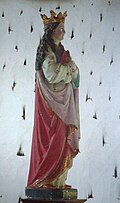 TryphineSaint · Breton saintJul 21
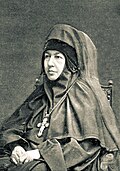 Arsenia SebryakovaVenerable · Abbess of Ust-Medveditsa ConventJul 21
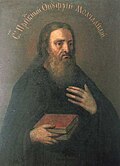 Onuphrius the SilentVenerable · Monk of the Near CavesJul 21
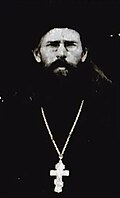 Gregory ZlatorunskyHieromartyr · PriestJul 21
 Meletios of KitrosHieromartyr · Bishop of KitrosJul 21
- AcaciusMartyrJul 21
- Curcach of Cill CurcaigheVenerableJul 21
 Éterne of ÉvreuxSaintJul 21
- EugeneMartyrJul 21