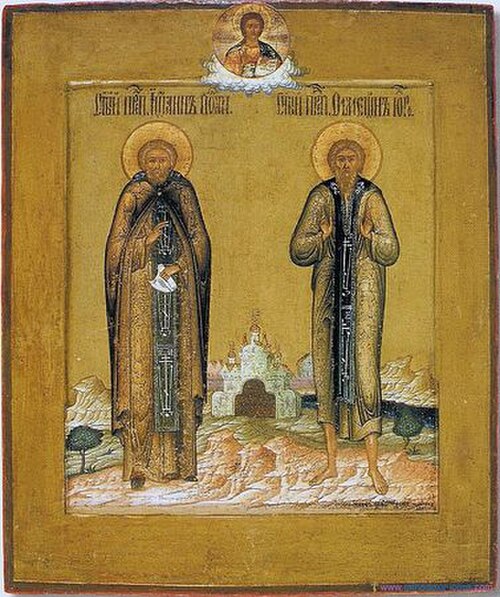
Fool-for-Christ
Simeon the Holy Fool
Monk and hermit of Byzantine-Syrian origin, a fool for Christ at Emesa in the sixth century.
- Feast
- July 21old style August 3
- Reposed
- 5886th century
- Place
- Emesa
- Order
- Fools-for-Christ
Life
Saint Simeon of Emesa, also called Simeon the Fool for Christ, was a monk and hermit of Byzantine-Syrian origin of the sixth century, one of the first fools for Christ. He is venerated by the Orthodox and Catholic Churches. His feast is on 21 July (3 August, new style).
The years of his life are not certain: Evagrius Scholasticus makes him a contemporary of Justinian, and Leontius of Neapolis places him in the time of Maurice. He is said to have been born into a well-to-do family at Edessa, where he lived, unmarried, with his aged mother, until twenty or thirty. He became a monk at the monastery of Abba Gerasimus, in Syria, with his friend and fellow ascetic John of Edessa. Simeon and John spent about twenty-nine years in the desert near the Dead Sea, in fasting and prayer. Then Simeon, urged by God, say the sources, went to Emesa to serve people. It is said that he asked the Lord to be able to serve in such a way that people should not know him. At Emesa, simulating madness and overturning conventional rules, he brought many to repentance, drew them from sin and turned them to the faith.
He entered the city, after many years in the desert, dragging a dead dog. Schoolchildren saw him and shouted: Hey, a crazy abba. The next day, a Sunday, he entered the church, put out the lights and threw nuts at the women. Going out, he overturned the tables of the pastry sellers. For this foolery he endured insults, abuse and beatings, which he bore patiently. Nevertheless, by prayer he healed many possessed, fed the hungry, preached the Gospel and helped the needy of the city; many holy deeds he did in secret. Leontius's account says that he healed a man with diseased eyes by anointing them with mustard, which blinded him, and afterward the eyes were healed on Simeon's advice, who thus showed him his sins and brought him to amendment. He pretended now to limp, now to hop, now to drag himself along on his buttocks, now to trip a man running; at the new moon he looked at the sky, fell and thrashed about; he revealed people's sins, changing his voice and appearance, and gave prophecies. His aim, according to the sources, was to save souls by this mockery; he also wished to hide his virtue, so as not to receive praise and honour from people.
He died around 570 (in other sources, 588) and was buried by the poor of the city, in the place appointed for strangers and the homeless. Some witnesses say that, as the body was carried to the grave, church singing of unknown origin was heard. Only after his death was the secret of his madness learned, which shook the people of Emesa and brought many to repentance. His life was written by Leontius of Neapolis, who symbolically compared his life to that of Christ. According to Bishop Kallistos Ware, it contains the most characteristic ideas of the Orthodox tradition about the fool for Christ.
Commemorated the same day July 21
 EzekielProphet · The ProphetJul 21
 Victor of MarseillesMartyrJul 21
 Arbogast of StrasbourgSaint · Bishop of StrasbourgJul 21
 TryphineSaint · Breton saintJul 21
 Arsenia SebryakovaVenerable · Abbess of Ust-Medveditsa ConventJul 21
 Onuphrius the SilentVenerable · Monk of the Near CavesJul 21
 Gregory ZlatorunskyHieromartyr · PriestJul 21
 Meletios of KitrosHieromartyr · Bishop of KitrosJul 21
- AcaciusMartyrJul 21
- Curcach of Cill CurcaigheVenerableJul 21
 Éterne of ÉvreuxSaintJul 21
- EugeneMartyrJul 21