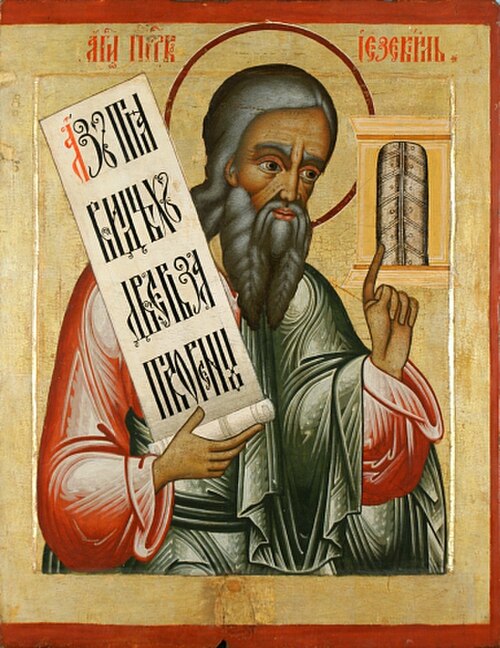
Prophet
Ezekiel
The Prophet
Prophet and priest of Israel, who received the visions recorded in his book during the Babylonian exile.
Life
The Holy Prophet Ezekiel was a priest and prophet in the time of the Babylonian captivity, the one to whom the visions in the book that bears his name were given. He is one of the four great prophets. The Church commemorates him on 21 July.
Who he was
According to the Synaxarion, he was born in the city of Sarir, of the tribe of Levi, the son of the priest Buzi. In the second siege of Jerusalem, in 597 before Christ, he was carried to Babylon at the age of twenty-five, together with King Jehoiachin and many other Jews. He lived in captivity by the river Chebar, at Tel Abib. His book mentions no children; his wife died in the years of the fall of Jerusalem (Ezekiel 24:15-18).
The vision of glory
In the thirtieth year, by the Chebar, the future of the people and of mankind was revealed to him. He saw a shining cloud with fire, and in the midst of the fire something like gleaming bronze. He saw four living creatures with four faces, of a man, a lion, an ox and an eagle, and beside them wheels full of eyes. Above them was a firmament like crystal, then a throne like sapphire, and on the throne a likeness as of a man, surrounded by a rainbow (Ezekiel 1:4-28).
According to the explanation of the holy Fathers, the human likeness on the sapphire throne prefigures the Incarnation of the Son of God from the most holy Virgin Mary, who is the living throne of God. The four creatures are the four Evangelists: the man (Matthew), the lion (Mark), the ox (Luke) and the eagle (John). The wheels with many eyes show the light given to all the nations of the earth. The prophet fell to the ground in fear, but the voice of God commanded him to rise and sent him to proclaim to the people of Israel. This was the beginning of his service.
The prophecies
Ezekiel announced to the people in exile the trials that would come for forsaking God, but also better times: the return from Babylon and the renewal of the Temple. His last dated prophecy is from April 571 before Christ, fifteen years after the destruction of Jerusalem, and his ministry lasted about twenty-two years. The book has three parts: prophecies against Jerusalem and its rulers, against the nations (especially Tyre and Egypt), and prophecies of renewal and hope.
Two visions are especially important. That of the Temple full of glory was interpreted as a foreshadowing of mankind freed from the work of the enemy and of the building of the Church of Christ. The closed gate through which only the Lord, the God of Israel, will enter (Ezekiel 44:2) is a prophecy of the Virgin, who bore Christ and remained a virgin; this reading is chanted at Vespers of the feasts of the Mother of God. The vision of the dry bones in the valley, to which the Spirit of God gave new life (Ezekiel 37:1-14), foretells the resurrection of all the dead and the new life granted through the Cross of the Lord.
Saint Demetrius of Rostov teaches from the book that if the righteous man turns from righteousness and sins, he will die in his sin, while the sinner who repents and keeps the commandments will not die (Ezekiel 3:20; 18:21-24).
Miracles and end
The prophet received from the Lord the gift of working miracles. Like Moses, he divided the waters of the river Chebar, and the Hebrews crossed to the other bank, escaping the pursuit of the Chaldeans. In a time of famine he asked God to increase the food of the hungry.
Because he rebuked a Hebrew prince for idolatry, he was condemned to death: bound to wild horses, he was torn apart. Pious Hebrews gathered the body and buried it on the plain of Maur, in the tomb of Shem and Arphaxad, forefathers of Abraham, near Baghdad. A tomb honoured by Jews at Al Kifl in Iraq is also held to be his burial place.
Commemorated the same day July 21
 Victor of MarseillesMartyrJul 21
 Simeon the Holy FoolFool-for-ChristJul 21
 Arbogast of StrasbourgSaint · Bishop of StrasbourgJul 21
 TryphineSaint · Breton saintJul 21
 Arsenia SebryakovaVenerable · Abbess of Ust-Medveditsa ConventJul 21
 Onuphrius the SilentVenerable · Monk of the Near CavesJul 21
 Gregory ZlatorunskyHieromartyr · PriestJul 21
 Meletios of KitrosHieromartyr · Bishop of KitrosJul 21
- AcaciusMartyrJul 21
- Curcach of Cill CurcaigheVenerableJul 21
 Éterne of ÉvreuxSaintJul 21
- EugeneMartyrJul 21