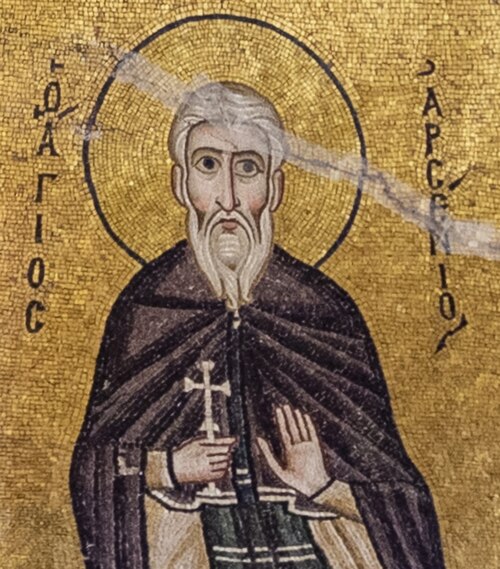
Venerable
Arsenius the Great
Hermit of Egypt
Tutor of the emperor's sons who became a hermit in Egypt, one of the most revered Desert Fathers.
- Feast
- May 8old style May 21
- Reposed
- 4495th century
- Place
- Memphis
- Order
- Venerables
Life
Saint Arsenius the Great, venerable, was tutor of the emperor’s sons, who became a hermit in Egypt and is one of the most venerated Fathers of the desert. His contemporaries called him “the Great”. He fell asleep around the year 445-449. He is commemorated on 8 May, and in the Catholic Church, before the new arrangement, on 19 July.
Youth and the court
Arsenius was born around 354, at Rome, in a Christian senatorial family, and received a fine education in rhetoric and philosophy, knowing Latin and Greek well. As a young man he was a cleric at a church of Rome and received the rank of deacon. According to tradition, Pope Damasus recommended him to the emperor Theodosius the Great, who had asked for a tutor for his sons, Arcadius and Honorius, and Arsenius was chosen, as a man well read in Greek literature. He reached Constantinople in 383 and was tutor to the imperial family eleven years. It is told that when Theodosius came one day to see his sons at their studies, he found them seated while Arsenius spoke to them standing, and ordered that the teacher sit and the pupils stand. At court he was given a great house and lived in plenty, but felt ever more strongly the wish to leave the world. Another source says that one day he punished Arcadius for a fault, and that Arcadius wished to take revenge, and Arsenius, learning of it, put on a beggar’s clothes and fled.
In the desert of Scetis
In 394 he left Constantinople in secret, on a ship for Alexandria, and withdrew into the desert. He presented himself to Saint Macarius the Great, father of the monks of Scetis, who entrusted him for testing to John the Dwarf. John, although he had been told who the guest was, took no notice of him and left him standing, while the others were invited to table. When the meal was half over, he threw him a piece of bread, saying carelessly that he might eat, if he wished. Arsenius picked up the bread with humility and ate, sitting on the ground. Satisfied with the proof of humility, John kept him under his guidance and tonsured him a monk. Arsenius accepted the rule and withdrew into his cell, coming out to the brothers only for the services.
The hermit’s life
In fifty-five years of hermit life he was always the poorest clad of all, punishing himself for his former apparent vanity. To atone for the perfumes of the court, he did not change the water in which he soaked the palm leaves from which he wove mats, but only poured fresh water over it, so that it smelled heavy. Even at work he did not slacken in prayer. Tears of devotion flowed always from his eyes. Above all he shunned whatever might disturb his union with God. When, after a long search, the place of his retreat was found, he would not return to court as counsellor to his former pupil, the emperor Arcadius, nor be his almoner for the poor. He received no one, however great, and left his disciples to receive them. When he was told that a wealthy relative had died and left him all his property, he answered: “I died before him; how can I be his heir?” He remained silent. A saying of his goes: “Many times I have repented of having spoken, but never of having been silent.” To keep from growing slack, he always asked himself: “Arsenius, why did you come to the desert?”
Moves and repose
In 434 the raids of the Mazices, a people of Libya, forced him to leave Scetis. He moved to Troe, near Memphis, and stayed some time on the island of Canopus, near Alexandria. For the next fifteen years he wandered the desert, before returning to Troe, where he fell asleep, around 445, aged about ninety-five, according to some sources; others give the years 448-449 and the age of a hundred. His life was written by Theodore the Studite.
Veneration
Most of what is known of him comes from the Paterikon, the collection of sayings of the Fathers of the desert. Several writings are also attributed to him, among them Instruction and Exhortation for monastic life, and a letter of his survives in Georgian. For monastic tradition he is among those who fled the world most clearly, a model of the hesychasts. His office is sung together with that of the holy apostle John the Theologian, on 8 May. In the Menaion of May he has several stichera and a canon, and the Canon of the Fathers of Cheesefare Saturday mentions him: “Arsenius, angel, power of silence, pray to Christ God for us sinners.”
Commemorated the same day May 8
 Benedict II of RomeSaint · Bishop of RomeMay 8
 Boniface IV of RomeSaint · Bishop of RomeMay 8
 Emmelia of CaesareaVenerable · Mother of St. Basil the GreatMay 8
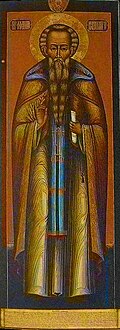 Philip of IrapVenerable · Founder of Irap HermitageMay 8
 Arsenius the Hard-workerVenerable · Monk of the Kiev CavesMay 8
- Helladius of AuxerreSaint · Bishop of AuxerreMay 8
 Pimen the Faster, AbbotVenerable · Abbot of the Kiev CavesMay 8
- Basil the ElderSaint · Father of Saint Basil the GreatMay 8
- AbranVenerableMay 8
- AdrianVenerableMay 8
- Adrian of VolokolamskVenerableMay 8
- Arsenios of VarnakovaVenerableMay 8