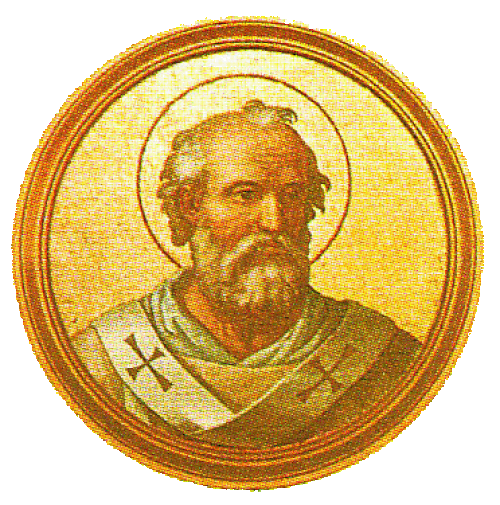
Saint
Boniface IV of Rome
Bishop of Rome
Bishop of Rome from 608 to 615, a former deacon under Gregory the Great, who consecrated the Pantheon as a church.
Life
Boniface IV of Rome was bishop of Rome from 608 until 8 May 615. Born around 550 in Abruzzo, he served as a deacon under Saint Gregory the Great and is remembered for his care for monastic life and for consecrating the Pantheon as a church. He is venerated as a saint in the Roman Catholic Church; in the sources available to us he has no feast of his own in an Orthodox calendar.
Origin
His father, John, was a physician, and according to the Book of the Pontiffs his family came from the Marsi, from the town of Valeria. In the days of Saint Gregory the Great, Boniface was a deacon of the Roman Church and a dispensator, the first of the officials responsible for the estates of the Church. Like Gregory, he ordered the Lateran palace after the manner of a monastery.
Ministry
After the death of Boniface III the see stood empty for more than nine months, until the emperor in Constantinople approved the election. His consecration is dated in 608, either 25 August or 15 September.
With the permission of Emperor Phocas, Boniface received the Pantheon, the pagan temple built by Agrippa. On 13 May 609 he consecrated it in honour of the Virgin Mary and all the martyrs, the first time in Rome that a pagan temple became a church. It is said that twenty-eight cartloads of holy bones were taken from the catacombs and laid beneath the high altar.
In 610 Mellitus, the first bishop of London, came to Rome to seek counsel for the newly founded English Church. He took part in a synod on the life of monks and returned with its decisions and with letters from the pope to Archbishop Laurence of Canterbury, to King Ethelbert of Kent and to the Anglo-Saxons. The synod's decrees that survive are now judged spurious. Between 612 and 615 Saint Columbanus, living at Bobbio, wrote to the pope at the urging of the Lombard king Agilulf about the condemnation of the Three Chapters. He told him that he was suspected of heresy for having accepted the Fifth Ecumenical Council. No reply is known.
His years in office were troubled by famine, plague and floods, and the Romans blamed the pope for them.
Repose and veneration
Boniface turned his own house into a monastery, where he retired and fell asleep in the Lord on 8 May 615. Some sources give 25 May. He was buried in the portico of Saint Peter's, and his relics were moved three times, the last on 21 October 1603 into the new basilica. The Roman Catholic Church commemorates him on 8 May, the day entered in the Roman Martyrology, and 25 May was an older day of commemoration.
Commemorated the same day May 8
 Benedict II of RomeSaint · Bishop of RomeMay 8
 Arsenius the GreatVenerable · Hermit of EgyptMay 8
 Emmelia of CaesareaVenerable · Mother of St. Basil the GreatMay 8
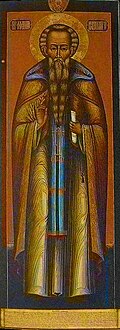 Philip of IrapVenerable · Founder of Irap HermitageMay 8
 Arsenius the Hard-workerVenerable · Monk of the Kiev CavesMay 8
- Helladius of AuxerreSaint · Bishop of AuxerreMay 8
 Pimen the Faster, AbbotVenerable · Abbot of the Kiev CavesMay 8
- Basil the ElderSaint · Father of Saint Basil the GreatMay 8
- AbranVenerableMay 8
- AdrianVenerableMay 8
- Adrian of VolokolamskVenerableMay 8
- Arsenios of VarnakovaVenerableMay 8