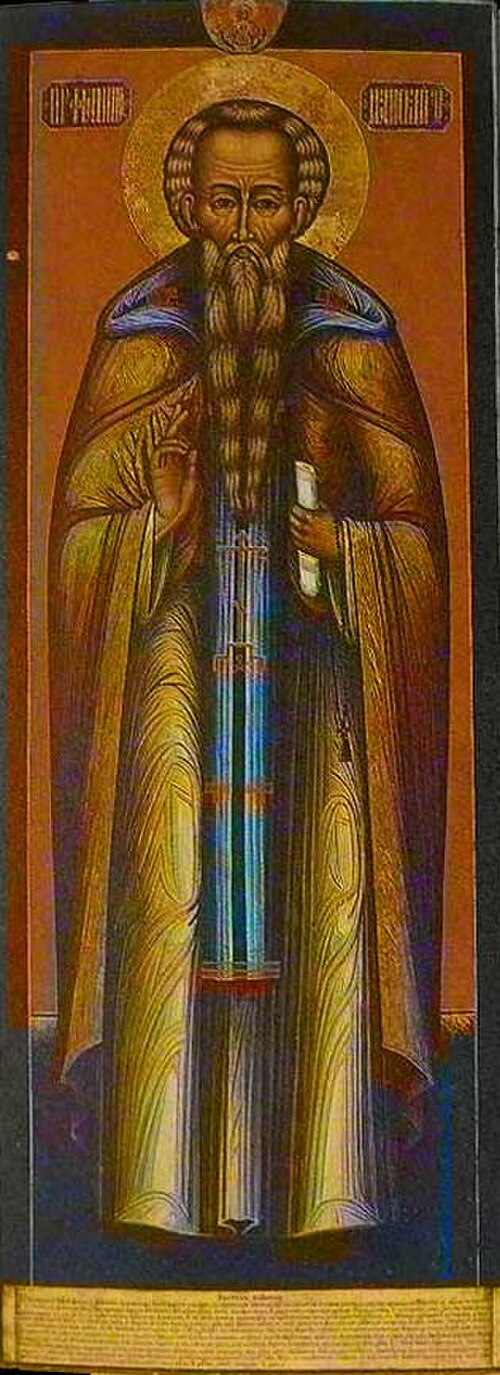
Venerable
Philip of Irap
Founder of Irap Hermitage
Disciple of Saint Cornelius of Komel, founder of the Irap Hermitage on the Andoga River; died in 1537.
- Feast
- May 8old style May 21
- Reposed
- 153716th century
- Place
- Vologda Governorate
- Order
- Venerables
Life
Venerable Philip of Irap (in the world Theophilus) was a Russian monk, born in 1493 and dead in 1537, a disciple of Saint Cornelius of Komel and founder of the Philip-Irap Krasnoborsk hermitage, on the river Andoga, in the Beloozero land. He is remembered on 8 May, the day of his arrival in the wilderness, and on 14 November, the day of his repose. His life was written by the monk Herman of the Spaso-Kamenny monastery, who lived for a time with the saint in his hermitage and wrote from his words.
The sources
The life was published and commented on by V. O. Klyuchevsky in 1879. A later copy, of the seventeenth century, was revised and somewhat confused the content. In this version posthumous miracles of the saint were added, occurring between 1661 and 1673. Herman's datings contain anachronisms, which causes some confusion in fixing the dates of the saint's life.
Early years
A peasant by birth, he was orphaned very young and did not remember his parents. In a famine he left his native place and lived on alms, until he settled near the monastery of Saint Cornelius, with a man called Vasily. From childhood he stood out for zeal in prayer and fasting, avoided children's games and went regularly to services. Saint Cornelius wished to see the boy and, after a talk with him, received him into obedience in his monastery. Theophilus was twelve then. After three years Cornelius tonsured him a monk with the name Philip. The training of the young monk was entrusted to a monk named Flavian, who taught him to read and the Holy Scripture. He did obediences in the church and in the bakery, and at night gave himself to prayer. Later, at the brethren's request, Cornelius made him a priest.
The Krasnoborsk hermitage
Wishing to escape human glory, Philip decided to leave the monastery and received for this the blessing of Saint Cornelius. After a time he set out north, in search of a place of quiet and prayer in solitude. On the way he spent the night at the Spassky monastery on Lake Kubenskoe, where he met the monk Herman, who would write his life.
After a long road, in a beautiful (red) pine forest on the bank of the river Andoga, in the Beloozero land, the saint chose the place of his solitude. Wishing to make a cell there, he applied to the local appanage prince Andrei Vasilyevich Sheleshpansky, asking leave to settle. The prince assigned the place at the mouth of the stream Maly Irap into the Andoga. Later he also gave the land between the Bolshoy and Maly Irap. This took place on 8 May 1517, on the commemoration of Saint John the Theologian. On the chosen place the saint set up a cell and a chapel in the name of the Holy Trinity. Soon the labours of the hermit drew many people to him, who came to seek spiritual counsel. With the help of the locals a church was soon built, consecrated in the name of the Holy Trinity. The prince gave the church a Gospel, an Apostle and the things needed for the service.
After fifteen years of struggle in solitude, the monk Herman of the Spaso-Kamenny monastery came to Philip's hermitage and asked leave to live and pray with the saint. For the last years Herman shared the monastic labours with Venerable Philip. Saint Philip passed to the Lord on 14 November 7046 (1537), on the commemoration of his heavenly patron, the Apostle Philip. The next day the hieromonk Job of the Alexander-Svirsky monastery came to the hermitage, and together they buried the body of Venerable Philip. Herman, after staying forty days in the hermitage, returned to Lake Kubenskoe. According to Herman, the saint lived forty-five years from his birth.
Veneration
The time of his glorification is not known exactly. It is known that in the second half of the seventeenth century he was venerated as a venerable saint, when the second redaction of the life was composed, to which a troparion and kontakion were added. Then too his icon was painted, after an older image sent by Princess Olga Krivoborskaya. Klyuchevsky supposes that local veneration began as early as the sixteenth century. The saint's commemoration was fixed on 8 May, the day of his arrival in the wilderness, and on 14 November, the day of his death.
Commemorated the same day May 8
 Benedict II of RomeSaint · Bishop of RomeMay 8
 Boniface IV of RomeSaint · Bishop of RomeMay 8
 Arsenius the GreatVenerable · Hermit of EgyptMay 8
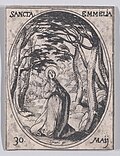 Emmelia of CaesareaVenerable · Mother of St. Basil the GreatMay 8
 Arsenius the Hard-workerVenerable · Monk of the Kiev CavesMay 8
- Helladius of AuxerreSaint · Bishop of AuxerreMay 8
 Pimen the Faster, AbbotVenerable · Abbot of the Kiev CavesMay 8
- Basil the ElderSaint · Father of Saint Basil the GreatMay 8
- AbranVenerableMay 8
- AdrianVenerableMay 8
- Adrian of VolokolamskVenerableMay 8
- Arsenios of VarnakovaVenerableMay 8