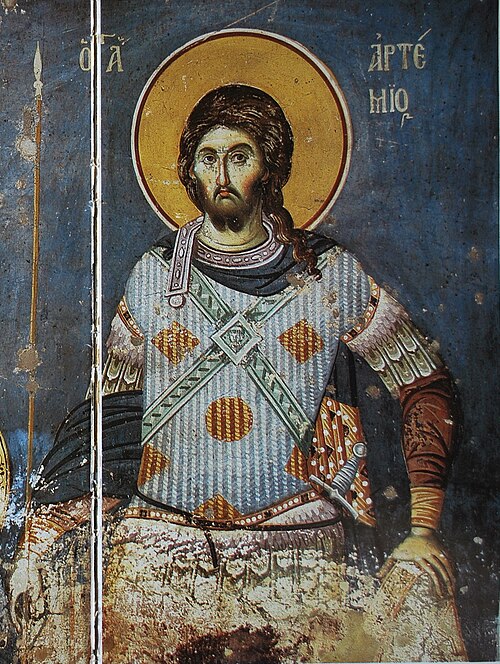
Great Martyr
Artemius of Antioch
Roman general, commander of Egypt
Roman general of Syrian birth, commander of Egypt, a great martyr who died in 362.
- Feast
- October 20old style November 2
- Reposed
- 3624th century
- Place
- Antioch
- Order
- Great Martyrs
Life
Saint Artemius the Great Martyr was a Roman general of Syrian birth (in some traditions, Egyptian), commander of Egypt (dux Aegypti), killed at Antioch in 362, in the time of the emperor Julian the Apostate. The Orthodox Church commemorates him on 20 October.
Few things are known with certainty of his life and death, and the Christian and pagan sources sometimes contradict one another. According to tradition he served in the army under Constantine the Great and then under his son Constantius. The story says that he saw the cross shown to Constantine and believed in Christ. In 360 he appears in a record of the senate of Oxyrhynchus as Flavius Artemius, with the rank of dux Aegypti. His life, from the seventh century, says he was sent to Greece to bring the relics of the Apostles Andrew, Luke and Timothy, which he took to Constantinople, but other sources do not mention him in these translations. Pagan and Syriac historians say that in Egypt he supported the Arian bishop George of Cappadocia, sacked the temple of Serapis and persecuted Saint Athanasius; Ammianus Marcellinus says he was executed in 362 for the crimes of which the Alexandrians accused him.
According to his martyrdom, when Julian became emperor and returned to paganism he summoned Artemius to Antioch. There he saw the emperor torturing two priests, Eugenius and Macarius, and spoke out in their defence, telling the emperor that he too was a man, of the same human nature, that the first author of evil is the devil, who had raised him against the Christians, but that the power of Christ is unconquerable. Julian ordered him imprisoned and tortured; he also accused him of the murder of his half-brother Gallus. Artemius steadfastly confessed the faith and was beheaded on 20 October 362. It is said he also prophesied the approaching death of Julian, who died the next year.
His body was taken by the Antiochene deaconess Arista, who carried it to Constantinople and placed it in the church of Saint John the Baptist, which then also took his name; healings took place there, especially of hernias. Toward the end of the seventh century a collection of miracles at his tomb was compiled. A particle of his relics was brought in 1073 to the Kyiv Caves Lavra.
Commemorated the same day October 20
 Gabriel of GeorgiaFool-for-Christ · Georgian MonkOct 20
 Nicholas LyubomudrovHieromartyr · PriestOct 20
 Herman KokelHieromartyr · Bishop of BlagoveshchenskOct 20
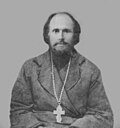 Zosimas PepeninHieromartyr · PriestOct 20
- John of BakuNew Martyr · Priest of BakuOct 20
- BarsabiasVenerable Martyr · Abbot and missionary in PersiaOct 20
- Acca of HexhamSaint · Bishop of HexhamOct 20
- Aderald of TroyesVenerableOct 20
- Aidan of MayoSaint · Bishop of MayoOct 20
- Alexander OrlovHieromartyrOct 20
- BachthesonMartyrOct 20
- BasilSaint · Bishop of TrebizondOct 20