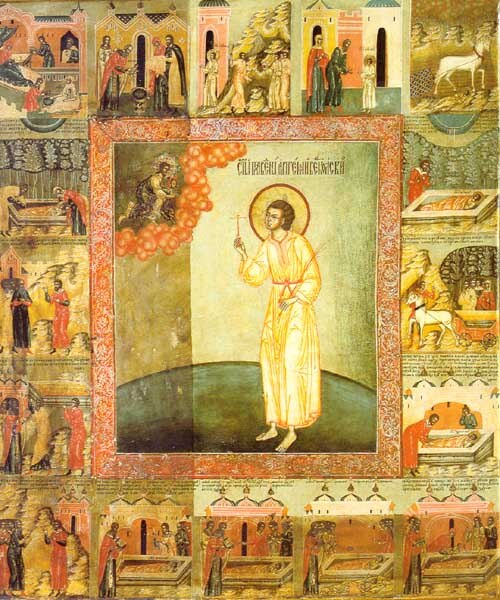
Righteous
Artemius of Verkola
Child saint
Russian child born in 1532 who died in 1545, venerated as a saint in the Russian Orthodox Church.
- Feast
- June 23old style July 6
- Reposed
- 154516th century
- Place
- Verkola
- Order
- The Righteous
Life
Saint Artemius of Verkola was a peasant boy of northern Russia who died at the age of twelve, in 1545, struck by a thunderstorm. The Church honours him as a young saint, known for the holiness of his short life and for the healings at his relics. He is commemorated on 23 June and 20 October.
Life
He was born in 1532 in the village of Verkola, in the Northern Dvina region, now in Pinezhsky District of Arkhangelsk Oblast. His father was named Kosma, nicknamed Maly, and his mother Apollinaria. According to tradition his sister was the righteous maiden Paraskeva of Piryma, also renowned for miracles after her death. All that is known of his life is what his Life says: that he shunned children's games and was gentle, God-fearing, obedient to his parents and diligent.
On 23 June 1545, when he was twelve, he was harrowing a field with his father. A strong thunderstorm began, lightning struck, and Artemius fell dead. According to the Life the immediate cause was not the lightning itself but the boy's terror of the storm. The villagers took the sudden death for a punishment of some secret sins and left his body in the forest without a service or burial, covered with brushwood and birch bark and fenced in. Popular belief held that burying those killed by thunderstorms in the common cemetery would bring misfortune on the village.
Finding of the relics
Thirty-five years later, in 1577, a local deacon named Agafonik saw a light over the place where the remains lay. Drawing near, he found the boy's body uncorrupted. The villagers carried it to the porch of the church of Saint Nicholas in Verkola. In the same year a grave sickness spread through the village, and the son of a man named Kallinik fell ill with fever. Kallinik prayed, venerated the coffin of Artemius, took some of the birch bark that had covered the body and laid it on the shoulders and baptismal cross of his child, who recovered at once. When he told the villagers, the plague ceased, and many healings began at the tomb.
Accounts of these miracles make up most of his Life. Most tell of healings of people of Verkola, Vaimuga and other parts of the Russian North, among them the future Saint Tryphon of Vyatka and the son of the voivode Afanasy Pashkov. The first version of the Life was written around 1618. His canonization took place about 1619.
Veneration
In 1648, by order of Tsar Alexis Mikhailovich, the monastery of Saint Artemius of Verkola was founded, and the relics were moved there on 17 November. The monastery was closed in 1919 after the revolution and the relics were hidden in 1920. Services resumed in 1990.
In icons he is shown as a youth with a round face and short, slightly wavy hair, in a short white shirt, sometimes red, barefoot, holding a cross and a branch or a lightning arrow. The most widespread icon shows him praying to the Saviour, who appears in a segment of cloud, with the wooden monastery on the bank of the Pinega, a ploughed field and the youth's body lying on the ground. His guardian angel presents his soul to the Saviour.
Commemorated the same day June 23
 Sviatoslav-Gabriel of VladimirRight-Believing · Grand Prince of VladimirJun 23
 Agrippina of RomeMartyr · Virgin and martyrJun 23
 George YaroslavichRight-Believing · Prince of MuromJun 23
 Patricius of VladimirHieromartyr · Sacristan in VladimirJun 23
 Mitrofan of AstrakhanHieromartyr · Archbishop of Astrakhan and TsarevJun 23
 Roman of KirzhachVenerable · Disciple of Saint SergiusJun 23
 Barlaam of SuzdalSaint · Bishop of SuzdalJun 23
- Paraskeva of PirinemRighteousJun 23
 Christina of VladimirRight-Believing · Princess of VladimirJun 23
- Eudokia AlexandrovnaRight-Believing · Daughter of Alexander NevskyJun 23
 Hilarion of SuzdalSaint · Metropolitan of SuzdalJun 23
- Joseph of ZaonikievoVenerableJun 23