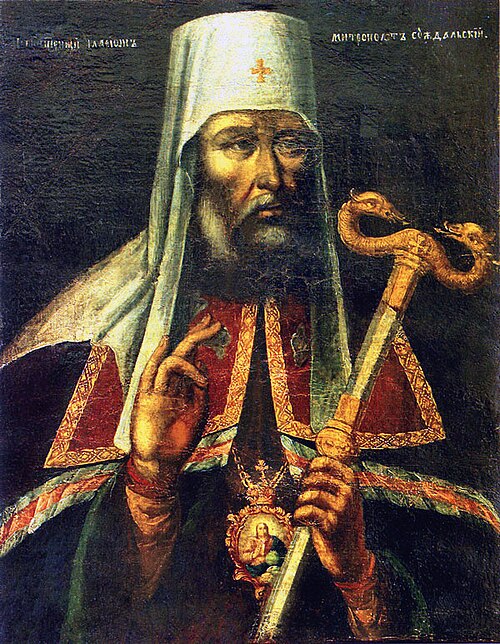
Saint
Hilarion of Suzdal
Metropolitan of Suzdal
Metropolitan of Suzdal and Yuriev and a co-founder of the Florishchi Hermitage; he died in 1707.
Life
Saint Hilarion of Suzdal, Hierarch, was Metropolitan of Suzdal and Yuriev, one of the founders and the first abbot of the Dormition monastery at Florishchi (Florishcheva Hermitage) in the Nizhny Novgorod governorate, an ascetic known for the gift of foresight and of working miracles. Born in 1631 at Nizhny Novgorod, he fell asleep in Suzdal in 1707. He was canonized in 1982 and is commemorated on 27 December.
Childhood and marriage
Born Ivan Ananyev into the family of a Nizhny Novgorod priest, Ananias, and his wife Melania, his father served first at the church of the Conception in the convent of that name, then the family moved to the village of Kirikovo, near the monastery of Saint Macarius of the Yellow Waters. From childhood he was quick: at four he had read all the books given then to children, the primer, the book of hours and the Psalter. In 1636, when he was five, his mother died. Three years later Ananias, with the blessing of Patriarch Joasaph, entered the Saviour monastery on the river Yunga, fifty versts down the Volga, taking his son, and there he became a monk with the name Anthony. In this modest monastery John spent his childhood and youth.
At sixteen, with his father's blessing, he went to visit relatives at Kirikovo, who decided to marry him. John resisted long, wishing the monastic life, but in the end gave way and married Xenia, daughter of a priest of a neighbouring village, whose brother Paul, a future bishop of Kolomna, was then struggling at the Paphnutius hermitage at Balakhna. Even married, he remained faithful to the monastic calling, asking his wife to keep unfeigned love for him, in secret, without living as spouses. When the relatives learned of it, they urged him to live with his wife as was customary, and he obeyed, seeing in Scripture that such a union is not counted a sin. After a year and a half Xenia fell ill and died. The young widower wept bitterly, but the relatives who counselled him to marry again found him this time unyielding.
On the monastic path
He was tonsured on 11 December 1653, at twenty-two, by Bishop Paul of Kolomna, receiving the name Hilarion. He learned of the place where he would live from a priest, Basil, who praised a secluded hermitage where four monks were struggling, the schemamonk Methodius and the brothers Barlaam, Jonah and Mekandr. While still in the world, Hilarion spent a time there, seeing his calling in the hermit life, but he kept postponing the move, until Schemamonk Methodius, back from Moscow, urged him to remember his promise. The church of Saint Ephraim the Syrian had already been built there. Hilarion went gladly to Florishchi mountain and found neither the stone church nor the monastery he had imagined, but still four monks. They had a church and urged him to accept the priesthood, and Hilarion resisted long, saying he was unworthy, until Methodius took him to Moscow for the patriarch's blessing. Patriarch Nikon knew his father, Hieromonk Anthony, and knew of the young man's gifts, so on 22 May 1654 he ordained him hieromonk, finding him very skilled in Holy Scripture.
The quiet did not last long: plague broke out in Russia and touched the monastery too, the monks died one by one, and Hilarion was left alone. He left for a time beyond the Oka, into the forests of Nizhny Novgorod, fifteen versts from the village of Afanasyevo, made a hut of brushwood and prayed that the Lord would send him someone with whom to return to Florishchi. When winter came, the local people brought straw to warm the hut, but fire engulfed it entirely and he barely managed to carry out his books. The peasants returned with axes and helped him make a wooden hut, cold and damp. People from other villages began to come to him for sermons. His brother Peter sent him vestments, books and supplies, urging him to return, and the young hieromonk returned to Florishchi, meeting on the way at Gorokhovets the monk Jonah, who had left the monastery before the plague.
Founder of the monastery
In time the ascetic's fame spread and pilgrims began to come. The number of brethren also grew; the priest Basil came too, and received in monasticism the name Benjamin. Because pilgrims got lost in the forests, the abbot blessed the making of roads through the forest toward Gorokhovets, Yakushev, Mugreevo and Ramenye, and he himself worked with the brothers, carrying logs for bridges and felling trees. The church built in 1651 in the time of Schemamonk Methodius burned, and it was decided to build another, also in honour of Saint Ephraim the Syrian. A defensive wall with a gate church was also planned; at the place of the latter, Hilarion saw the wonderworkers of Solovki, Saints Zosima and Sabbatius, appear, and the church was consecrated in their honour in 1657. Temptations also came: the local people refused to help with building, saying the monks wanted to starve them. Hilarion grew sad and prayed fervently, and the Lord appeared to him in a dream and told him to grieve no more. Next day some unknown people came with alms that sufficed for all the buildings planned.
Church troubles began: Patriarch Nikon confirmed the new service books, brought into agreement with the Greek. Hilarion accepted the new rules, but there were ill-wishers who denounced him to the patriarch as having joined the Old Believers and urging the brethren to the same. Brought before the patriarch, who reproached him for disobedience, he said that, though he had doubted the rightness of the reform, he had long served by the new books. The patriarch was satisfied but sent him to the Chudov monastery for a forty-day trial, then let him return in peace. Robbers often came seeking the "monastery's treasures"; once they seized Hilarion and, torturing him with fire, asked where he hid the silver, and, not believing that all had been spent on building the monastery, plundered it, taking even the copper cauldrons and old clothes. Sometimes the brethren hid with the abbot in chimney flues or in the forests. He also suffered much from monks, who murmured and left the monastery. Famine, sickness and fear of the enemy tested hearts.
In June 1660 he received the blessing of Metropolitan Pitirim, locum tenens of the patriarchal throne after Nikon's deposition in 1658, and a new church was built, consecrated in honour of the Dormition of the Mother of God, with money from an unknown benefactor in Moscow. A year of famine then came, and Florishchi helped the needy, so that the monks assigned to this were exhausted. When the flour ran out Hilarion looked for benefactors to lend money, and just when the provisions were almost gone, pilgrims came who gave the brotherhood ten pounds of silver, saving both the brothers and those they fed.
Rise of the monastery and the gift of healing
He was said to have the gift of prophecy and of working miracles. His fame reached Moscow and Tsar Alexei Mikhailovich. In the capital, at the patriarchal women's almshouse at Kuliki, a demon had settled, through someone's sorcery, and let no one there sleep by day or night, dragging them from bed, shouting obscenities and making noise. Many clergy had tried to drive it out without success, and they thought of the wonderworker in the hermitage. The tsar's envoys frightened the abbot, who thought he had again been denounced and uttered only "Lord, have mercy", but he went to Moscow, where the tsar reassured him and asked him to drive out the demon. With the monks Mark and Joseph he went to the almshouse, served vespers and read the akathist to the Mother of God, and the demon shouted and laughed at him, then turned into a black cat and threw itself at his feet, but he took it and threw it aside without anger. Next day he blessed water, sprinkled the whole house and commanded the demon, in God's name, to leave. For seven weeks he struggled with it, then stayed ten more weeks, assured that the unclean spirit had gone, and returned to the monastery.
Hilarion established in the monastery a strict rule of prayer: schemamonks had to make six hundred prostrations daily and those who could read to read seven kathismata; needless conversation with pilgrims was forbidden and going out of the monastery became rare; every monk who had a craft worked without pay for the monastery, and the abbot himself went out to common labour. After Tsar Alexei's death his son Feodor became tsar. In 1676 the voivode Ivan Maksimovich Yazykov, close to the tsar, began to come often to the monastery with gifts and spoke to the tsar about Hilarion. The tsar wished to meet him; Hilarion bowed to the ground, and the tsar raised him and asked his blessing, and he refused long, for unworthiness, but in the end accepted. After a long talk the tsar was convinced that the hieromonk truly had a gift from God, and from then on Hilarion often went to the tsar's palace, guiding the tsar and those around him. Later he became Metropolitan of Suzdal and Yuriev.
Veneration
He fell asleep at Suzdal in 1707. The Church canonized him in 1982 and commemorates him on 27 December. The Florishchi monastery which he built remained a place of ascetic struggle and pilgrimage.
Commemorated the same day June 23
 Sviatoslav-Gabriel of VladimirRight-Believing · Grand Prince of VladimirJun 23
 Agrippina of RomeMartyr · Virgin and martyrJun 23
 Artemius of VerkolaRighteous · Child saintJun 23
 George YaroslavichRight-Believing · Prince of MuromJun 23
 Patricius of VladimirHieromartyr · Sacristan in VladimirJun 23
 Mitrofan of AstrakhanHieromartyr · Archbishop of Astrakhan and TsarevJun 23
 Roman of KirzhachVenerable · Disciple of Saint SergiusJun 23
 Barlaam of SuzdalSaint · Bishop of SuzdalJun 23
- Paraskeva of PirinemRighteousJun 23
 Christina of VladimirRight-Believing · Princess of VladimirJun 23
- Eudokia AlexandrovnaRight-Believing · Daughter of Alexander NevskyJun 23
- Joseph of ZaonikievoVenerableJun 23