
Hieromartyr
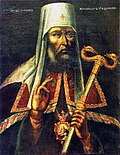
Mitrofan of Astrakhan
Archbishop of Astrakhan and Tsarev
Archbishop of Astrakhan and Tsarev, who died a martyr at Astrakhan in 1919; glorified in 2001.
Life
The Holy Hieromartyr Mitrofan of Astrakhan, in the world Dmitry Ivanovich Krasnopolsky, was Archbishop of Astrakhan and Tsarev. A diligent and merciful hierarch, he played an important part at the Council of 1917-1918 in restoring the Russian patriarchate and was shot in Astrakhan in the summer of 1919, having refused to abandon his flock. The Russian Orthodox Church numbered him among the saints in 2001.
Childhood and youth
He was born on 22 October 1869 (3 November New Style) in the village of Alexeyevka in the Biryuch district of Voronezh province, into a poor family. His father was a stonemason and his mother the daughter of a village sacristan. He was the best pupil in the village school, and through the efforts of his teacher, who also paid for his keep, he was admitted to the Biryuch theological school.
He finished there in 1884 and entered the Voronezh seminary, from which he graduated in 1890. That same year he married and was ordained deacon of the Church of the Kazan Icon in a suburb of the town of Korotoyak.
In 1893, after the birth of their son, his wife died. Left a widower, he chose the monastic path and entered the Kiev Theological Academy. In 1896 he was tonsured a monk and ordained hierodeacon, and from June 1897 he served as a hieromonk. He graduated from the academy with the degree of candidate of theology.
Teacher and rector
In November 1897 he was appointed inspector of the Irkutsk seminary, and from 1898 he was its rector. He was also a member of the local committee of the Orthodox Missionary Society and of the diocesan school council, and in 1900 he received the pectoral cross.
From 1902, as an archimandrite, he headed the seminary in Mogilev. He censored sermons at the cathedral, supervised religious instruction in the city's schools and served as dean of the Brotherhood Monastery in Mogilev. In 1905 he was one of the founders of a local conservative organization that later joined the Union of the Russian People.
Bishop of Gomel
On 11 February 1907 he was consecrated in the Trinity Cathedral of the Alexander Nevsky Lavra as Bishop of Gomel, vicar of the Mogilev diocese. The consecration was performed by Metropolitans Anthony of Saint Petersburg, Vladimir of Moscow, Flavian of Kiev and other hierarchs. He led the Orthodox Theophany Brotherhood in Mogilev and opened missionary courses for the rural clergy.
From 1907 to 1912 he was a deputy in the Third State Duma for Mogilev province. He chaired the Duma's commission on combating drunkenness and sat on the commissions for resettlement, church affairs and public education, defending the rights of the Orthodox Church in his speeches. The struggle against alcoholism remained one of his lasting concerns, and in 1912 he helped lead a congress of those working in the field.
Bishop of Minsk in wartime
On 3 November 1912 he was appointed Bishop of Minsk and Turov. The clergy of Minsk called him a steadfast fighter for the Orthodox cause. He was patron of the city's Orthodox Brotherhood of Saint Nicholas and served on the board of the local Red Cross.
During the First World War he often went to the front to strengthen the soldiers' morale and came under fire more than once. He organized broad relief for civilians left homeless in the territories taken by the enemy and set up diocesan hospitals for the wounded. For this work he received the Order of Saint Alexander Nevsky in 1916, having earlier been awarded the Orders of Saint Anna and Saint Vladimir.
Shepherd of Astrakhan
On 11 July 1916 he was appointed Bishop of Astrakhan, and from 1917 his title was Astrakhan and Tsarev. He proved an energetic archpastor: he established a diocesan hospital and a school for refugee children, and he entrusted the Brotherhood of Saints Cyril and Methodius with the care of poor families whose breadwinners had been called up to the army.
He worked against the sects and in January 1917 opened missionary courses in Astrakhan and in the village of Prishib. In a short time he travelled through the whole diocese, visiting even parishes no bishop of Astrakhan had ever reached. In the spring of 1917 part of the clergy tried to remove him, but the diocesan assembly expressed full confidence in him and allowed him to continue his work.
At the Council of 1917-1918
Bishop Mitrofan was a member of the Local Council of the Russian Church of 1917-1918. Even before it opened he had gathered and carefully studied the historical and canonical evidence about the patriarchate, which formed the basis of his report.
Elected chairman of the department on the higher church administration, he presented his report on the restoration of the patriarchate on 11 October 1917. He argued that Peter the Great's abolition of the patriarchate had been an uncanonical act that left the Russian Church headless, that the Synod had remained an institution foreign to Russia, and that the idea of the patriarch had lived on in the people's hearts as a "golden dream". The Church needed a patriarch, he said, as a spiritual leader who would inspire the people, call them to amend their lives and go first before them. His report played an important part in the Council's decision of 28 October 1917 to restore the patriarchate.
On his initiative the Council also glorified the Hieromartyr Joseph, Metropolitan of Astrakhan, killed in 1671 by the rebels of Stepan Razin. The glorification took place in Astrakhan in May 1919, shortly before Mitrofan's arrest.
The last year in Astrakhan
In April 1918 he was raised to the rank of archbishop. In February 1918, at his initiative, a great procession went through the centre of the city, and in the former governor's garden he served a litia at the common grave of Red Army soldiers killed in recent fighting. In this way he showed that the Church mourned equally for all the victims of the civil war, and one witness called that day a triumph of faith.
In 1918-1919 he was in conflict with part of the clergy and faithful, led by the vicar bishop Leonty (von Wimpfen), who was revered for his righteous life. Archbishop Mitrofan opposed any cooperation with Soviet organizations and the creation of a "Spiritual Union of Orthodox Christians" that would be registered by the authorities. He said it was better to lose the churches and serve under the open sky than to sacrifice Christian freedom and truth.
Refusing to flee
On 25 March (7 April) 1919, the feast of the Annunciation, he served at the Annunciation Monastery. In his sermon he spoke of those who had perished through the needless actions of the authorities, and after the Liturgy he served a memorial service for those killed innocently.
The clergy, understanding the danger, begged him to leave Astrakhan at once. The archbishop refused. He told them he could not flee at the very time their innocent brothers were being shot before their eyes, that he bore on his breast the Cross of the Saviour, which would reproach him for such faintheartedness, and that he was clean and guiltless before his country and his people.
Arrest and martyrdom
In the summer of 1919 he was arrested by the Cheka on the orders of Sergei Kirov, together with Bishop Leonty. Both were accused of conspiring against Soviet power. The faithful of Astrakhan tried to obtain their release but were refused by the head of the Cheka, Georgy Atarbekov. Throughout his interrogations the archbishop stood firm, yielding neither to threats nor to persuasion to testify against himself or others.
He was sentenced to death. When he was led out to be shot, he blessed the firing squad, and the soldiers refused to fire at him. He was shot by Chekists, one of whom tore out a tuft of his beard. He received the crown of martyrdom on 23 June 1919 (6 July New Style). According to a tradition preserved in Astrakhan, Archbishop Mitrofan and Bishop Leonty were reconciled before their execution.
The grave
The faithful ransomed the bodies of the two hierarchs and buried them in the Pokrovo-Boldinsky Monastery. A brick monument was raised over the grave, where people came to pray, and in 1930 the authorities destroyed it to stop the pilgrimages.
The site now lies within the grounds of a hospital, and later excavations by Hegumen Joseph (Maryan) showed that the hierarchs' remains are no longer there. After the war word spread that they had been reburied in the city cemetery, where believers set up a wooden cross; the authorities repeatedly removed it, but it always reappeared.
The man and pastor
At first sight he seemed severe, but the sternness remained only in his face, a mark of a hard childhood. In truth he was kind, simple and hospitable, with a good heart ready to respond to any misfortune. He received everyone, regardless of rank, and listened patiently even to the humblest village reader.
He often sent money to poor families and supported needy seminarians at his own expense. He prayed much, rose very early and attended the Liturgy every day in the chapel of the bishop's residence. He left many sermons, speeches and writings, among them a study on the ascetic teaching of Saint Basil the Great.
Glorification
His name was placed on the list of new martyrs prepared by the Russian Church Outside of Russia in 1981. On 26-27 December 2001 the Holy Synod of the Russian Orthodox Church decided to include him in the Synaxis of the New Martyrs and Confessors of Russia, and his solemn glorification took place on 14 April 2002 in the Pokrovsky Cathedral of Astrakhan. He is commemorated on 23 June (6 July New Style), the day of his martyrdom, and in the Synaxis of the New Martyrs of the Russian Church.
Commemorated the same day June 23
 Sviatoslav-Gabriel of VladimirRight-Believing · Grand Prince of VladimirJun 23
 Agrippina of RomeMartyr · Virgin and martyrJun 23
 Artemius of VerkolaRighteous · Child saintJun 23
 George YaroslavichRight-Believing · Prince of MuromJun 23
 Patricius of VladimirHieromartyr · Sacristan in VladimirJun 23
 Roman of KirzhachVenerable · Disciple of Saint SergiusJun 23
 Barlaam of SuzdalSaint · Bishop of SuzdalJun 23
- Paraskeva of PirinemRighteousJun 23
 Christina of VladimirRight-Believing · Princess of VladimirJun 23
- Eudokia AlexandrovnaRight-Believing · Daughter of Alexander NevskyJun 23
 Hilarion of SuzdalSaint · Metropolitan of SuzdalJun 23
- Joseph of ZaonikievoVenerableJun 23