Venerable
Athanasia of Aegina
Abbess of Aegina
Byzantine abbess born on the island of Aegina around 790, who reposed in 860 at Timia.
- Feast
- April 12old style April 25
- Reposed
- 8609th century
- Place
- Aegina
- Order
- Venerables
Life
Saint Athanasia of Aegina was a Byzantine abbess of the ninth century who lived on the island of Aegina in the Saronic Gulf, in the days of the first Arab raids on the Aegean. A noblewoman twice married against her will, she gave her wealth to the poor and turned her home into a convent, and later she became guide of her community and healer of the sick. The Church commemorates her on 18 April.
The sources
Her life survives in a single work, preserved in a manuscript of the year 916 (Vaticanus Graecus 1660). The author did not give his name. Scholars think he was a man, who wrote soon after her death and witnessed the miracles at her tomb, which he verified with the nuns who had lived with her. He apologizes for his plain style and says he wrote so that her story would not be lost. A short life of her is also found in the Greek synaxaria and in the Menaion printed at Venice in 1603. Exact dates are not known; she was born around 790 and departed in 860.
Childhood and marriages
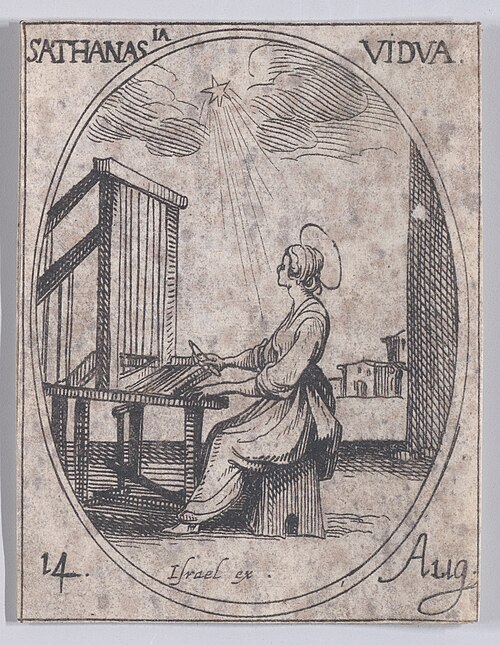
Athanasia was the daughter of the Christian nobles Niketas and Irene. She received the ordinary education of girls of her time, beginning at about seven, with the reading of the Psalter and Scripture. In a vision in childhood, while learning to weave at the loom, she saw a shining star come down from heaven and rest on her breast before vanishing. This light enlightened her soul and gave her a loathing for the vanity of life, and from then on she longed to live for God.
Her parents did not allow her to enter a convent. At sixteen she was married to a young officer, who was killed in an Arab pirate raid a little over two weeks after the wedding. An imperial decree required unmarried women and widows to marry, so her parents married her a second time, again against her will. Her second husband was a truly devout man; after a few years the two agreed to separate so that both could live the monastic life, and he remained a monk until his death.
Convent and asceticism
Athanasia gave to the poor all that she had, joined a group of pious women and with them founded a convent on Aegina, in her own house. She built three churches on the island, dedicated to the Mother of God, Saint John the Baptist and Saint Nicholas. After three or four years she accepted, unwillingly, the office of abbess, but remained the strictest with herself in food, sleep and clothing. She ate a little bread and drank a little water after the ninth hour, took no cheese or fish except at Easter, ate only raw greens every other day and drank nothing in Great Lent. She slept on large stones with a small goat-hair blanket and wore a goat-hair shirt next to her skin and a ragged woollen garment over it. From the day she became a nun until her death she ate no fruit. She prayed with tears and sang the psalms without ceasing.
She was generous, welcoming travelling monks and giving widows, orphans and the needy what they required. In a time of famine she fed all the hungry, even foreigners and heretics from Asia Minor; some scholars see in the "Atsinganoi" mentioned then one of the earliest written notices of the Roma. Every Sunday and feast day she gathered the women of the town and read and explained Scripture to them. It was said of her that no harsh word came from her mouth, against the small or the great, against slave or free. In her lifetime she worked only one miracle, healing a man with the same eye disease from which she herself had suffered. The community was later moved to Timia, near the ancient church of Saint Stephen the Protomartyr.
Withdrawal and repose
As her fame grew, crowds came to see her. Seeking quiet, she went to Constantinople and lived shut in a cell for almost seven years. During this time, according to some sources, she was an adviser to the Empress Theodora. A dream sent her back to Aegina, where she soon fell ill and passed to the Lord a few days later, on 15 August 860, the feast of the Dormition of the Mother of God, which remained one of her days of commemoration. Some sources give 14 August.
Miracles and veneration
Most of her miracles took place after her death. At the commemoration forty days later, two men and a woman were freed from evil spirits during the liturgy. Fragrant oil dripped from all sides of her coffin, and when it was opened her body was found incorrupt. The abbess who succeeded her saw her in dreams, as did other sisters. A goat-hair garment that had belonged to her healed a girl suffering in her neck. After a year the relics were taken up and placed in an open coffin for veneration. There seems to have been another translation, commemorated on 13 April.
Her cult remained largely local, on Aegina. The relics are kept at Timia in a reliquary made for them, and the faithful honour them for their healing power. The Serbian Orthodox Church commemorates her on 12 April Old Style, while the Greek and Romanian calendars keep 18 April. Her biographer called her a praiseworthy woman who bore a name meaning immortality.
Commemorated the same day April 12
 Julius ISaint · Bishop of RomeApr 12
 Zeno of VeronaSaint · Bishop of VeronaApr 12
 Sabbas the GothMartyrApr 12
- Damian of PaviaSaint · Bishop of PaviaApr 12
 Basil of PariaConfessor · Bishop of PariaApr 12
- Akakios the New of KafsokalyviaVenerable · Hermit of Mount AthosApr 12
- Philophthea of PasăreaVenerable · Schemanun of PasăreaApr 12
- Isaac of SpoletoVenerableApr 12
 AlferiusVenerableApr 12
- Basil of ParionConfessor · Bishop of ParionApr 12
- Conda of Daire DachoimaVenerableApr 12
- Constantine of GapSaint · Bishop of GapApr 12