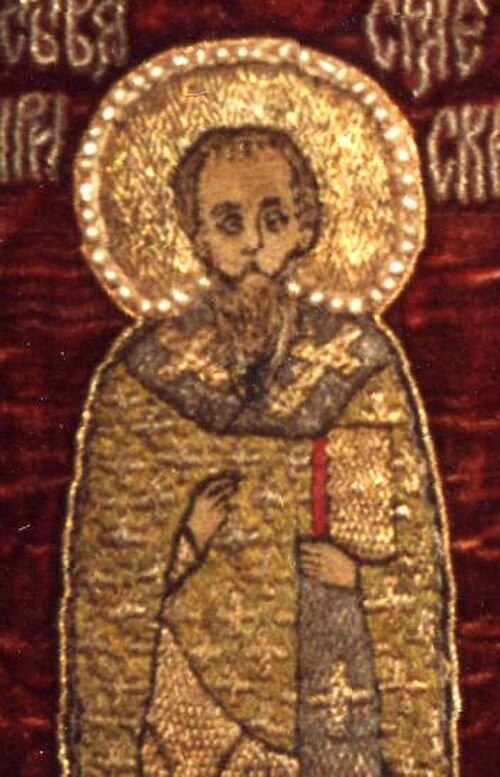
Confessor
Basil of Paria
Bishop of Paria
Bishop of Paria in the metropolis of Cyzicus, a defender of icons who suffered in the iconoclast persecution.
- Feast
- April 12old style April 25
- Era
- unknown
- Order
- Confessors
Life
Saint Basil of Paria was bishop of the city of Paria (the metropolis of Cyzicus), a supporter of the veneration of icons, who suffered in the iconoclast persecution in the Byzantine Empire, in the first third of the ninth century. The Orthodox Church honours him among the holy confessors and commemorates him on 12 April. He should not be confused with Venerable Basil the Confessor (the Decapolite) and Venerable Basil the New, confessor.
Basil was bishop of Paria, in the metropolis of Cyzicus. In the time of iconoclasm he defended the veneration of icons: he avoided communion with the iconoclasts, did not allow them into his diocese and did not carry out the imperial orders to destroy icons. For his faithfulness to the veneration of icons he endured many persecutions. Under Bishop Basil the future patriarch Ignatius began his church career. Basil made him first a reader, then ordained him deacon and later priest.
The Life of Basil is found in the Menologion of Basil II and in the Synaxarion of the Church of Constantinople (tenth century). The Life does not show in the time of which emperors Basil served as bishop, and only on the basis of the mention in the Life of Patriarch Ignatius is his service placed in the second period of iconoclasm.
An icon painter's guide of the eighteenth century tells how Basil looked, and Victor Fartusov's Guide to the Painting of Icons of the Holy Servants of God adds that he is of a type like the Syrian, holding in his hands an icon of the Saviour and a scroll with an inscription. The Studite typica rarely include the commemoration of Basil of Paria. The saint's service is described briefly (without troparion and kontakion) in the Evergetis Typikon (end of the eleventh century). The order of service for the saint is also known from copies of the Studite Menaia. The Jerusalem Typikon and the Menaia direct that on the day of Basil of Paria's commemoration the ordinary weekday service be performed, without a troparion. The hymnody of Basil of Paria includes three stichera in tone 8 at Lord, I have cried, with the Theotokion and the Stavrotheotokion, a canon with irmoi in tone 8, Having passed through the water, with a kathisma in tone 3 and a kontakion in tone 2. Modern Greek Menaia also contain a troparion.
Commemorated the same day April 12
 Julius ISaint · Bishop of RomeApr 12
 Zeno of VeronaSaint · Bishop of VeronaApr 12
 Sabbas the GothMartyrApr 12
 Athanasia of AeginaVenerable · Abbess of AeginaApr 12
- Damian of PaviaSaint · Bishop of PaviaApr 12
- Akakios the New of KafsokalyviaVenerable · Hermit of Mount AthosApr 12
- Philophthea of PasăreaVenerable · Schemanun of PasăreaApr 12
- Isaac of SpoletoVenerableApr 12
 AlferiusVenerableApr 12
- Basil of ParionConfessor · Bishop of ParionApr 12
- Conda of Daire DachoimaVenerableApr 12
- Constantine of GapSaint · Bishop of GapApr 12