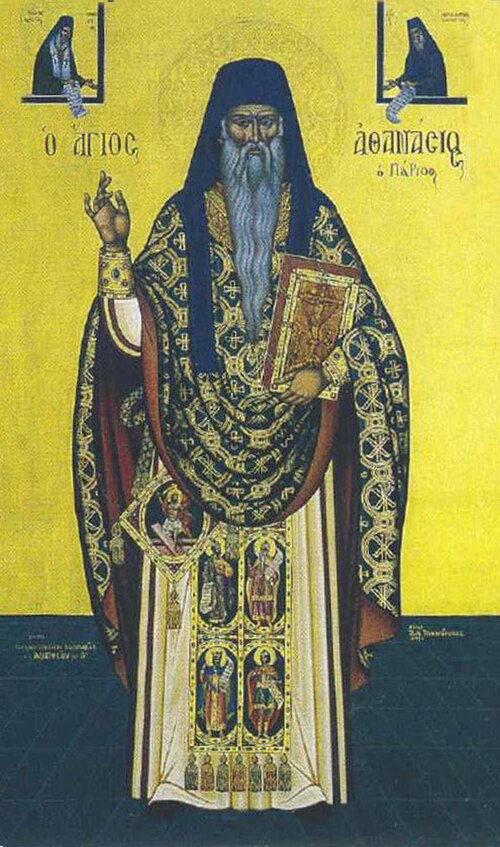
Venerable
Athanasios Parios
Hieromonk and Teacher of the Nation
Greek hieromonk, theologian and hymnographer, Teacher of the Nation and leader of the Kollyvades; died on Chios in 1813.
- Feast
- June 24old style July 7
- Reposed
- 181319th century
- Place
- Chios
- Order
- Venerables
Life
Saint Athanasios Parios was a Greek hieromonk, theologian, philosopher, teacher and hymnographer, one of the "Teachers of the Nation" in the time of the Modern Greek Enlightenment and the second leader of the Kollyvades movement, after Neophytos Kavsokalyvites. Born in 1721 or 1722 at Kostos on the island of Paros, he fell asleep on 24 June 1813 on the island of Chios. He wrote lives of saints, hymns and many works of teaching. He is commemorated on 24 June. He was numbered among the saints by the Orthodox Church in 1995.
Life
Born Athanasios Touleos in the village of Kostos on Paros, his father, Apostolos Touleos, was from Sifnos and had settled on Paros after marrying a local woman. He received his first schooling in his village, then, desiring higher studies, left his parents and his place and went to Smyrna, to the Greek school there, founded in 1717 and later called the Evangelical School, where he stayed six years. In 1752 (by another source 1751) he entered the Athonite Academy, where he was a pupil of Neophytos Kavsokalyvites and Eugenios Voulgaris; from the first he learned the grammar and syntax of Theodore Gaza, from the second philosophy, and then rhetoric and pastoral theology. He studied later at Corfu, under Nikephoros Theotokis, physics.
In 1758, at the urging of Eugenios Voulgaris, he took the direction of the School of the Nation at Thessalonica; his pupil there was the future new martyr Athanasios of Xirokrini. He taught there only two years, since the school was closed by an epidemic of plague. He took refuge at Corfu, then at Mesolonghi, at the invitation of his fellow student at the Athonite Academy, Panagiotis Palamas, who had founded from 1760 the "Palamian School". From 1767 to 1770 he taught again at Thessalonica and soon received an honorary invitation from the Patriarchate to head the Athonite Academy. He accepted at once and stayed on the Holy Mountain, where he met Makarios Notaras, who urged him to be ordained. He was ordained priest by him. At that time he became actively involved in the Kollyvades movement and was not only driven from the school but in 1776 condemned as a heretic and defrocked by Patriarch Sophronios II and the Synod of Constantinople. He returned to Thessalonica as teacher at a gymnasium and in 1781 was forgiven, after defending himself successfully before Patriarch Gabriel IV and the Synod, and restored to communion and the priesthood. He stayed at Thessalonica until 1786, collaborating closely with Nikodemos the Hagiorite on the edition of the works of Gregory Palamas. He wrote and continued an important work of exegesis, apologetics, dogmatics, liturgics, hymnography, philosophy and pedagogy.
In 1786 he left for Paros, but the Russo-Turkish war did not let him land on the island, and he went to Chios. There he led, between 1788 and 1811, a school, which he brought to great flourishing. At ninety he withdrew to the cell of Saint George Resti, where he fell asleep on 24 June 1813. His apolytikion says: "Adorned with wisdom in all things of piety, a God-inspired teacher of the Church of Christ, you were shown a shining pillar of rectitude of life, Father Athanasios; therefore the island of Paros boasts of your glory, and we all honour your divine gifts."
The quarrel with Korais
He also wrote on social and political themes, not only theological. Being learned and a linguist, he saw the changes the Enlightenment was bringing in Europe, and began to judge, in his conservative language, European political events and to attack them as "arbitrary heretical error". He wrote the "Paternal Teaching", in which he opposed the liberal proposals of the Enlightenment thinkers for revolution; the book was printed by the Patriarchate and seems to have expressed also political interests of the Porte, so it may not fully reflect the author's views. The book caused attacks on the Church from the Enlightenment people, who accused it of pro-Turkishness, though it expressed the view of the great majority of the Phanariots, who lived with the fear that a local uprising, even if successful, would expose the rest of the Greeks to the Turks' fury. Adamantios Korais answered personally with the "Brotherly Teaching", with sharp personal characterizations. The difference between the two worlds was that the Enlightenment people sought a clean national state, with limits by ancient Greek geography, while Athanasios and the more conservative sought a traditional multinational state, in which also small groups of Greeks scattered through the Ottoman Empire could be saved. His writing survives; about sixty works are known, educational, hagiographic, literary, dogmatic-canonical and apologetic, sermons, letters, epigrams, textbooks of grammar and rhetoric.
Disciples and writings
Among his disciples: Athanasios of Koulakia, later a monk of Vatopedi, who died a martyr by hanging in 1774, because he did not renounce the faith; Minas Minoidis, who taught rhetoric and philosophy at Serres and Thessalonica, and at Paris ancient Greek, and was an interpreter at the French foreign ministry; Ierotheos Dendrinos and Christodoulos; and Saint Nikephoros of Chios, who knew him when Athanasios led the school at Chios. He translated into modern Greek the "Extended Life of Saint Clement of Ohrid" (1774). Among his works: "Antipapas" (1785), on the work of Saint Mark of Ephesus; "Paternal Teaching" (1797), written by him but published under the name of Patriarch Anthimos of Jerusalem; "Christian Apologies" (1798); "Rhetoric and Metaphysics" (1787); "A Response to the Unwise Zeal of the Philosophers Coming from Europe" (1802); and "Epitome" (1806), a theology textbook made with Saint Makarios of Corinth.
Commemorated the same day June 24
 John the BaptistProphet · The ForerunnerJun 24
 Nicetas of RemesianaSaint · Bishop of RemesianaJun 24
 Rumbold of MechelenMartyr · Missionary and martyrJun 24
 Mikhail II of TverRight-BelievingJun 24
 John the Hermit of BohemiaVenerable · First hermit of BohemiaJun 24
- Orentius, Pharnacius, Heros, Firmus, Firminus, Cyriacus and LonginusHoly Martyrs · The Seven Brothers of LazicaJun 24
- James and John of MenyugaHoly Right-Believing Rulers · Child brothers of NovgorodJun 24
- OrentiusMartyrJun 24
- Panagiotes of CaesareaNew MartyrJun 24
- Agilbert of CréteilMartyrJun 24
- Agoard and Aglibert of CréteilHoly MartyrsJun 24
- Agoard of CréteilHoly MartyrsJun 24