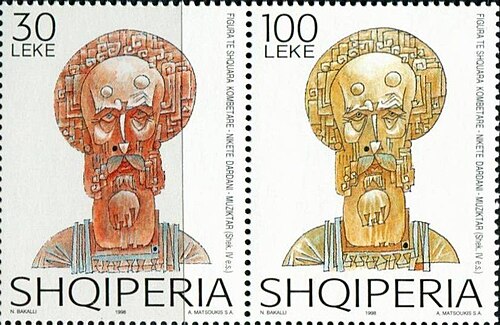
Saint
Nicetas of Remesiana
Bishop of Remesiana
Bishop of Remesiana in the province of Dacia Mediterranea, writer and theologian, who died around 414.
Life
Saint Nicetas was bishop of Remesiana, in the Roman province of Dacia Mediterranea (now Bela Palanka, in Serbia), a writer and theologian, who died around 414. He is venerated in the Orthodox and the Catholic Church. His feast is on 24 June (in the West, 22 June).
He was born around 335, a Dardanian by birth, as he says himself: I am Dardanian. Remesiana stood on the river Nišava, between Niš and Pirot. He lived in the time of the First Ecumenical Council and that of Constantinople (381). Pope Innocent I calls him our brother Nicetas in letters of 409 and 414; from this it is thought that he shepherded for some fifty years. He reached Italy at least twice; in 398 he went to Nola, on pilgrimage to the tomb of Saint Felix, and was hosted by his friend Paulinus of Nola, who dedicated two poems to him. Paulinus praises his missionary work: he taught the Gospel to barbarians, changed by him from wolves to sheep, and taught robbers to sing of Christ with a Roman heart. He is presumed to have been the missionary to the Bessi, a Thracian tribe of the Rhodope mountains; some Bulgarian scholars attribute to him a translation of the Bible into their language, but this is disputed. Romanian tradition counts him among the evangelisers of Dacia and Dobruja, but many authors have confused him with Saint Nicetas the Roman (15 September) or with Saint Sabbas the Goth. He is not mentioned in the Constantinopolitan synaxarion, but in the Roman Martyrology.
He promoted Latin sacred song in the liturgy and is said to have composed several hymns; some scholars of the nineteenth and twentieth centuries attributed to him the Te Deum, traditionally ascribed to Ambrose and Augustine, but this is considered controversial. Of his principal doctrinal work, Instructions for Candidates for Baptism, in six books, lengthy excerpts survive; they show that he stressed the orthodox teaching on the Holy Trinity. They contain the expression communion of saints, about the mystical bond uniting the living and the dead in one hope and love, an expression with no earlier trace, which has since become central in formulations of the Creed. He also wrote on the fallen virgin and on the reckoning of Easter.
Commemorated the same day June 24
 John the BaptistProphet · The ForerunnerJun 24
 Rumbold of MechelenMartyr · Missionary and martyrJun 24
 Mikhail II of TverRight-BelievingJun 24
 Athanasios PariosVenerable · Hieromonk and Teacher of the NationJun 24
 John the Hermit of BohemiaVenerable · First hermit of BohemiaJun 24
- Orentius, Pharnacius, Heros, Firmus, Firminus, Cyriacus and LonginusHoly Martyrs · The Seven Brothers of LazicaJun 24
- James and John of MenyugaHoly Right-Believing Rulers · Child brothers of NovgorodJun 24
- OrentiusMartyrJun 24
- Panagiotes of CaesareaNew MartyrJun 24
- Agilbert of CréteilMartyrJun 24
- Agoard and Aglibert of CréteilHoly MartyrsJun 24
- Agoard of CréteilHoly MartyrsJun 24