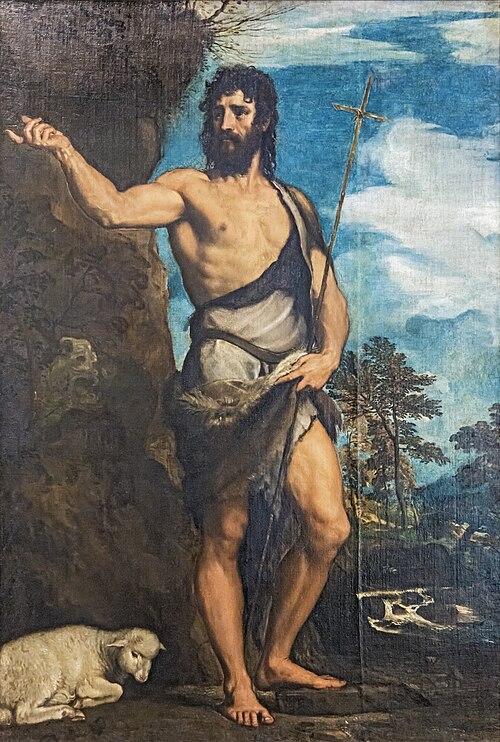
Prophet
John the Baptist
The Forerunner
He prepared the way for Christ and baptized Him in the Jordan, and was beheaded by order of Herod.
Life
The holy Prophet John the Baptist, the Forerunner of the Lord, is the last of the prophets of the Old Testament and the one who prepared the way of Christ. He baptized the Lord in the river Jordan and received a martyr's death because he rebuked King Herod Antipas. Of him Christ said that among those born of women no one greater has arisen. The Church honours him several times a year, and in the Deisis his icon stands beside that of the Mother of God, on either side of Christ.
Birth
His parents, the priest Zechariah and the righteous Elizabeth, were advanced in years and had no children. While Zechariah was offering incense in the Temple in Jerusalem, an angel appeared to him and announced that his prayer was heard and that Elizabeth would bear a son, whom he was to name John. Zechariah did not believe and was struck dumb. Elizabeth conceived and kept herself hidden for five months, after which she received the visit of the Virgin Mary, whom the Gospel of Luke calls her relative.
On the eighth day, at the circumcision, the relatives wished to name the child after his father, but Elizabeth asked for the name John, and Zechariah wrote the same name on a tablet. His tongue was loosed at once and, filled with the Holy Spirit, he sang the song of praise in which he foretold that the child would be called a prophet of the Most High and would go before the Lord to prepare His ways.
The voice in the wilderness
The child grew and became strong in spirit, then withdrew into the wilderness until the day of his appearing to Israel. He wore a garment of camel's hair with a leather belt and ate locusts and wild honey. The Gospels show him as a stern and unbending man, not a reed shaken by the wind and not a man clothed in soft garments.
In the fifteenth year of the Emperor Tiberius, John began to preach on the banks of the Jordan a baptism of repentance for the forgiveness of sins, and crowds came to him, confessed their sins and were baptized. To the Pharisees and Sadducees who came in pride he demanded fruits worthy of repentance, and to ordinary people he gave plain instruction: whoever has two coats should share with him who has none, tax collectors should take no more than they were ordered, and soldiers should oppress no one and be content with their pay.
The Baptism of the Lord and his witness
When Jesus came to the Jordan, John recognized Him and baptized Him. The Holy Spirit came down upon the Lord in the form of a dove, and the voice of the Father bore witness to the Son. The evangelist John preserves the words of the Forerunner, "Behold the Lamb of God, who takes away the sin of the world". Some of his disciples, among them Andrew, followed Christ. John called himself the friend of the bridegroom and said of the Lord, "He must increase, but I must decrease".
Martyrdom
John rebuked Herod Antipas for taking Herodias, the wife of his brother. Herod imprisoned him; according to the historian Josephus the prison was the fortress of Machaerus, east of the Dead Sea. The Gospels show that the king feared John, knowing him to be a righteous and holy man, and listened to him gladly. At the banquet on his birthday, after the dance of Herodias's daughter, Herod swore to give her whatever she asked, and she, urged by her mother, asked for the head of John. The prophet was beheaded in prison, and his disciples took his body and buried it. The Church teaches that after his death in the body John descended to hades and proclaimed there too the coming of Christ, so that he remained the Forerunner in death as he had been in life.
Relics and veneration
According to an Orthodox tradition, the head of the saint was found by his disciples and taken to the Mount of Olives, where it was buried and found twice, which gave rise to the feast of the First and Second Finding of the venerable head. Other accounts say that it was found in the time of Constantine and taken secretly to Emesa in Syria, and its Third Finding, in the year 452, is also kept by the Orthodox Church. Several places lay claim to the head, among them the Umayyad Mosque in Damascus and the cathedral of Amiens. The right hand, with which he baptized the Lord, was carried according to tradition from Antioch to Constantinople in the year 956, and a part of it is kept at Cetinje.
The Orthodox Church commemorates him on six days of the year. His Nativity is kept on 24 June, the Beheading on 29 August, a day of strict fast, his Synaxis on 7 January, the day after Theophany, his Conception on 23 September, the First and Second Finding of the head on 24 February and the Third Finding on 25 May. Many churches and monasteries bear his name as their dedication.
Commemorated the same day June 24
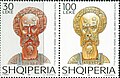 Nicetas of RemesianaSaint · Bishop of RemesianaJun 24
 Rumbold of MechelenMartyr · Missionary and martyrJun 24
 Mikhail II of TverRight-BelievingJun 24
 Athanasios PariosVenerable · Hieromonk and Teacher of the NationJun 24
 John the Hermit of BohemiaVenerable · First hermit of BohemiaJun 24
- Orentius, Pharnacius, Heros, Firmus, Firminus, Cyriacus and LonginusHoly Martyrs · The Seven Brothers of LazicaJun 24
- James and John of MenyugaHoly Right-Believing Rulers · Child brothers of NovgorodJun 24
- OrentiusMartyrJun 24
- Panagiotes of CaesareaNew MartyrJun 24
- Agilbert of CréteilMartyrJun 24
- Agoard and Aglibert of CréteilHoly MartyrsJun 24
- Agoard of CréteilHoly MartyrsJun 24