Martyr
Athanasius of Melitene
A martyr of Melitene, put to death for his faith in Christ.
- Feast
- November 7old style November 20
- Era
- unknown
- Order
- Martyrs
Life
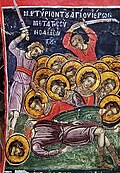
Saint Athanasius of Melitene is commemorated together with Saint Hieron and the others who suffered with him at Melitene in the time of the emperors Diocletian and Maximian. They are remembered on 20 November. The surviving account puts Hieron in the foreground, and Athanasius is numbered among the other martyrs of the company.
The call and the resistance
Hieron was born at Tyana in the second Cappadocia, of a God-fearing mother named Stratonike. When the emperors learned that the inhabitants of Armenia and Cappadocia refused to bow to idols, they sent two cruel men, Agricolaus to Armenia and Lysias to Cappadocia, with orders to put to death the Christians who would not worship idols and to enlist the strong young men and men in the army. Lysias heard of Hieron, a sturdy and brave man, and sent soldiers to take him. Hieron, learning that he was being taken into the army, refused to serve alongside idolaters. Seizing a piece of wood, he put them to flight and drove them off as a lion drives kids. A second time the soldiers came in greater numbers, and he gathered eighteen Christians, hid in a cave nearby and repelled the attacks. A friend of his, Kyriakos, gently persuaded him to come out and led him home to his mother, an old blind widow, who wept bitterly over him. Hieron took leave of her and set out for Melitene, with the soldiers and with his kinsmen Victor, Matronian and Antony.
During the night someone in white garments appeared to him and told him that he was on the right way, going to fight for the heavenly King, and that soon he would receive honour and glory from Him. Hieron was filled with joy. His only worry was his mother, whom he entrusted to Christ, the Father of orphans and widows.
The prison at Melitene
At Melitene he was shut up with thirty-three other Christians. He said to them: "Tomorrow they will try to force us to sacrifice to idols; let us not obey, but offer God a sacrifice of praise, and He will give us strength to bear the torments." The others answered with one voice that they would rather die for Christ than live bowing to idols. Lysias brought them to trial. Someone pointed out Hieron as the one who had resisted, and the martyr confessed that he had beaten the soldiers. Lysias ordered his hand cut off to the elbow, while the others were beaten for a long time and thrown back into prison.
One of Hieron's kinsmen, Victor, weakened by the beatings and fearing more, bribed the clerk who kept the list of Christians to strike out his name, and was let out of the prison at night. But he soon died, and lost property, life and the crown of martyrdom alike. Hieron wept for him with tears. Then he gave his kinsmen Antony and Matronian his last will: his property in Pisidia he left to his sister Theotimia, so that she might keep his memorial on the day of his death, and the rest to his mother, together with the severed hand, to be laid in the place he would indicate.
Martyrdom
On the fifth day Lysias brought them to trial again and tried by gentleness and threats to turn them from Christ. Failing, he had them beaten without mercy with rods and then condemned them to be beheaded. On the way to the place of execution, with Hieron at their head, they sang with joy: "Blessed are the undefiled in the way, who walk in the law of the Lord." There they knelt and prayed: "Lord Jesus Christ, receive our souls." Then their heads were cut off.
Antony and Matronian asked for Hieron's body, but Lysias wanted the head for its weight in gold. A rich and renowned man named Chrysaphius paid the price and kept the head with honour. Antony and Matronian fled by night with the saint's hand and gave it to his mother Stratonike. She washed it with her tears, kissed it, and begged her son not to forsake her in his prayers. The bodies of the martyrs were buried secretly by other Christians. Chrysaphius later built a church on the place where the saints had been beheaded and laid Hieron's head in it.
Commemorated the same day November 7
 WillibrordSaint · Bishop of UtrechtNov 7
 Herculanus of PerugiaHieromartyr · Bishop of PerugiaNov 7
 Congar of SomersetVenerable · Welsh abbotNov 7
 Michael of KulebakiHieromartyr · ArchpriestNov 7
 Cyril SmirnovHieromartyr · Metropolitan of Kazan and SviyazhskNov 7
 The 33 Martyrs of MeliteneHoly MartyrsNov 7
 Sergius ZverevHieromartyr · Archbishop of YeletsNov 7
- Alexander IlinskyHieromartyrNov 7
- Alexander KrylovHieromartyrNov 7
- Alexander KurmyshskyHieromartyrNov 7
 Alexis MolchanovHieromartyrNov 7
- Amarand of MoissacSaintNov 7