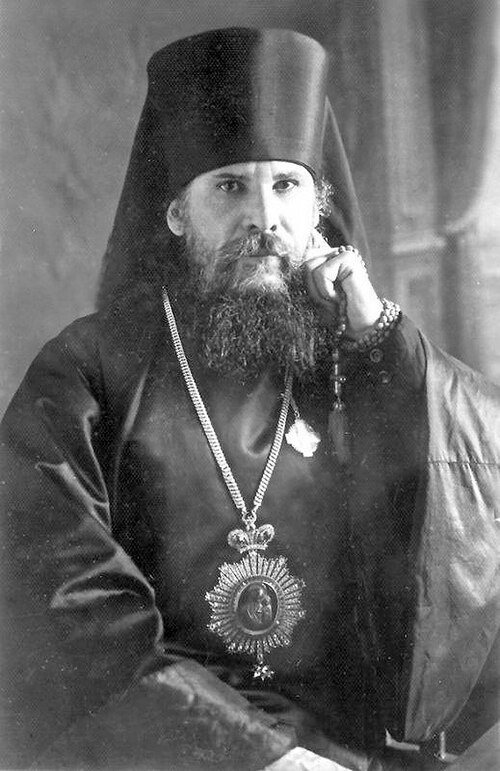
Hieromartyr
Augustine Belyaev
Archbishop of Kaluga and Borovsk
Archbishop of Kaluga and Borovsk, born in 1886, who died a martyr in 1937; canonized in 2000.
- Feast
- November 10old style November 23
- Reposed
- 193720th century
- Place
- Tula Oblast
- Order
- Martyrs
Life
Saint Augustine (in the world Alexander Alexandrovich Belyaev, 1886-1937), hieromartyr, was Archbishop of Kaluga and Borovsk, a widowed priest who became bishop, a defender of the Patriarchal Church against the Renovationists, who passed through exile and camp and was shot on 23 November 1937 at the Tesnitsa firing range near Tula. He was glorified in August 2000. He is commemorated on 23 November.
Family and formation
He was born on 28 February 1886 in the village of Kamenka (today Kamenniki), Yuryevets district, Kostroma province, in the family of Archpriest Alexander and Evdokia, the youngest of five children. He later wrote that the patriarchal order of his father's house imprinted on his mind moral responsibility for every step, and so he demands of others as much as he demands of himself. In 1913 he married Yulia Lyubimova, a priest's daughter, and they had two daughters, Yulia (1914) and Nina (1919). His wife died of consumption on 22 June 1920. He graduated from the church school at Kineshma, the Kostroma seminary and the Kazan Theological Academy (1911), as candidate of theology. In 1911-1920 he was a teacher in boys' and girls' schools in Penza.
In 1920 he was briefly arrested for "agitation against Soviet power": as church warden he had opposed the pro-Bolshevik People's Church that had appeared in Penza province. On 28 August 1920 he was ordained priest at the Nativity church in Penza. In 1922 he was arrested again for "resisting the confiscation of church valuables", moved to Kineshma, was raised to archpriest and then tonsured a monk.
Bishop
Patriarch Tikhon appointed him Bishop of Ivanovo-Voznesensk, at the request of representatives of eleven Orthodox communities of the diocese. The ruling bishop had passed to the Renovationists, and the vicar bishop Vasily was in exile. From 21 September 1923 he was Bishop of Ivanovo-Voznesensk, vicar of the Vladimir diocese. He led the resistance to the Renovationist Church: after his consecration all the clergy of the town, except those of one church, came over to his side, and many priests left the Renovationists and returned to the Patriarchal Church. He often served, in village churches too, and preached. He liked orderly services, reverent singing and reading, without theatricality. With his blessing religious circles were organized.
Between February and August 1924 he was under arrest. From 1925 he had to live in Moscow and Kineshma, coming to Ivanovo only for services, then, at the request of the faithful, many of them workers, he was allowed to return. On 8 September 1926 he was arrested at the demand of the local OGPU, whose chief wrote that he had formed illegal circles of Christians to bring back into the bosom of the Church children, especially of Communists, aged thirteen to sixteen. He was sentenced to three years of exile in Central Asia, at Khujand and Pendzhikent, until March 1930, where he made a house church in his room. The faithful gathered signatures for his release and money for the exiled bishop; the organizers were arrested. On 1 October 1929 he was appointed Bishop of Alma-Ata, but the local authorities refused registration, and after his exile he was forbidden to return to the Ivanovo region.
Syzran, the camp, Kaluga and martyrdom
From 1 April 1930 he was Bishop of Syzran, with authority among the faithful. In 1931 he was arrested at Syzran, together with sixteen priests, one monk and thirty-nine laymen. The indictment said that the bishop was a support for old traditions and that the most reactionary clergy had gathered around him. He was also accused of helping exiled believers. He did not admit guilt. Asked about his correspondence with believing youth from Ivanovo, he answered that it is shameful and unscientific to believe in materialism. He was sentenced to three years and was in the Svirlag camp near Lodeynoye Pole. On 9 April 1934 he was named Bishop of Kaluga and Borovsk, was beloved by his flock, and on 2 April 1936 was raised to archbishop.
On 20 September 1937 he was arrested at Kaluga. He rejected the charges of counter-revolutionary activity. On 19 November 1937 he was sentenced to death, and on 23 November he was shot with a group of clergy and laity at the Tesnitsa firing range near Tula. In August 2000 his name was entered among the New Martyrs and Confessors of Russia.
Commemorated the same day November 10
 Justus of CanterburySaint · Archbishop of CanterburyNov 10
 Herodion of PatrasApostle · Bishop of PatrasNov 10
 Erastus of CorinthApostle · Steward of CorinthNov 10
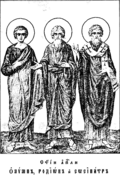 OlympasApostle · Greeted by the Apostle PaulNov 10
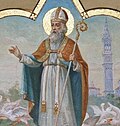 BaudolinoVenerable · Hermit of Forum FulviiNov 10
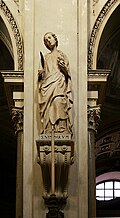 Nymphe of PalermoMartyr · Patron of PalermoNov 10
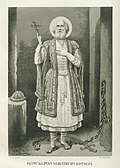 Konstanti-KakhayMartyr · Georgian nobleman of KartliNov 10
 Miles of SusaHieromartyr · Bishop of SusaNov 10
- Monitor of OrléansSaint · Bishop of OrléansNov 10
 Apollon BabichevNew Martyr · Psalm-readerNov 10
- John SkadovskyHieromartyr · PriestNov 10
- Orestes of TyanaMartyrNov 10