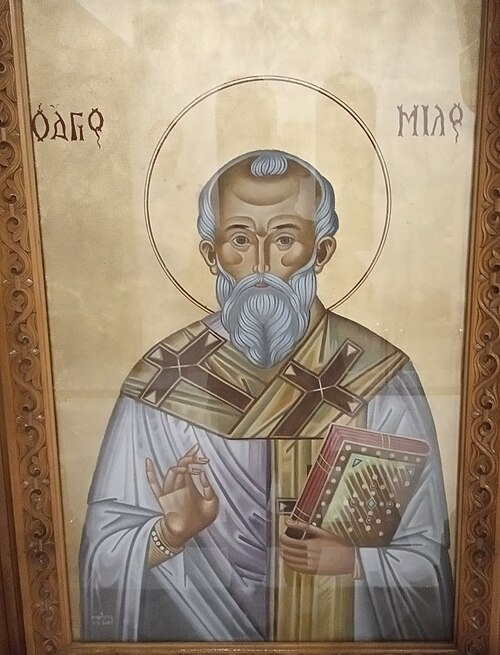
Hieromartyr
Miles of Susa
Bishop of Susa
Bishop of Susa in Persia from before 315 until his martyrdom in 340 or 341.
- Feast
- November 10old style November 23
- Reposed
- 3404th century
- Order
- Martyrs
Life
Saint Miles, Hieromartyr (Mar Miles), was Bishop of Susa in Sasanian Persia from before 315 until his martyrdom in 340 or 341. He laboured to evangelize Susa, travelled widely in the Eastern Roman Empire, opposed the claims of Bishop Papa of Seleucia-Ctesiphon and was killed at the start of the great forty-year persecution of Christians in Persia. He is commemorated on 10 November (by other sources, 13 November).
Sources and name
Miles is mentioned in one of the Persian martyr acts in the Syriac Martyrology of 411. Sozomen, writing at Constantinople in the first half of the fifth century, briefly summarizes a Syriac account of his life, and toward the end of the sixth century a fuller Syriac hagiography appeared, the Acts of Miles or Martyrdom of Miles. His story also found its way into the Old English Martyrology. The name Miles is probably Persian (meaning "brave"), though it could also be from the Latin miles, soldier; it was common in the Church of the East in Persia and unknown in the Roman Empire. A single manuscript of the Synodicon Orientale mentions seven bishops of that name. In the Greek synaxaria it appears as Millis, Miles or Milos.
Youth and travels
According to the Acts, Miles was a native of Susa. Before becoming a Christian he was a Zoroastrian and served in the Sasanian army. He was consecrated bishop of Susa by Bishop Agapetus (Gadyahb) of Beth Lapat (Gondeshapur). He travelled widely in the vicinity of Susa, then made a series of Christian pilgrimages. According to Sozomen, failing in his efforts to convert the inhabitants to Christianity, he uttered imprecations against the city and left; soon, says Sozomen, the city incurred the king's wrath and was destroyed by an army with three hundred war elephants. On his travels he took with him only the Gospels. He stopped first at Jerusalem, then at the monastery of Saint Anthony in Egypt, where he met Amun, Anthony's successor, and finally at Nisibis, where he helped Bishop Jacob build the church that bears his name. Then he went to Seleucia-Ctesiphon, the capital of the empire. It has been suggested, however, that these travels are "the defensive invention of history" by later dissidents opposed to the growing authority of the bishops of Seleucia-Ctesiphon, who sought to support their case by linking their hero to well-known people and names in the Church.
At Seleucia-Ctesiphon
Miles was the chief opponent of the claims to primacy in the Persian Church of Papa bar Aggai, bishop of Seleucia-Ctesiphon. Their confrontation at a synod in 315 is told in two different ways in the Acts of Miles and in the Synodicon Orientale. In the Synodicon, in a supposed letter read by Bishop Agapetus at the synod of Patriarch Dadisho (424), some bishops accused Papa of "violence and impurity" and Miles sat in judgment on him; during the proceedings Papa struck the Gospels, saying angrily: "Speak, Gospels, speak.", and was struck by divine judgment with a paralysis of one side, probably a stroke. His condition was brought to the notice of the bishops of the Roman Empire, who sent a letter confirming the position of the bishop of Seleucia as head of the Church in Persia and placing in charge his archdeacon, Simeon bar Sabbae, while he was incapacitated; the Western bishops rejected the trial, since "only Christ can be judge of a patriarch". In the Acts of Miles he arrived at Seleucia-Ctesiphon and found the Church in schism; he challenged Papa in a public meeting, holding the Gospels. Papa seized the Gospels and said: "Speak then, Gospel, if you have anything to say." Before Papa was struck (by a bolt of lightning, in this source), Miles explained to the crowd that God would punish him for pride. In Roman sources there is no trace of an appeal from a Persian bishop, and the letter of the Roman bishops is probably a fabrication from the time of Patriarch Joseph (552 to 567), but there is no reason to doubt that a confrontation took place between Papa and the bishops led by Miles over authority in the Persian Church.
Martyrdom
The surviving version of the Acts of Miles was probably written in the late sixth century and contains many fantastic elements, which make it hard to separate fact from fiction. Jérôme Labourt thought, from the mention at the end of otherwise unknown companions, that it may combine traditions connected with several martyrs. According to the Acts, after leaving Seleucia-Ctesiphon Miles worked miracles: he cast many demons out of people, healed a woman who had lain ten years, struck with leprosy a man who had judged unjustly and sworn falsely, like Gehazi, and many received the faith of Christ. He was arrested by Shah Shapur II at the start of the great persecution (340 or 341) and executed at Ray (Beth Raziqaye). It is told that, returning to his country and converting many, the governor Gormizd Gufriz ordered him and two disciples thrown into prison; tried, he answered fearlessly: "My faith is true and I will not defend it with your lying words. My teaching is pure and I will not show it to your unclean ear, but I will tell you the truth: woe to you, wicked man, and to all who like you insult God. By His justice He will condemn you in the age to come to hell and its fearful darkness." In rage Gormizd pierced him in the chest with a sword, and his brother, Nerses, thrust a knife into his heart. Dying, Miles said: "Since you agreed to kill me innocent, tomorrow, at the same hour in which you killed me, you will shed one another's blood, and your mother will be left childless." His two disciples were killed with stones, and the bodies of the martyrs were buried by Christians, with chanting. The next day the brothers Gufriz and Nerses killed each other at the hunt.
Miles was buried at Malcan, together with his companions Aborsima and Sina; because of the saint's protection, Malcan later became an impregnable fortress. Miles, Aborsima and Sina are among the 120 Persian martyrs named in the earliest dated Syriac manuscript, the Martyrology of 411. A Syriac copy of the Acts seems to have reached England, perhaps among the possessions of Theodore of Tarsus; Miles is in the Old English Martyrology of the late ninth century, at 15 November, based on a Syriac account. The Acts was never translated into Greek, but his story was known in the Greek world: an account is found in the Synaxarion of Constantinople of the late ninth century, and the Menologion compiled for Emperor Basil II around 1000 contains the martyrdom of Miles, Aborsima (Eubores) and Sina (Sebon), at 13 November. In 596 there was a monastery dedicated to him in Lycaonia in Asia Minor, to whose abbot Athanasius Pope Gregory the Great wrote. The only church in Europe dedicated to him is at Patras in Greece, built after a miracle attributed to him there in 1939.
Commemorated the same day November 10
 Justus of CanterburySaint · Archbishop of CanterburyNov 10
 Herodion of PatrasApostle · Bishop of PatrasNov 10
 Erastus of CorinthApostle · Steward of CorinthNov 10
 OlympasApostle · Greeted by the Apostle PaulNov 10
 BaudolinoVenerable · Hermit of Forum FulviiNov 10
 Nymphe of PalermoMartyr · Patron of PalermoNov 10
 Augustine BelyaevHieromartyr · Archbishop of Kaluga and BorovskNov 10
 Konstanti-KakhayMartyr · Georgian nobleman of KartliNov 10
- Monitor of OrléansSaint · Bishop of OrléansNov 10
 Apollon BabichevNew Martyr · Psalm-readerNov 10
- John SkadovskyHieromartyr · PriestNov 10
- Orestes of TyanaMartyrNov 10