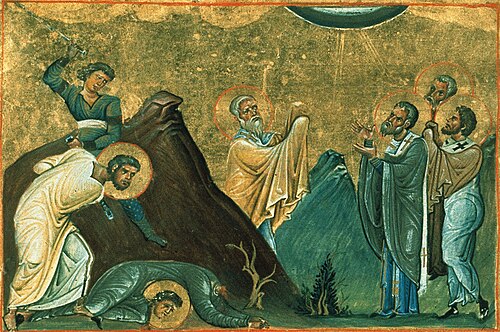
Apostle
Erastus of Corinth
Steward of Corinth
One of the Seventy and steward of the city of Corinth, named by the Apostle Paul in Romans.
- Feast
- November 10old style November 23
- Reposed
- 1001st century
- Place
- Rome
- Order
- Apostles
Life
Saint Erastus the Apostle was one of the Seventy apostles and a disciple of the Apostle Paul, the steward of the city of Corinth. The Orthodox Church remembers him on 10 November, on 4 January, in the Synaxis of the Seventy, and on 26 July.
Saint Paul mentions him in the Epistle to the Romans 16:23: “Erastus the steward of the city greeteth you.” An Erastus mentioned in 2 Timothy 4:20 and Acts 19:22 is often taken to be the same. Erastus was probably from Corinth, a Greek by birth. The office of steward (treasurer) of the city shows that he came from a noble family and was of an honourable age, otherwise such an office in a great city would not have been entrusted to him. Most likely he first heard the Gospel of Jesus Christ from Saint Paul himself, on his first visit to Corinth, coming from Athens. He went with Paul to Jerusalem and probably lived there for a time, serving the local Church. Greek and Latin writers call him steward of the Church of Jerusalem, and in the list of the Seventy by Dorotheus it is said: “Erastus was steward of the Church of Jerusalem.”
According to the Eastern tradition he was bishop of Paneas (a city in northern Palestine) and died in peace, at a great age. The Catholic Church venerates him as a martyr and holds him to be bishop of Caesarea Philippi, successor of Epaphroditus. Some scholars have asked whether it is even possible to conclude from the New Testament that he was a Christian; he could have been a wealthy patron of the Church without being a believer himself. In 1928-1929 and 1947, parts of an inscription mentioning an Erastus were found near a paved area northeast of the theatre of Corinth: “Erastus, in return for his aedileship, paved it at his own expense.” Some scholars have identified this aedile with the Erastus of the Epistle to the Romans, but others dispute it.
Commemorated the same day November 10
 Justus of CanterburySaint · Archbishop of CanterburyNov 10
 Herodion of PatrasApostle · Bishop of PatrasNov 10
 OlympasApostle · Greeted by the Apostle PaulNov 10
 BaudolinoVenerable · Hermit of Forum FulviiNov 10
 Nymphe of PalermoMartyr · Patron of PalermoNov 10
 Augustine BelyaevHieromartyr · Archbishop of Kaluga and BorovskNov 10
 Konstanti-KakhayMartyr · Georgian nobleman of KartliNov 10
 Miles of SusaHieromartyr · Bishop of SusaNov 10
- Monitor of OrléansSaint · Bishop of OrléansNov 10
 Apollon BabichevNew Martyr · Psalm-readerNov 10
- John SkadovskyHieromartyr · PriestNov 10
- Orestes of TyanaMartyrNov 10