Venerable
Baldred of Tyninghame
Hermit and abbot
Northumbrian hermit and abbot who lived in East Lothian in the eighth century, linked with Bass Rock.
- Feast
- March 6old style March 19
- Reposed
- 7568th century
- Place
- Bass Rock
- Order
- Venerables
Life
Saint Baldred (Balther) of Tyninghame was a Northumbrian hermit and abbot who lived in East Lothian, in present-day Scotland, in the eighth century, often called the "Apostle of the Lothians". He died, according to tradition, in 756 (6 March, hence 757 by the modern calendar). He is commemorated on 6 March. Our sources show no Orthodox veneration: he appears in the calendar of the Scottish Episcopal Church and in local Scottish tradition, not in an Orthodox canonization.
Dating
According to Hovendeus, his death is in 756. Simeon of Durham says "in the twentieth year of King Eadberht of Northumbria", and Turgot of Durham "in the seventeenth year of the episcopate of Cynulf", that is also 756. The eighth-century date is now generally accepted, though, because of a passage in the sixteenth-century Aberdeen Breviary, he has often been linked with the sixth-century saint Kentigern.
Life
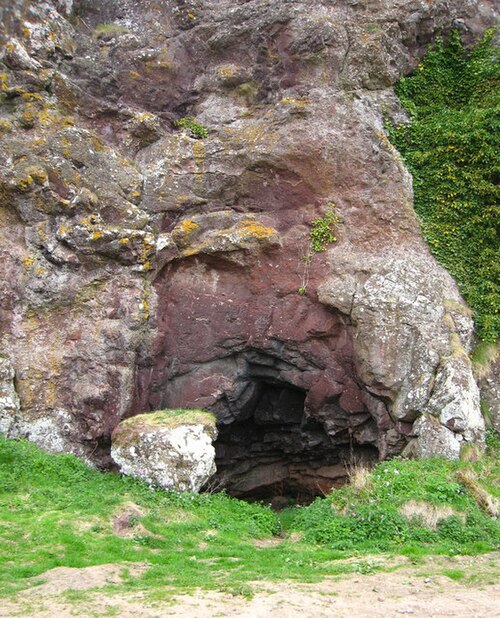
Simeon of Durham says that the boundaries of his pastorate embraced the whole land which belongs to the monastery of Saint Balther, called Tyninghame, from Lammermuir to Inveresk (Eskmouthe). His cult was centred on four churches: Auldhame, Whitekirk, Tyninghame and Prestonkirk, between East Linton and North Berwick. He is believed to have founded a monastery at Tyninghame, but, to withdraw from the pastoral government of the Lothian Britons, he chose the Bass Rock, where he built himself a small hut and a chapel, though at times he lived in a cave, "Saint Baldred's Cave", on Seacliff Beach. He is said to have lived in the diocese of Lindisfarne, and so to have been Northumbrian, which is not hard to believe, for the Lothians were then part of the kingdom of Northumbria; yet most sources assert Irish connections, and Hector Boece says he served in a district which then formed part of Pictland.
Veneration
About halfway up the Bass Rock are the ruins of an old chapel, in fact the parish church of the Bass, said to mark the place of his cell; a papal bull of 6 May 1493 mentions the building, and in 1542 it was reconsecrated in the name of Saint Baldred. After his death a dispute arose between the parishes of Auldhame, Tyninghame and Prestonkirk, as to which should have the body. According to the story, on the advice of a holy man, they spent the night in prayer, and in the morning three bodies were found, in all respects alike, each in its winding sheet, ready for burial; the story was probably invented to explain the claims of each church. In the grounds of Tyninghame House stands the twelfth-century church of Saint Baldred, which stands on the site of his monastery, which according to the Chronicle of Melrose was sacked by the Danes in 941. His body at Tyninghame was taken to Durham cathedral by Alfred Westow, in the early eleventh century; the Russian source says that his relics and those of Saint Cuthbert were moved in 1104. At Prestonkirk there existed, until 1770, a statue of the saint much venerated by the people, and nearby Saint Baldred's Well, famed for its healing qualities. The Episcopal church in North Berwick bears his name.
Commemorated the same day March 6
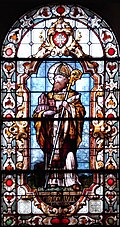 Chrodegang of MetzSaint · Bishop of MetzMar 6
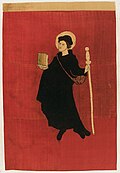 Fridolin of SäckingenVenerable · Founder of Säckingen AbbeyMar 6
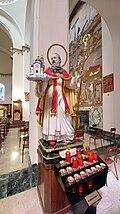 Marcian of TortonaSaint · Bishop of TortonaMar 6
 The 42 Martyrs of AmoriumHoly Martyrs · Martyrs of AmoriumMar 6
 Job of AnzerVenerable · Hieromonk at SolovkiMar 6
 Dositheus TsereteliHieromartyr · Metropolitan of KutaisiMar 6
 Conon the Father and Conon the SonHoly MartyrsMar 6
- AetiosSaintMar 6
- Aetius of AmoriumMartyrMar 6
- Anthony KologodskyVenerableMar 6
- Arcadius of CyprusVenerableMar 6
- Basil of BolognaSaint · Bishop of BolognaMar 6