Holy Martyrs
The 42 Martyrs of Amorium
Martyrs of Amorium
Byzantine officials captured at the fall of Amorium in 838 and executed in 845 for refusing to renounce Christ.
Life
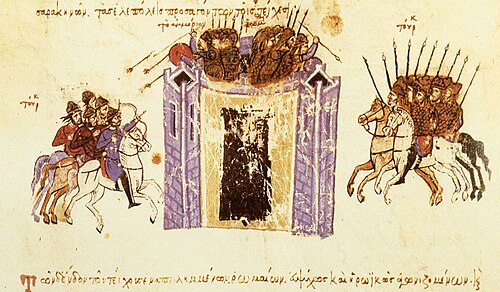
The Holy Forty-Two Martyrs of Amorium were senior officials and soldiers of the Byzantine Empire, taken prisoner by the Arabs at the fall of the city of Amorium in Asia Minor in 838. Held for seven years in prison at Samarra, in the Abbasid Caliphate, they refused every pressure to deny Christ and accept Islam and were beheaded on 6 March 845. The Orthodox Church and the Roman Catholic Church commemorate them on the day of their martyrdom.
The fall of Amorium
According to the chroniclers, in 837 Emperor Theophilos captured the city of Zapetra, held to be the birthplace of Caliph al-Mu'tasim, and celebrated the victory in Constantinople with a triumph in the Hippodrome, even ordering the city's fountains to be filled with wine. The next year, 838, seeking revenge, the caliph launched a great campaign against Theophilos's own ancestral city, Amorium. In July, in battle with the Arab general Afshin, the Byzantines suffered a heavy defeat, and the emperor barely escaped, leaving his city to its fate.
Amorium was then one of the largest cities of the Empire, capital of the Anatolic Theme and the place of origin of the reigning Amorian dynasty. Large Byzantine forces had gathered there under leading officials, among them seven strategoi, governors of themes. In the summer the Arab army, led by the caliph himself, laid siege to it. After twelve days the city fell on 15 August 838, through the treachery of a Byzantine officer named Boiditzes. Much of the population and garrison was slaughtered and the rest taken captive; on the way to Syria most of these also perished for lack of water and food.
Years of imprisonment
Only the high-ranking prisoners survived, forty-two officers and notables of the city, who were taken to Samarra, the capital of the caliphate, and thrown into prison, where they spent almost seven years in very harsh conditions. Emperor Theophilos and, after his death in 842, Michael III and Empress Theodora, ruling as regent, repeatedly tried to ransom or exchange them, but the caliphs rejected every offer.
Al-Mu'tasim's successor, Caliph al-Wathiq, resolved to force the prisoners to renounce their faith. Thinking that the years of captivity had broken them, he sent men who brought them food and clothing and spoke to them of abandoning Christ. Among them were Greeks, including the traitor Boiditzes himself.
Confession
The caliph's envoys insisted above all that God was on the side of the Muslims, since He gave them victories. The martyrs firmly rejected these arguments. The tradition preserved in the synaxaria says that they replied that if victory and power proved the truth of a faith, then the idolatry of the Egyptians, Babylonians, Greeks and Romans, and the fire-worship of the Persians, would also have been true, since each of these peoples had once ruled over the others. Christians, they said, know that God sometimes gives them victory and at other times permits suffering in order to correct them and bring them to repentance for their sins.
The synaxaria also tell that when they were told that Muhammad was the true prophet, the martyrs asked: if two men disputed over a field, and one had many witnesses that the field was his while the other had no witness but himself, whose would the field be? When their interlocutors answered that it belonged to the one with many witnesses, they had pronounced their own judgement: Christ has as witnesses all the prophets, from Moses to John the Baptist, whom they too acknowledge, while the other has no witness but himself.
Martyrdom
Convinced that the prisoners would not be moved, the caliph ordered their execution. On 6 March 845 they were led out to the bank of a river, which the sources call the Euphrates, and beheaded by Ethiopian slaves before a great crowd of Muslims and Christians. The first to be killed was Theodore Krateros, then the magistros Constantine Baboutzikos, the empress's kinsman. According to one tradition, one of the prisoners wavered, but the caliph's advisers said that one who had not kept his own faith would not keep theirs either, and he too was killed; according to another version, these words concerned the traitor Boiditzes.
The bodies were thrown into the river. The synaxaria say that the body of the one who had apostatised sank at once, while the bodies and heads of the martyrs floated and came to rest on the opposite bank, near a monastery. For three days its abbot saw a light above that place, and the Christians gathered and buried the bodies, which became venerated relics.
The names of the martyrs
Only a few of the forty-two are known by name. Theodore Krateros, a court eunuch and protospatharios, perhaps strategos of the Bucellarian Theme, is regarded in the lives as their leader. The patrikios Aetios was strategos of the Anatolic Theme. The magistros Constantine Baboutzikos, brother-in-law of Empress Theodora, was apparently the highest in rank; he was the first to be urged to accept Islam and perhaps the first to be executed. Also named are the patrikios Theophilos, Constantine, the notary of Baboutzikos, Bassoes, called “the runner”, Astrios and Kallistos of the Melissenos family.
Kallistos, a patrikios and tourmarches, is given a fuller biography in the lives: he rose from imperial spatharios to count of the Scholae and then to doux of Koloneia, until he was seized by the Paulician soldiers under his command and handed over to the Arabs, who placed him among the prisoners from Amorium.
Their lives
The life of the forty-two was written soon after their death by the monk Euodios, who saw in the fall of Amorium a divine punishment for Emperor Theophilos's renewal of Iconoclasm. Most of his work consists of the discussions about faith between the steadfast prisoners and those sent to convert them. Euodios's work is regarded as the last example of the genre of collective martyrdom and was widely circulated. In the ninth and tenth centuries other lives were written: by Michael Synkellos, one attributed to Sophronius of Cyprus, one in the Imperial Menologion and an anonymous one, and the Byzantine chronicles also record their death. The oldest Slavonic translation of their life is found in the Codex Suprasliensis.
Veneration
The Holy Forty-Two Martyrs of Amorium are commemorated on 6 March (19 March in the New Style), the day of their death. Unlike the Forty Martyrs of Sebaste, they are rarely depicted in Byzantine art; when they do appear, they are shown as a group of officials in court dress.
Commemorated the same day March 6
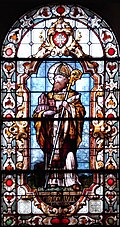 Chrodegang of MetzSaint · Bishop of MetzMar 6
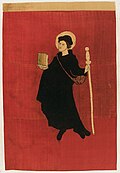 Fridolin of SäckingenVenerable · Founder of Säckingen AbbeyMar 6
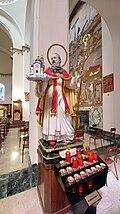 Marcian of TortonaSaint · Bishop of TortonaMar 6
 Baldred of TyninghameVenerable · Hermit and abbotMar 6
 Job of AnzerVenerable · Hieromonk at SolovkiMar 6
 Dositheus TsereteliHieromartyr · Metropolitan of KutaisiMar 6
 Conon the Father and Conon the SonHoly MartyrsMar 6
- AetiosSaintMar 6
- Aetius of AmoriumMartyrMar 6
- Anthony KologodskyVenerableMar 6
- Arcadius of CyprusVenerableMar 6
- Basil of BolognaSaint · Bishop of BolognaMar 6