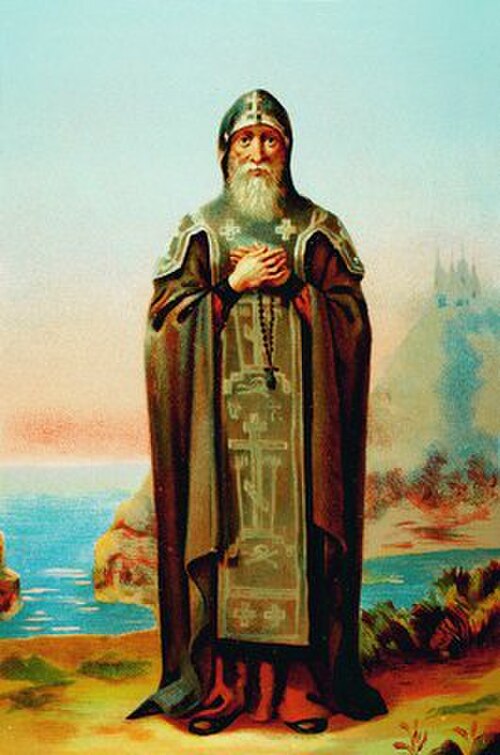
Venerable
Job of Anzer
Hieromonk at Solovki
Moscow parish priest who became a monk at Solovki, schemamonk Iisus; born in 1635, died in 1720.
- Feast
- March 6old style March 19
- Reposed
- 172018th century
- Place
- Solovetsky Monastery
- Order
- Venerables
Life
Venerable Job of Anzer (in the world John, in the schema Jesus) was a Moscow priest who became a monk at Solovki, born in 1635 in Moscow and died in 1720 at the Solovki monastery, at the age of eighty-five. He was numbered among the venerable saints of the Russian Church for veneration throughout the Church at the Council of Bishops of the year 2000. His name is entered in the Synaxis of the Solovki Saints. The Serbian source commemorates him on 6 March (19 March by the new calendar), while the Russian source mentions the repose and the finding of the relics but does not give the days; the record gives several days (6 March, 29 May, 12 and 5 June).
John was born in Moscow and was a parish priest, renowned for his virtuous ministry, and at the end of the seventeenth century he was appointed by Tsar Peter I priest of the court church and chosen as confessor of the tsar and the ruling house. At that time Grishka Talitsky, in his frenzy, preached the coming of the Antichrist, by whom he meant Tsar Peter. Talitsky confessed to Father John and in the course of the confession told him about Peter. The priest told no one anything, keeping the secret of confession. Grishka, caught, revealed under torture what he had told Father John in confession. This was reported to the tsar and in 1701 John was sent into exile to the Solovki monastery, to be tonsured a monk. The Serbian source says that he came there because of a slander.
He received monastic tonsure with the name Job (in honour of Job the much-suffering) and bore the harshest obediences together with the other monks. In 1702 the venerable one moved to Anzer Skete, for stillness, where, soon after the death of Eleazar of Anzer, he became abbot. The number of the skete's inhabitants under him reached thirty. The tsar, learning of the innocence of his former confessor, called him to return. In 1710 Job received the great schema with the name Jesus, in honour of the righteous Joshua son of Nun. In 1714 he left Anzer Skete and, together with his disciples, founded the Golgotha-Crucifixion Skete, on the same principles that Venerable Eleazar had received at Anzer Skete. The ruling house gave considerable funds for the building of the community. In 1715 the inhabitants of the skete built a wooden church in honour of the Crucifixion of the Lord.
Venerable Job died on the Sunday of Orthodoxy in the year 1720 and was buried in the grave he had prepared himself. After a stone church dedicated to the Crucifixion of the Lord was built in 1828 in the Golgotha-Crucifixion monastery, Job's relics rested under a slab in the side chapel of the Dormition of the Mother of God. On 11 June 2000 the relics were found and placed in the church of the Resurrection of Christ of Anzer Skete. The troparion of Venerable Job, in the schema Jesus, of Anzer, in the fifth tone, calls him a model of virtues, full of the fear of God and of the Holy Spirit, a true lover of stillness, who raised a monastery on the island of Anzer; the kontakion, in the eighth tone, says that he acquired the love of Christ in his heart, endured many sorrows and found a haven on the island in the sea, being a faithful successor of the precepts of Venerable Eleazar.
Commemorated the same day March 6
 Chrodegang of MetzSaint · Bishop of MetzMar 6
 Fridolin of SäckingenVenerable · Founder of Säckingen AbbeyMar 6
 Marcian of TortonaSaint · Bishop of TortonaMar 6
 The 42 Martyrs of AmoriumHoly Martyrs · Martyrs of AmoriumMar 6
 Baldred of TyninghameVenerable · Hermit and abbotMar 6
 Dositheus TsereteliHieromartyr · Metropolitan of KutaisiMar 6
 Conon the Father and Conon the SonHoly MartyrsMar 6
- AetiosSaintMar 6
- Aetius of AmoriumMartyrMar 6
- Anthony KologodskyVenerableMar 6
- Arcadius of CyprusVenerableMar 6
- Basil of BolognaSaint · Bishop of BolognaMar 6