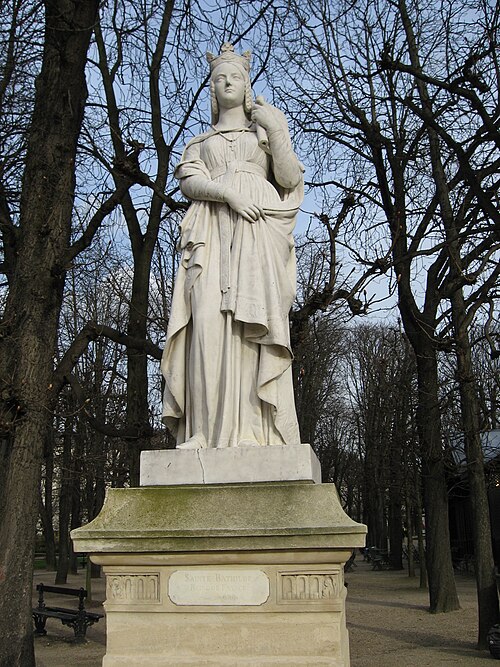
Right-Believing
Balthild
Queen of the Franks
Queen of Neustria and Burgundy, wife of Clovis II, later a nun at Chelles, who died in 680.
- Feast
- January 30old style February 12
- Reposed
- 6807th century
- Place
- Chelles
Life
Saint Balthild (Bathilda, Baudour) was queen of Neustria and Burgundy, wife of King Clovis II, and then regent for her son Chlothar III. She was born around 626 and died on 30 January 680 at Chelles, near Paris. The Church remembers her for her almsgiving, for ending the trade in Christian slaves and for the monasteries she founded. She is venerated chiefly in the West, but she also appears in Orthodox calendars, where her feast is 30 January.
Beginnings According to tradition she was an Anglo-Saxon of noble birth, perhaps a relative of King Ricberht of East Anglia. Her Life says that as a child she was sold into slavery and came into the household of Erchinoald, mayor of the palace of Neustria. More recent research thinks the story of her slavery may be an invention and that she belonged to a high-ranking Anglo-Saxon family. The Life shows her as beautiful, wise, humble and attentive to the needs of others. When Erchinoald, widowed, wanted to marry her, she hid until he had remarried. Later she was noticed by King Clovis II, who asked for her hand in marriage, around 648.
Balthild bore Clovis three sons, all of whom became kings: Chlothar III, Childeric II and Theuderic III. Even as queen she remained humble and was known for her charity and her gifts.
Regent The king died between 655 and 658, most sources saying 657. Chlothar, the eldest son, came to the throne while still a child, and his mother governed as regent. She stopped the trade in Christian slaves and strove to ransom children who had been sold. Together with Saint Eligius, according to Dado, she made the buying and freeing of slaves her favourite charity. She founded the abbeys of Corbie, for men, and Chelles, for women, and supported Jumièges, Luxeuil, Fontenelle and Saint Claudius of Besançon. It is uncertain whether she also founded Jouarre and other monasteries.
With her support the liturgical order of Luxeuil was adopted in great churches of the land, such as Saint-Denis, Soissons, Tours and Orléans. Some historians also see in her monasteries a way of restraining the opposition of the nobles. A more hostile account, in the Life of Saint Wilfrid, shows the queen as a ruthless ruler, but the story is not certain. Struggles for power with Ebroin, mayor of the palace, followed, after which she left the court.
At Chelles In 664, when Chlothar came of age to rule, Balthild retired to her abbey at Chelles. Some sources say that she lived there as a nun, others that she did not receive the tonsure. She died on 30 January 680 and was buried in the abbey church. Her Life was written soon after, by someone of the community at Chelles. A fragment of an apron, thought to be hers, has a cross embroidered in silk, not gold thread, which is taken as a sign of her simplicity.
Veneration Her official cult began in 833, when her relics were moved to a new church, in the time of the emperor Louis the Pious. Pope Nicholas I numbered her among the saints, around 860. Her relics were raised again on 3 July 1631. She is the protectress of the sick, of children and of widows. She is commemorated on 30 January.
Commemorated the same day January 30
 Peter of BulgariaRight-Believing · Tsar of BulgariaJan 30
 Aldegund of MaubeugeVenerable · Abbess of MaubeugeJan 30
- Agrippinus of AlexandriaSaint · Patriarch of AlexandriaJan 30
- Matthias of JerusalemSaint · Bishop of JerusalemJan 30
 Zeno the FasterVenerable · Schemamonk of the Kiev CavesJan 30
 Pelagia of DiveevoFool-for-Christ · Fool for ChristJan 30
- Stephen NalivaikoNew Martyr · Exiled to NorilskJan 30
- Zeno of CappadociaVenerable · Syrian hermitJan 30
- Demetrius of SlivenNew MartyrJan 30
- Theodore of MytileneNew MartyrJan 30
- Ailbhe son of RonanSaintJan 30
- Amandinus of RomeMartyrJan 30