Great Martyr
Barbara
of Nicomedia
Maiden of Nicomedia, killed by her own father for her confession of faith in Christ.
- Feast
- December 4old style December 17
- Reposed
- 3064th century
- Place
- Nicomedia
- Order
- Great Martyrs
Life
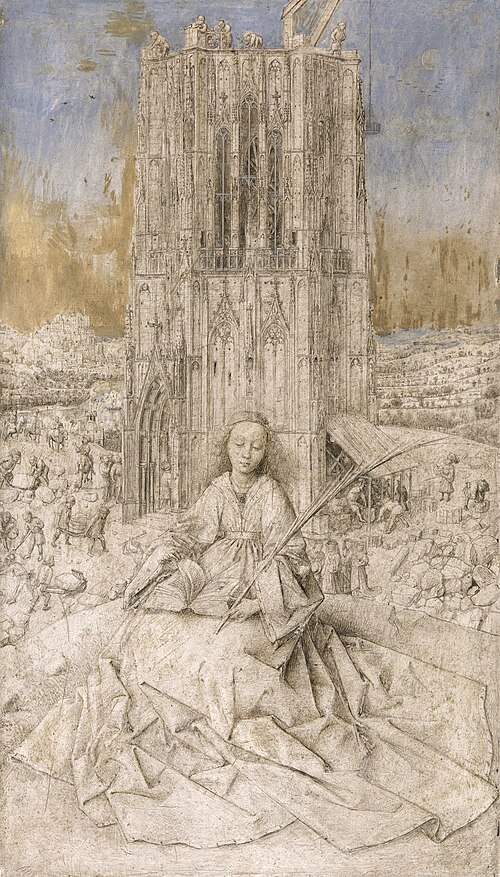
The Holy Great Martyr Barbara is a virgin who, according to the Lives, was killed by her own pagan father for confessing Christ, at the beginning of the fourth century. The sources do not agree on the place: Byzantine tradition calls her Barbara of Heliopolis (today Baalbek), while others say Nicomedia. The Church commemorates her on 4 December, and she is one of the best loved martyrs of Christendom.
The tower
The accounts say that her father, Dioscorus, a rich idol-worshipper who had lost his wife, kept her carefully in a tower, to shield her from the eyes of strangers and from Christians. From there, gazing at the beauty of the world, Barbara asked who had made heaven and earth, and understood that gods made by human hands could not have made them. When rich suitors asked for her hand, she firmly refused.
During a time when Dioscorus was away, Barbara met Christian women who spoke to her of the Trinity, of the Incarnation of Christ and of His Resurrection. A priest who came from Alexandria disguised as a merchant taught her the faith and baptised her in the name of the Father and of the Son and of the Holy Spirit. While Dioscorus was gone, a stone building with two windows was going up beside the house; Barbara asked that a third be made, in the image of the Light in three Persons.
The confession
On his return Dioscorus demanded an account, and his daughter confessed her faith. In rage he rushed at her with his sword. Barbara fled and hid in a cleft of the mountain, which according to the Lives opened before her; a shepherd betrayed her, and her father beat her and dragged her back. He then handed her to the governor, saying that he disowned her as a daughter unless she returned to the gods.
The governor counselled her at length, but she confessed Jesus Christ as God and rebuked idolatry. The Greek Synaxarion names the governor Marcian, and Western tradition Martinianus. She was beaten with oxhide thongs and her wounds were rubbed with rough hair cloth, and she was thrown into prison. At night the Lord appeared to her and said: Take courage, My bride, and do not fear, for I am with you. The next day her body bore no trace of the torment.
Seeing this miracle, a Christian woman, Juliana, also confessed her faith. They led both women naked through the city, hung them from a tree, tortured them with hooks and torches and struck their heads with a hammer. Then their heads were cut off. Barbara was killed by Dioscorus himself, and soon after he was struck by lightning, which turned his body to ashes. According to some, Barbara was buried by a Christian, Valentinus, and her tomb became a place of miracles.
Relics
Her veneration, first in the East, is seen from the ninth century; the oldest traces are found at Edessa, in the basilica of the Copts at Cairo and in the Byzantine empire. Her relics were kept in Constantinople; according to the Russian synaxarion, in the twelfth century the daughter of Emperor Alexios Komnenos, also named Barbara, took them to Kyiv when she married Prince Michael Izyaslavich. They now rest in Saint Volodymyr's Cathedral. Other parts reached Venice around the year 1000, through Maria Argyropoulina, at Torcello, and on Athos, at the monasteries of Simonos Petras, Hilandar, Karakallou and Koutloumousiou, at Mega Spilaio and elsewhere.
Legacy
The earliest accounts of her life appear only in the seventh century, and her veneration spread from the ninth; for this reason historians doubt the details of the Life, and the Roman Catholic Church removed her from the general calendar in 1969, while keeping her in its list of saints.
The lightning that struck her father made her patroness of those who work with fire and explosives, of artillerymen, miners, builders and fortifications. She is one of the Fourteen Holy Helpers of the Middle Ages and is invoked against death without confession. In Greece she is patron of the city of Drama, where a sweet called varvara is made on her day; in Georgia her day is kept as Barbaroba. In Romania a church dedicated to her stands at Salina Târgu Ocna. In the troparion of the day we sing: Let us honour holy Barbara, for she crushed the snares of the enemy and escaped from them like a bird, by the help and weapon of the Cross.
Commemorated the same day December 4
 John of DamascusVenerable · Hymnographer and theologianDec 4
 Clement of AlexandriaSaint · Teacher at the school of AlexandriaDec 4
 Gennady of NovgorodSaint · Archbishop of NovgorodDec 4
- AdaVenerable · AbbessDec 4
 Catherine of PetrogradNew MartyrDec 4
 Kira ObolenskayaNew Martyr · Princess and teacherDec 4
 Alexander PosokhinHieromartyrDec 4
- Alexis SaburovHieromartyrDec 4
- Anastasia TitovaVenerable MartyrDec 4
- Barbara and JulianaHoly Great MartyrsDec 4
- Basil KashinHieromartyrDec 4
- Bearchan of Cluain SostaSaintDec 4