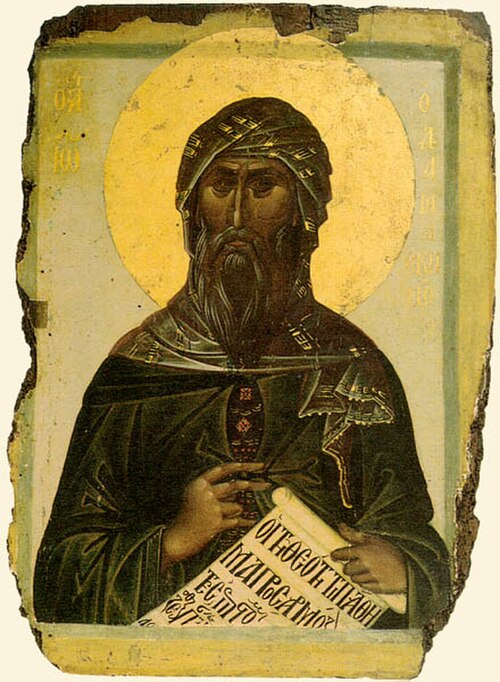
Venerable
John of Damascus
Hymnographer and theologian
Priest and monk of Mar Saba, great defender of the holy icons and author of liturgical hymns.
- Feast
- December 4old style December 17
- Reposed
- 7498th century
- Place
- Holy Lavra of Saint Sabbas
- Order
- Venerables
Life
Saint John of Damascus was a monk and priest at the lavra of Saint Sabbas near Jerusalem in the eighth century. The Church honours him as one of her great theologians and hymnographers and as a fearless defender of the holy icons.
Family and service at court
He was born at Damascus around 675 or 680 into a distinguished Christian family, under the rule of the Arab caliphs. His father, Sergius (Sarjun) Mansur, was a treasurer at the caliph's court. John had a foster brother, Cosmas, the future Melodist and bishop of Maiuma. The father had ransomed a learned monk, Cosmas of Calabria or Sicily, from the slave market and entrusted the children to his teaching. Both mastered the secular and spiritual sciences. After the father's death John became a counsellor of the caliph and prefect of Damascus. Some modern scholars doubt that he served at court, but this is what Church tradition relates.
Defence of the icons
At Constantinople the iconoclast heresy had arisen, supported by Emperor Leo III the Isaurian (717 to 741). John, living beyond the empire's borders, wrote three treatises between 726 and 731 against those who revile the holy icons. The emperor could not reach him, so he resorted to slander. A forged letter, as if John offered to help him against Damascus, was sent to the caliph, who ordered John's right hand cut off. That evening the hand was returned to him. He pressed it to his wrist and prayed before the icon of the Mother of God. Falling asleep, he heard Her voice saying that he was healed and must labour unceasingly with that hand. On waking he found it restored, with only a red mark. In thanksgiving he hung a silver hand on the icon, hence the name of the icon of the Mother of God "of the Three Hands" (Tricherousa), kept at Hilandar Monastery on Athos and commemorated on 28 June and 12 July. The caliph asked his forgiveness, but John refused to return to his post.
Monastic life
He gave his wealth to the poor and went to Jerusalem with Cosmas, to the monastery of Saint Sabbas. The monks hesitated to take such a learned man as a disciple, until one experienced Elder agreed. The Elder commanded him to do nothing by his own will and once sent him to Damascus to sell baskets at an inflated price; only his former steward recognized him and bought them. When a monk died, the brother begged John to compose consolation for the burial, and John wrote the funeral troparia. For this disobedience the Elder banished him and gave him a harsh penance. Then, in a vision of the Mother of God, the Elder was told to let him write again. The Patriarch of Jerusalem ordained him priest and made him preacher at his cathedral, but John returned to the lavra and spent the rest of his life writing spiritual books and hymns.
Writings and hymns
His chief work is the Fount of Knowledge, in three parts: philosophical chapters, On Heresies (about a hundred, among them Islam, treated as the "heresy of the Ishmaelites"), and the Exact Exposition of the Orthodox Faith in a hundred chapters, a summary of Orthodox doctrine. He also wrote treatises against the Nestorians and Monophysites, a dialogue against the Manichaeans, a disputation between a Christian and a Saracen, the Sacred Parallels, and homilies on the Nativity of the Mother of God, her Dormition (three), and the Transfiguration, along with praises of Saint John Chrysostom and other saints. The tale of Barlaam and Josaphat is traditionally ascribed to him, but scholars regard it as later.
As a hymnographer he helped to establish the canon form: 90 of his canons survive, of which 14 are in the service books. The Canon of Pascha and parts of the Octoechos are famous. For the beauty of his speech he was called Chrysorroas, "streaming with gold".
Repose and veneration
Tradition says he reposed in peace in the lavra of Saint Sabbas in 749, aged more than a hundred. The lives of the Orthodox Church in America give about 780. The iconoclast council of Hieria (754) anathematized him, but his teaching was vindicated by the Seventh Ecumenical Council at Nicaea in 787. Pope Leo XIII declared him a Doctor of the Church in 1890. The Church celebrates him on 4 December.
Commemorated the same day December 4
 Clement of AlexandriaSaint · Teacher at the school of AlexandriaDec 4
 BarbaraGreat Martyr · of NicomediaDec 4
 Gennady of NovgorodSaint · Archbishop of NovgorodDec 4
- AdaVenerable · AbbessDec 4
 Catherine of PetrogradNew MartyrDec 4
 Kira ObolenskayaNew Martyr · Princess and teacherDec 4
 Alexander PosokhinHieromartyrDec 4
- Alexis SaburovHieromartyrDec 4
- Anastasia TitovaVenerable MartyrDec 4
- Barbara and JulianaHoly Great MartyrsDec 4
- Basil KashinHieromartyrDec 4
- Bearchan of Cluain SostaSaintDec 4