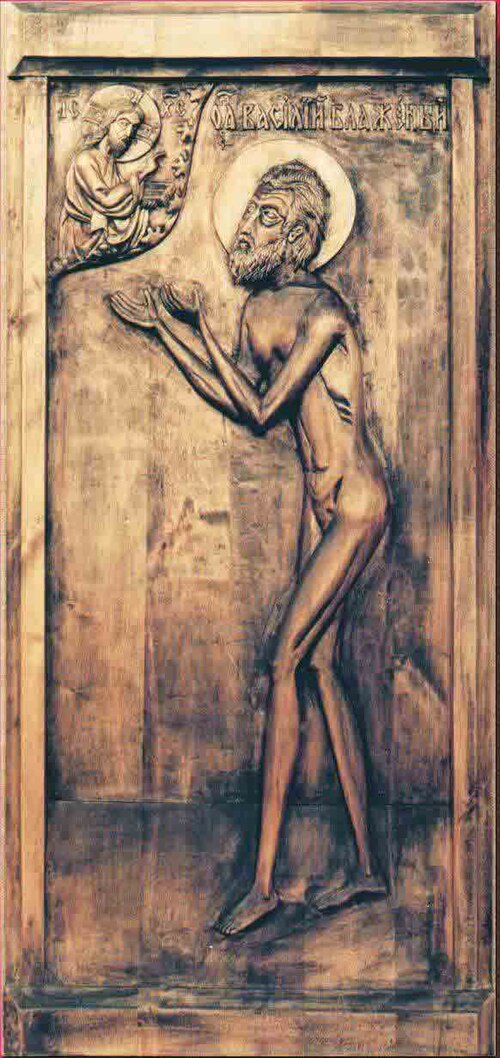
Fool-for-Christ
Basil the Blessed
Fool for Christ of Moscow
Fool for Christ of Moscow in the sixteenth century, whose name the cathedral on Red Square bears.
- Feast
- August 2old style August 15
- Reposed
- 155716th century
- Place
- Moscow
- Order
- Fools-for-Christ
Life
Saint Basil the Blessed, the Wonderworker of Moscow, was a fool for Christ who lived in Moscow in the sixteenth century. He walked the streets almost without clothing, rebuked injustice, helped those too ashamed to beg, and was granted the gift of foreseeing events. The famous cathedral on Red Square came to be called by his name because he lies buried beside it. His memory is kept on 2 August (15 August by the Russian civil calendar).
Early years
According to his Life, Basil was born in December 1468 on the porch of a church at Yelokhovo, then outside Moscow, where his mother Anna was praying. The sources name his father Jacob and say that his parents were simple people. They gave him as an apprentice to a shoemaker. The Life tells that a merchant once came to order boots which he said would last a year, and the boy wept and said that the man would never wear them, since he would soon die. A few days later it came to pass, and the master understood that his apprentice was no ordinary young man.
At sixteen Basil came to Moscow and began the struggle of foolishness for Christ. In burning summer heat and in hard frost he went naked and barefoot through the streets, and as a sign of penance he carried chains. Later the people of Moscow saw in him a holy fool, a man of God and a rebuker of wrong.
The holy fool
His acts were strange. He would overturn a tray of loaves or spill a jug of kvas, and the angry traders beat him, which he bore with joy and thanked God for. Afterward it was found that the bread was badly baked and the kvas spoilt. Another time he saw a demon in the form of a beggar at the gates of a church, who gave swift success in their affairs to all who gave him alms. Basil recognised the trick and drove him away. He censured those who gave alms in the hope of an easy blessing on their business, with no pity for the poor.
He took pity above all on people who were too ashamed to ask for help. Once he gave away rich gifts from the tsar to a foreign merchant who had lost everything and had eaten nothing for three days, but who wore good clothes and could not beg. He went into taverns to find some seed of good even in people who had fallen very low, and to encourage them with kindness. When he passed a house where people revelled and drank, he sometimes wept and embraced its corners. Asked why, he answered that sorrowing angels stood by that house, grieved by the sins of the people, and that he begged them with tears to pray for the sinners' conversion.
A tradition tells of a merchant at Pokrovka whose stone church collapsed three times. Basil sent him to Kiev to a poor man named John, who was rocking an empty cradle and said he was paying a debt to his mother. The merchant remembered his own mother, whom he had thrown out, brought her home, asked her forgiveness and then finished his church.
Foresight and the tsar
Through long struggle and prayer he received the gift of foreseeing the future. In 1547 he foretold the great fire of Moscow, and through prayer he put out a fire at Novgorod. He also did not fear to rebuke the powerful. When Tsar Ivan the Terrible, standing at the divine service, was thinking of building a palace on the Sparrow Hills, Basil reproached him for it.
Repose and veneration
According to the Life he spent seventy-two years in this labour and fell asleep on 2 August at the age of eighty-eight. The year is given as 1557 by the Orthodox Church in America and by the Russian church sources, while some historians give 1552. The metropolitan of Moscow, Saint Macarius, with the clergy, led the burial. His body was laid by the church of the Trinity on the moat, near the cathedral of the Intercession which Ivan built after the conquest of Kazan.
A Council led by Patriarch Job glorified him on 2 August 1588. The people's reverence was so strong that the Trinity church and the attached Intercession cathedral came to be called the church of Basil the Blessed, a name they bear today. His relics rest in the cathedral, and his chains are kept at the Moscow Theological Academy. On early icons he is shown old, white-haired and naked, with a staff in his hand.
Commemorated the same day August 2
 Stephen I of RomeHieromartyr · Bishop of RomeAug 2
 NicodemusRighteous · Disciple of the LordAug 2
 GamalielRighteous · Teacher of the Apostle PaulAug 2
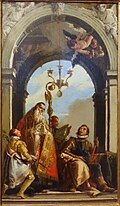 Maximus of PaduaSaint · Bishop of PaduaAug 2
- Theodore of the DardanellesNew Martyr · New Martyr of the DardanellesAug 2
- Abibas of JerusalemRighteousAug 2
- Aelfthryth of CrowlandSaintAug 2
- AlfredaVenerableAug 2
- Athanasius ZhulanovMartyrAug 2
- Auspicius of AptSaint · Bishop of AptAug 2
- BasilMartyrAug 2
- Basil of VologdaFool-for-ChristAug 2